Criticism vs Complaint in a Relationship: The Small Shift That Keeps Love Safe
You're folding laundry on the bed, matching socks, half-listening, when your partner mentions they forgot to book the car in for its service, the one you'd talked about last week. Before you've decided to say anything, it's already out: "You never follow through on anything." Not you forgot the car. Not I'm frustrated we're behind on this. But you never. A sock in each hand, and somehow you've just made a statement about their entire character.
Criticism vs complaint in a relationship comes down to the hinge between those two sentences, and it is smaller than it looks. This isn't about policing your words. It's about noticing the moment a specific frustration curdles into a verdict about who someone is. It happens to the kindest people alive, usually while they're tired and matching socks.
The moment a complaint becomes something bigger
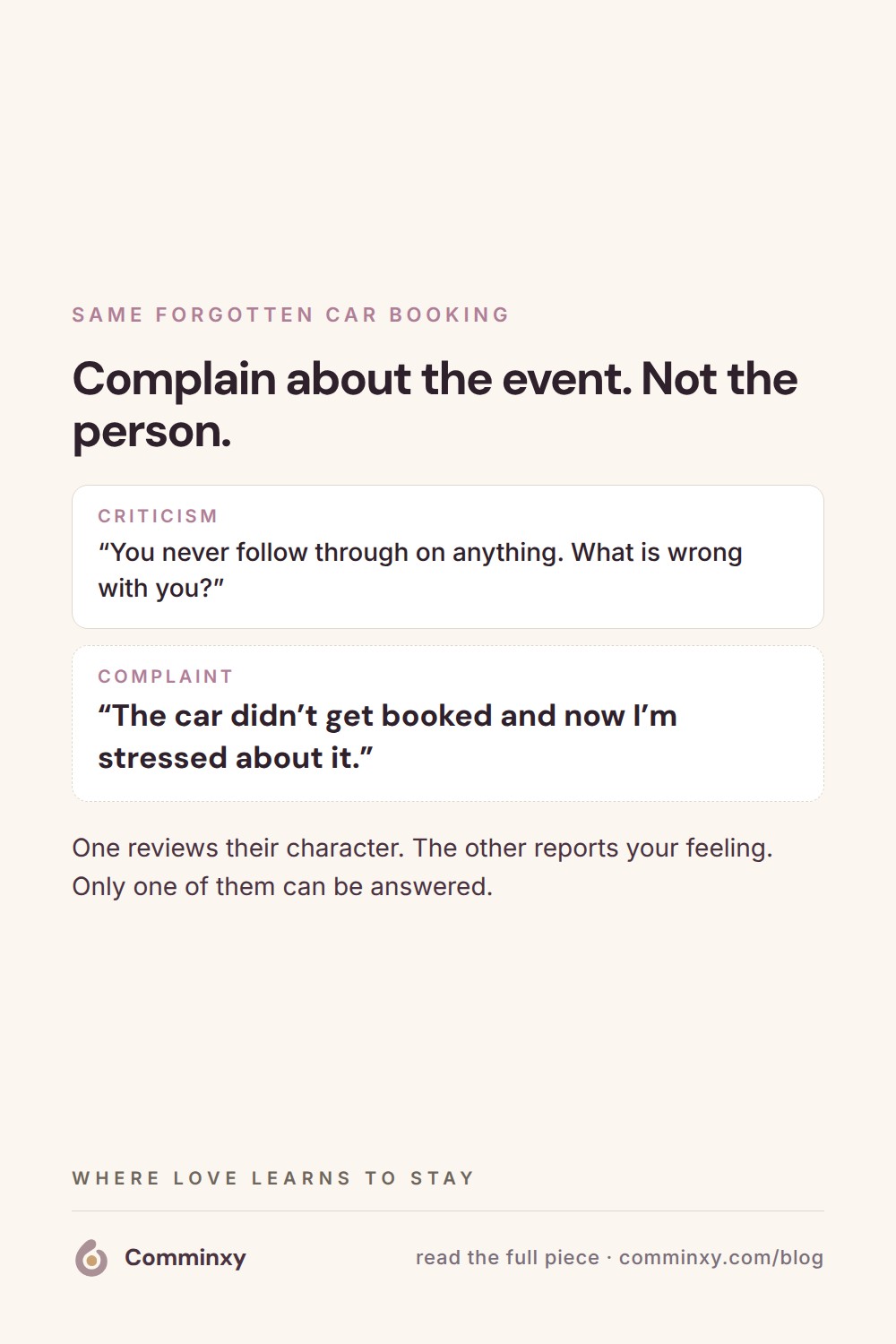
A complaint is about a thing. The car didn't get booked and now I'm stressed about it. It has edges. It points at a moment, a task, a Tuesday. You can do something with it.
Criticism is about a person. You never follow through. You always forget. What is wrong with you? It stops pointing at the car and starts pointing at them, at some flaw they supposedly carry around like a name tag. The strange thing is that it usually arrives when you care more, not less. When something matters and it slips, the disappointment reaches for the biggest words within reach.
You can feel the shift if you're watching for it. A complaint leaves the other person somewhere to stand. Criticism backs them into a corner and hands them a label, and nobody alive responds well to being handed a label.
Why the word "never" arrives before you mean it to
Nobody wakes up planning to review their partner's character over a car service.
It arrives because criticism is efficient. When you're depleted, your brain doesn't want to build a careful sentence about a specific event. It wants shorthand. You never is shorthand, and it bundles every past disappointment into one fast, sharp swing.
There's a reason this matters more than it feels like it should in the moment. Gottman and Levenson, publishing in the Journal of Personality and Social Psychology in 1992, found that criticism, along with defensiveness, contempt and stonewalling, reliably separated the couples who stayed close from those who drifted toward divorce. The danger isn't that criticism is a monstrous act. It works more like a doorway. Criticism invites defensiveness, defensiveness invites more criticism, and the two of you end up in a conversation that was never about the car.
So when you never slips out, what you're hearing is a tired person whose care got dropped somewhere. The words came out big because the feeling underneath them is real. Worth holding onto at two in the morning, when you're replaying it.
What the complaint is quietly trying to say
Underneath almost every criticism there's a complaint that never got to speak. Underneath that complaint, usually, is a need. Small, specific, human.
You never follow through is often a costume worn by something far more exposed: I feel like I'm carrying this alone, and I'm frightened that I always will be. That's the real sentence. It's also much harder to say, because saying it means admitting you're worried and tired rather than annoyed and right.
This is the trade criticism makes on your behalf. It hands you one second of feeling righteous and takes away the tender thing you actually needed heard. Your partner, hearing only the accusation, never gets near the softer truth underneath it. They defend. You escalate. The need stays buried under the rubble of who said what.
The small swap that changes the temperature
The shift is smaller than most advice makes it sound. Talk about the moment, and about yourself, rather than about their character.
Instead of you never follow through, try I noticed the car didn't get booked, and honestly I'm feeling stretched trying to keep track of everything. Same frustration. Same person feeling it. But now there's a specific event and a real feeling, and nowhere in that sentence is a verdict about who your partner fundamentally is. You've handed them a problem the two of you can solve, instead of a flaw they have to defend.
You won't get this right every time. Nobody does. The socks will be in your hands and you never will be out of your mouth before you've decided anything at all. Getting better at this has never meant catching it every time. It means noticing a beat late and adding the sentence that went missing. Sorry, that came out bigger than I meant. What I'm actually feeling is overwhelmed. If you want more ways to catch these moments before they set, this piece on the four communication patterns that quietly wear couples down sits right alongside this one.
What repair sounds like after the sharp thing is said
A criticism that slips out doesn't get to define the conversation.
It only started it badly, and conversations get turned around midway all the time, usually by someone willing to be slightly awkward for ten seconds. Repair can be as plain as stopping mid-sentence. Wait. Let me start that again. It can be naming what you actually meant. I don't think you never follow through. I think I'm tired and I got scared I was doing this on my own. It can carry a little warmth. The couples that Carstensen, Gottman and Levenson followed for Psychology and Aging, the ones who stayed close across decades, used humour and affection right in the middle of the argument to bring their own bodies down from the edge. Not to dodge the issue. To stay soft enough to solve it.
Nobody in a long relationship has a clean record here. The record was never the point. The reach back is, clumsy and a little embarrassing and offered anyway, and your partner will remember it far longer than the sock-in-hand accusation.
So the next time you're on the edge of the bed with the laundry half folded and something specific has gone sideways, you don't have to swallow the frustration or throw it. There's a third sentence available. The one about the car, and about you, and about the tired, tender thing underneath. Comminxy was built to help you find that sentence a little sooner. Not to make you someone who never swings. Just to make the reach back easier, and a little less lonely, every time you need it.
Questions people ask
What is the difference between criticism and a complaint?
A complaint is about an event, criticism is about a person. The car did not get booked is a complaint. You never follow through is criticism. The first can be solved, the second can only be defended against.
Why do I criticise my partner when I do not mean to?
Because criticism is fast and a tired brain reaches for shorthand. Building a careful sentence about one specific event takes effort you may not have at the end of a long day. The sharpness is usually exhaustion rather than contempt.
Is criticism in a relationship always harmful?
Not as a single moment, no. The research points at the pattern rather than the incident: criticism invites defensiveness, which invites more criticism. What decides the damage is whether anyone reaches back afterwards.
How do I stop saying never and always?
Swap the word for the actual event and add how you feel about it. Instead of you always forget, try the appointment got missed and I am feeling stretched. You will still say never sometimes, and that is worth catching a beat late rather than not at all.
Keep the idea with you — pin it, or download the cards.




The softer sentence is usually there, a beat behind the sharp one.
Get Comminxy free →