How to Communicate Across Time Zones as a Couple Without Slowly Drifting Apart
It's 6:15 in the morning and you're sitting on the edge of the bed with your laptop open, hair still flat from sleep, because that's the only window. She's about to have dinner. You're about to start your day. And you have exactly eleven minutes before your first call, so you're both talking a little faster than usual, trying to fit a whole marriage into a sliver of overlap. Then the video freezes on her mid-laugh, and by the time it unfreezes she's already saying "I should let you go." You close the laptop. You haven't even had coffee, and you already miss her more than you did before you called.
If you're trying to figure out how to communicate across time zones as a couple without slowly losing the thread of each other, you already know the strange arithmetic of it. It isn't that you don't talk. It's that the talking keeps happening at the wrong edges of the day. Her tired, or you rushing, or both of you catching each other in the thin margins where nobody is quite themselves.
The problem isn't the distance. It's the mismatch of moods.
When you're in the same city, you get each other's whole day. The good hour and the bad one, the version of them who is buzzing after a win and the version who is quietly deflated at 9pm. You get to choose your moment. You wait until the mood is soft before you say the harder thing.
Across time zones, you lose that choosing. Your only window might land squarely on his most drained hour, or on your most distracted one. So the conversation isn't drifting because you don't care. It's drifting because you keep meeting each other at the emotional low tide, and then wondering why the water feels shallow.
Why the first three minutes carry more weight than you think
There's a moment in every one of these calls. Right at the start. The first few sentences. How you say hello. Whether the first thing out of your mouth is warmth or a complaint about the connection dropping again.
Research on conflict between newlyweds found that the outcome of a fifteen-minute conversation could be predicted from the first three minutes with 96% accuracy (Carrère & Gottman, Family Process). The way a conversation opens tends to be the way it goes.
Think about what that means when your total conversation might only be a few minutes some days. When there's no overlap left for a slow warm-up, no evening on the couch to recover a rough start. The opening isn't the appetiser anymore. It's the whole meal. A call that begins with "sorry, this is a terrible time" so often ends with both of you feeling further away than when you dialled.
The connection isn't in the calls. It's in the small returns.
Couples who hold together across oceans and clocks often do it through something quieter than the grand daily video call.
Researchers Stafford and Canary spent years studying what actually keeps relationships alive, and they found that maintenance comes down to a handful of ordinary behaviours: positivity, openness, small assurances. Their model explained up to 56% of relationship satisfaction (Stafford & Canary, Journal of Social and Personal Relationships). None of those require perfect timing. None of them need you both awake at once.
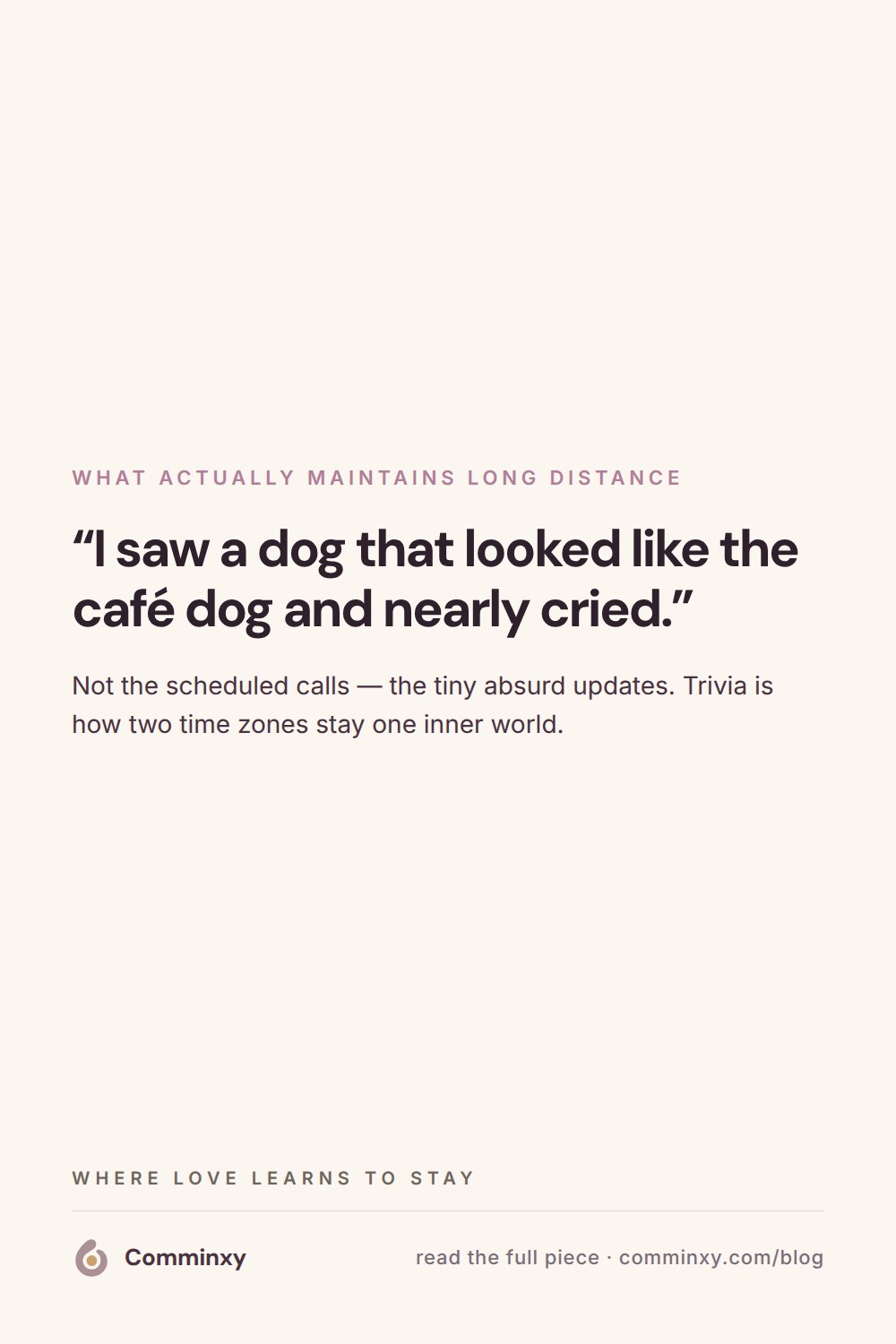
The assurance can be a voice note left while she sleeps, so it's the first thing she hears. The openness can be a message that says I saw a dog today that looked exactly like the one from that café and I nearly cried, which is insane. It's the little returns to each other, scattered across the mismatched hours, that do the real holding. Not the one live window where you're both performing "we're fine." If you want to go deeper on this, there's more in how to communicate in a long distance relationship.
Why the text you send at midnight can land like a slap at noon
Time zones do something cruel to written words. You type something in frustration at 11pm your time (fine, do whatever works for you) and go to sleep, the feeling already fading from you. But she wakes up eight hours later, fresh, coffee in hand, and reads it cold. To you it was a passing mood. To her it's the opening line of her whole morning.
The gap between when you send and when they read means your words arrive without you attached to them. There's no face to soften it, no tone, no chance to say "wait, that came out wrong" before it lands. If that dynamic feels painfully familiar, why you keep saying things you regret to your partner over text sits right in the middle of it.
What the way back actually looks like
The repair here is smaller and stranger than "talk more." It's about giving each other back the context that distance keeps stealing.
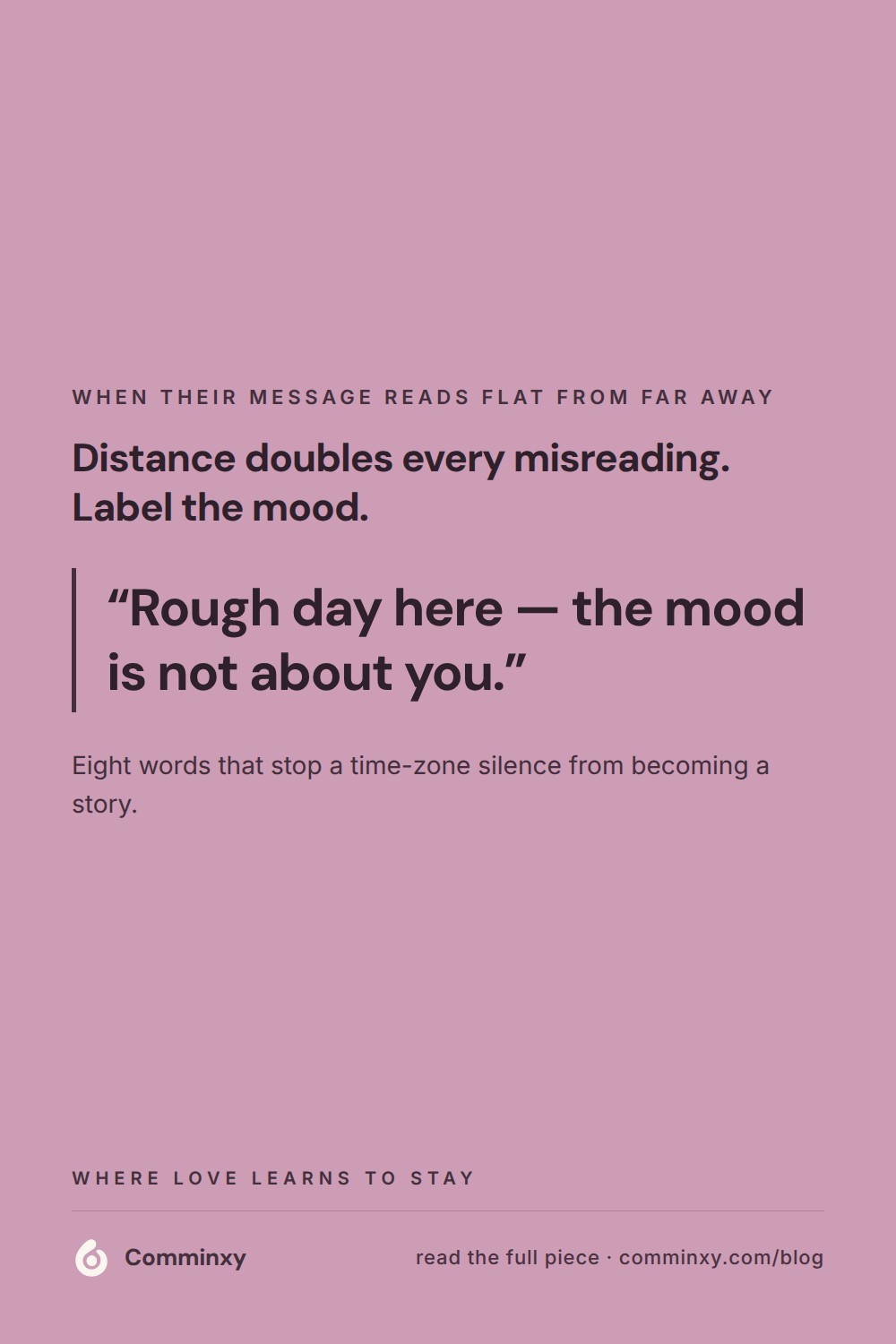
Sometimes that means naming the tide out loud. "I'm catching you at a bad hour, aren't I? We don't have to solve anything, I just wanted to see your face." That single sentence does what a shared living room used to do: it tells your partner the mood isn't about you. Sometimes it means agreeing that the hard conversations wait for the one window when you're both actually awake and steady, and the in-between hours are for warmth only. And sometimes it's as ordinary as ending a message with something tender even when you're annoyed, so that whatever she reads at breakfast still has your love folded inside it.
This is hard because you're doing something the human nervous system was never built for: loving someone whose morning is your midnight, and trusting that the thread holds across all that dark air. More of the groundwork lives in how to communicate better with your partner, if you want it.
So the next time it's 6:15 and the screen freezes on her face mid-laugh, try to let that be the image you carry into your day instead of the "I should let you go." The call was short. The connection wasn't. What keeps two people close across a wall of hours isn't the perfect window. It's the hundred small returns you make to each other in between, the voice notes landing while the other sleeps, the tenderness tucked into a message read cold. That's what an app like Comminxy is quietly built to help you keep hold of when the clocks refuse to cooperate, not to close the distance, but to remind you both that even here, across all those hours, love is still learning how to stay.
Questions people ask
how do you stay connected with your partner in different time zones
Stay connected through small returns like voice notes and tender messages scattered across mismatched hours, not just scheduled video calls. Reserve hard conversations for when you are both awake and steady, and use the in-between time for warmth only. Name the mood out loud when you catch each other at a bad hour so your partner knows it is not about them.
why do time zone differences make relationships harder
Time zones force you to meet each other at the emotional low tide when one of you is drained or distracted, losing the ability to choose your moment. You miss the whole arc of each other's day and only get the thin margins where nobody is quite themselves. Written words also arrive cold without your face or tone to soften them, so messages sent in one mood land in a completely different emotional context.
how do you start a conversation with your partner in a different time zone
Start with warmth rather than complaints about connection or timing, because how a conversation opens tends to be how it goes. Let the first thing out of your mouth carry tenderness, especially when your total conversation might only be a few minutes. If you are catching them at a bad hour, name it out loud so the mood does not feel like distance between you.
Keep the idea with you — pin it, or download the cards.



Comminxy helps you hold the thread across mismatched hours when clocks refuse to cooperate
Get Comminxy free →