The Best Couples Communication Apps 2026: An Honest Look at What Actually Helps Love Stay
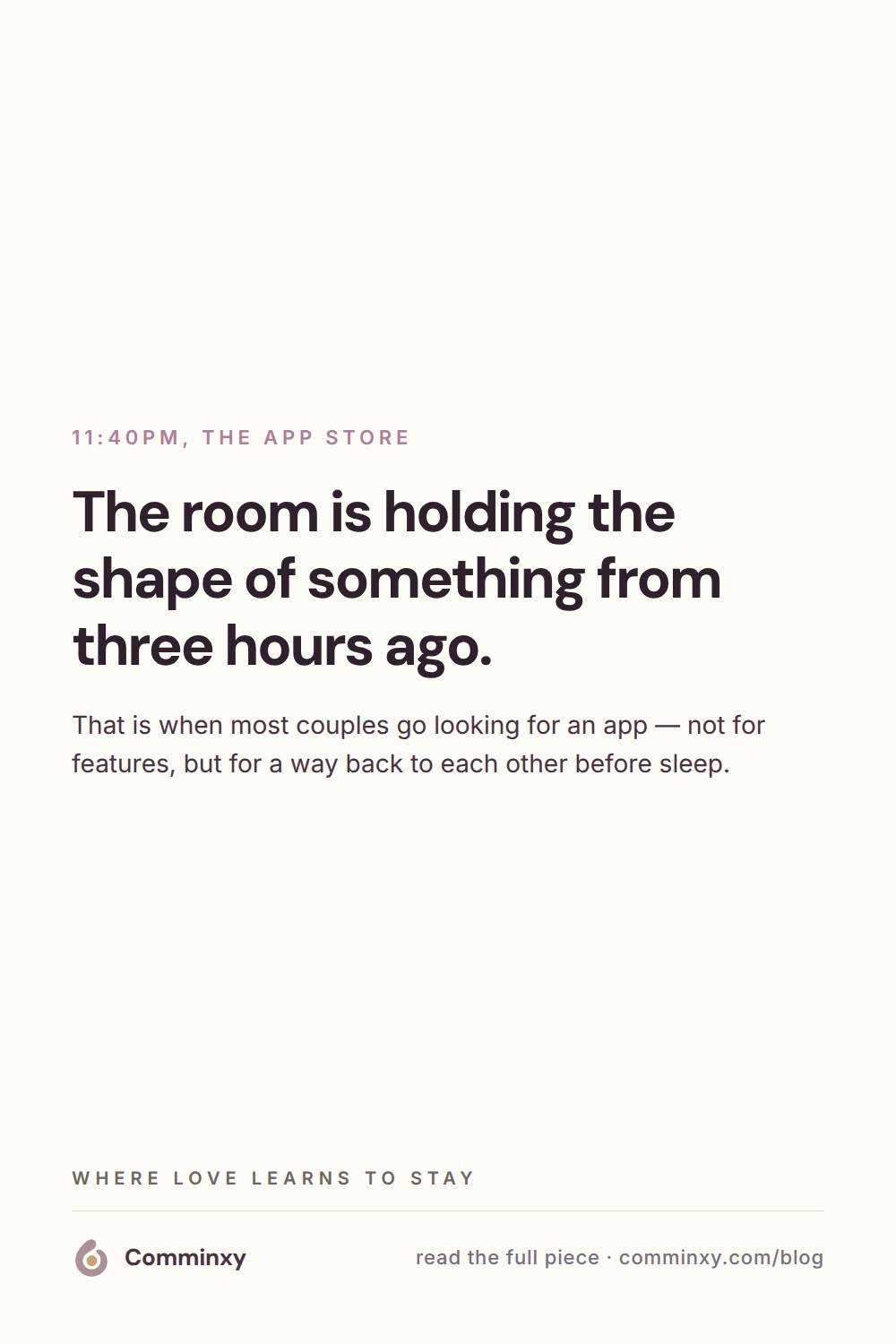
It's 11:40 at night. You're both in bed, and the room has that particular quiet, not the peaceful kind, the kind that's still holding the shape of something that happened three hours ago. Your phone is face-down on the nightstand, but you've picked it up twice already, half-looking for something. Not a message. Not a distraction. Something more like help. And somewhere in that scrolling you've typed the phrase into the search bar, half-embarrassed, half-hopeful: the best couples communication apps 2026, as though the right one might reach into your particular silence and loosen it.
That search, at that hour, is not a small thing. It's love looking for a door. And before we compare anything, one thing said plainly: we build one of these apps. Comminxy is ours. Weigh what follows accordingly. Where another fits you better, we will say so.
What you're actually reaching for at that hour
When we asked 132 people how their relationships actually go wrong, misunderstanding came up 61 times. Infidelity came up once. Nobody downloads an app because they want a feature. They download it because a conversation went sideways at dinner and they don't know how to walk it back, or because they can feel the distance growing in the small silences and don't have the words for it yet.
The apps in 2026 come in roughly three shapes, and it helps to see them for what they are rather than what they promise. There are the connection apps, Paired, Lasting and their cousins, built around daily questions and prompts to keep you turning toward each other. There are the scheduling and logistics apps that quietly reduce the friction of a shared life, the "who's picking up the kids" apps that matter more than they sound. And there's a third shape, the one we bet on: apps built around what's happening in the moment a conversation is going wrong, when your heart rate is climbing and the next sentence is about to make everything worse.
That third category is where we think the real question lives. That is our thesis, not a neutral finding. The reasoning: the trouble in most relationships isn't a lack of prompts. It's what happens in the ninety seconds after someone says the wrong thing.
Why the first three minutes are the whole game
It goes the same way almost every time. One partner opens a hard conversation, and in the very first sentence you can already feel where it will land. Not because of the topic. Because of the temperature. "You never" versus "I've been feeling." The difference is almost nothing, and it's everything.
This isn't a hunch. Carrère and Gottman found, in Family Process, that they could predict the outcome of a fifteen-minute conflict conversation from just its first three minutes, with 96% accuracy. Ninety-six percent. The fight is mostly decided before it has really begun, because those opening seconds set a tone both people then live inside.
Sit with what that actually means for you. The moment that matters most is not the big talk you keep postponing. It's the small, fast, almost invisible one, the way you begin. And that is precisely the moment no app has traditionally been able to reach, because it happens too fast, in the body, before the conscious mind has caught up. This is also why so many of us end up saying things we regret over text, where the reply leaves before the softer version arrives.
What an app can honestly reach, and what it can't
Here is the straight version, which matters more than a sales pitch and matters more still because we sell something. No app reaches into your chest and slows your heart when you're flooded. No app has ever loved anyone. The thing that repairs a relationship is still, always, the two people in it choosing to turn back toward each other.
But here is what a well-built app can do, and it's not nothing. It can catch you in the gap. It can notice, when you're mid-text and the words are getting sharp, that you're not actually angry, that you're scared or tired or unheard, and give you a half-second to feel that before you hit send. It can help you see the pattern you're both caught in, so it stops feeling like a fight between two people and starts feeling like a thing you're up against together.
Gottman and Levenson named the most corrosive of these patterns the "Four Horsemen", criticism, contempt, defensiveness and stonewalling, in the Journal of Personality and Social Psychology, and showed how they distinguish couples who stay regulated from those who spiral. If you've ever felt one of those creep into your kitchen, you'll recognise them instantly. We've written more about the four patterns and how they take hold, because seeing them clearly is often the first thing that loosens their grip. An app that helps you notice a horseman arriving is reaching something real.
How to choose without losing the plot
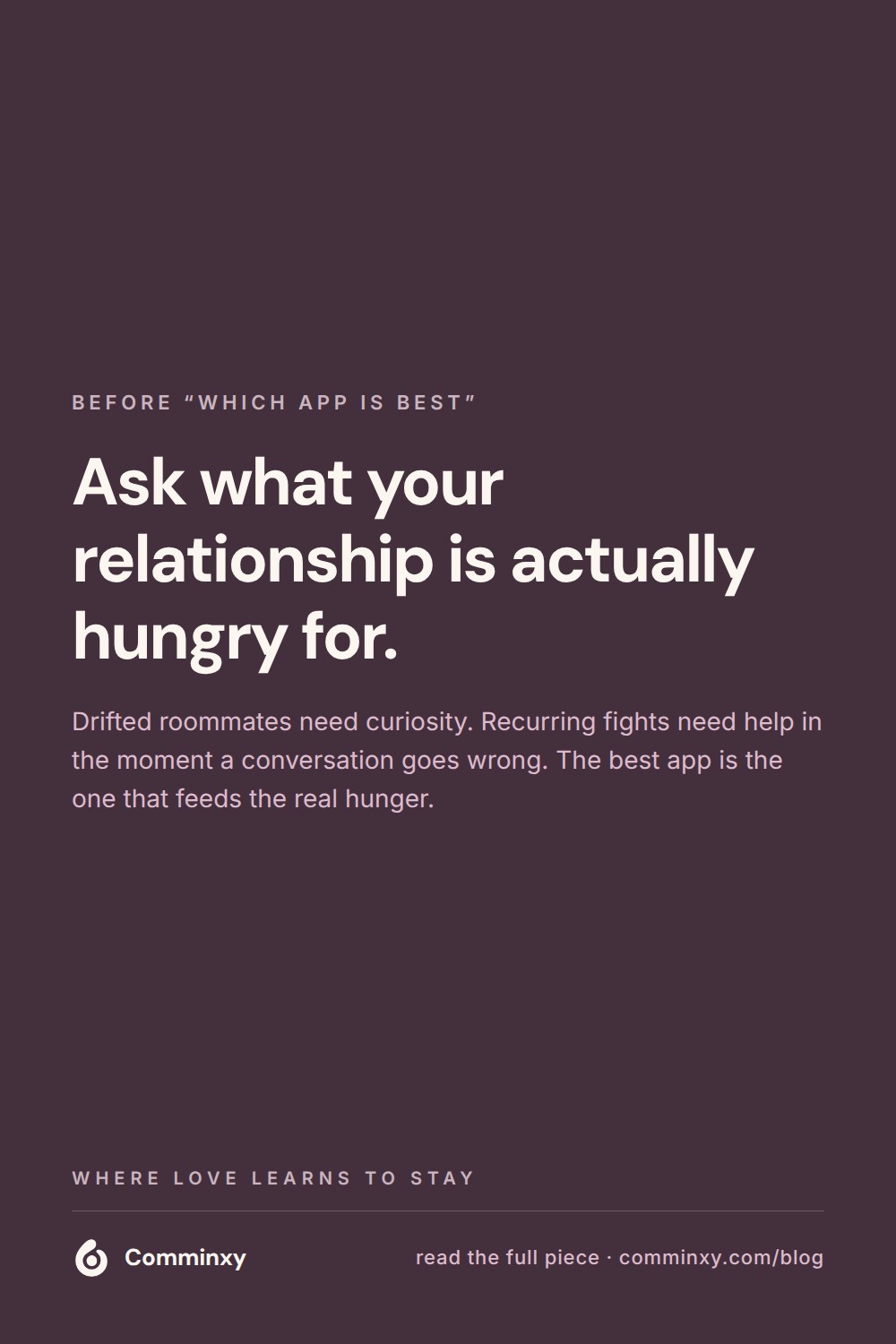
So when you're standing in the app store at midnight, here's the quieter question underneath "which is best." Ask what your relationship is actually hungry for right now. If you've simply drifted, if the two of you have become good roommates and forgotten how to be curious about each other, then a connection app with daily questions might be exactly the small return you need, and ours is not the one to buy. Stafford and Canary found that everyday maintenance behaviours like openness and positivity account for a startling amount of relationship satisfaction, up to 56% by their measure. The small stuff isn't small.
But if your ache is the harder one, the conversations that keep going wrong, the texts that detonate, the first three minutes that keep setting fire to the rest, then what you need isn't more prompts. You need something that meets you in the heat of the moment. That's a different tool for a different wound, and there's no shame in knowing which one is yours.
The way back is smaller than the app store makes it look
Whatever you choose, the thing that actually matters is easy to lose among the feature lists. The repair you're looking for is not a grand reconciliation. It's one softer opening. One text you rewrote before sending. One moment where you noticed the horseman at the door and chose, just barely, to close it. Couples don't stay together because they found the perfect app. They stay because, again and again, one of them found a way back into the room. If you want the fuller version of that, it lives in learning to communicate a little differently, one small honest sentence at a time.
And you will still get it wrong. You'll download something, mean it, and send the sharp text anyway on a Tuesday when you're tired. That isn't a failure of the tool or of you.
So here you are, 11:40 at night, phone in hand, the quiet still holding its shape beside you. You didn't reach for that search bar because your love is broken. You reached because it's still here, still asking for a door. Comminxy can stand beside you in those first fragile three minutes and hand you the softer sentence when your hands are shaking. Not to fix you, never that. To help you back into the room a little sooner, which is all repair has ever been.
Questions people ask
Do couples communication apps actually work?
They help with some things and not others. Daily prompts and shared logistics genuinely reduce friction over time. What almost none of them reach is the moment a conversation is going wrong in real time, which is where most of the damage happens.
What is the best couples communication app in 2026?
It depends which of the three problems you have. If you want to stay curious about each other, a prompt-based app suits you. If the friction is logistical, a shared planning app does more. If your trouble is how hard conversations start, neither shape will reach it.
Can an app fix a relationship?
No, and any app claiming otherwise is worth being wary of. What an app can do is help you notice a pattern sooner, or make one difficult moment slightly easier. The repair itself is still done by two people.
What should I look for in an app for couples?
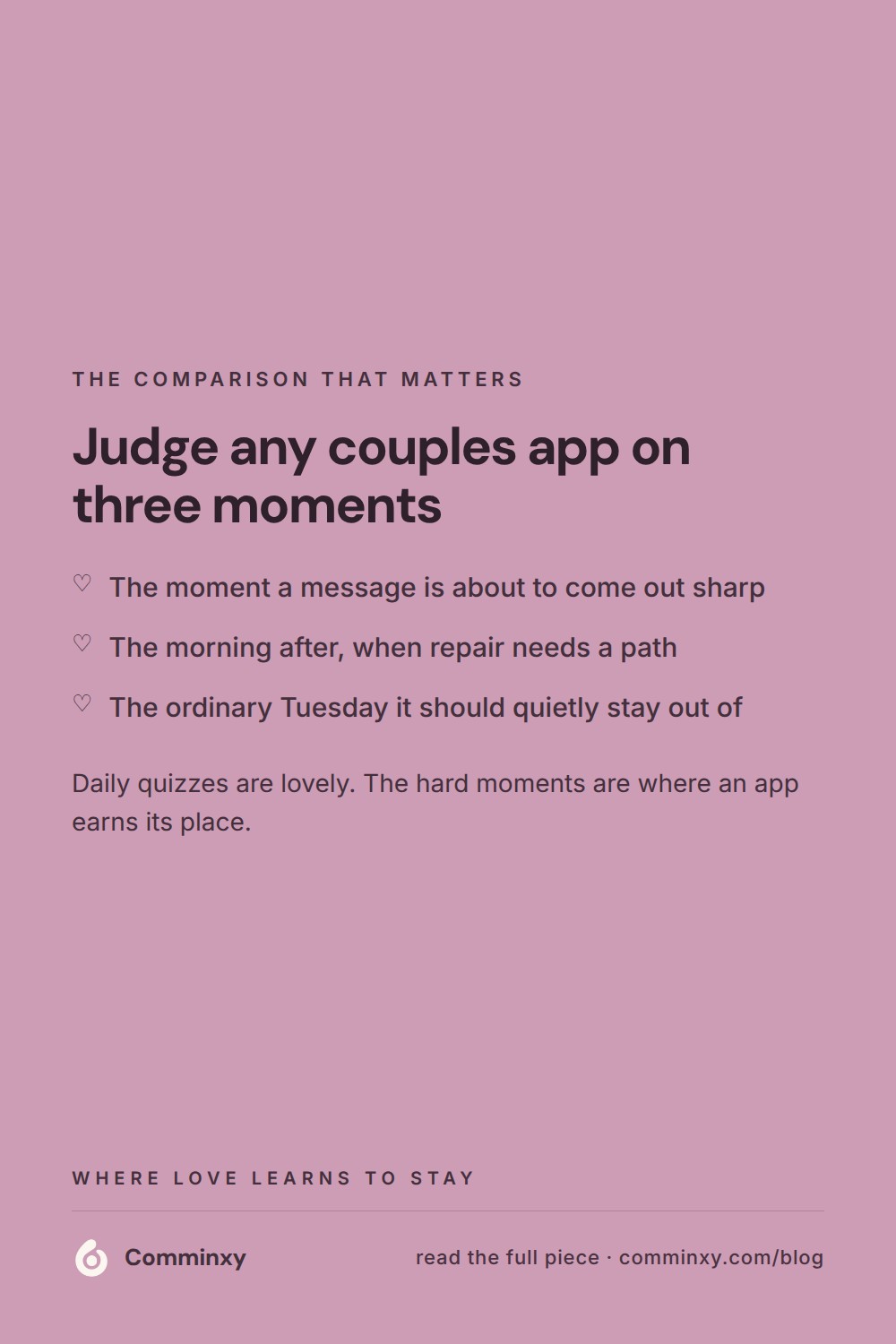
Ask what moment it is designed to reach. Most are built for the calm hours when you are both willing. Look at whether it offers you anything at all in the moment your heart rate is climbing, because that is when it matters most and when least is available.
Keep the idea with you — pin it, or download the cards.


The ninety seconds after the wrong sentence is where help matters.
Get Comminxy free →