How to Be Vulnerable With Your Partner When Opening Up Feels Unsafe
There is a version of the truth you carry around half-said. It sits just behind the easy answer, the one about being tired, the one about work being busy, the one that keeps the evening moving. You know the fuller thing. You could say it. And most nights you decide not to, because to be vulnerable with your partner means handing them something they could set down carelessly, and you have felt that carelessness before, and you would rather keep the thing than watch it dropped.
So you hold it. And holding it feels, from the inside, like the sensible thing to do.
This is not cowardice, whatever the word in your head keeps calling it. Something in you is doing exactly what it learned to do. The question worth sitting with is not whether you are brave enough. It is what your silence is actually protecting, and whether it is still protecting the thing it thinks it is.
Two things are true when you go quiet
One reading is that you are keeping yourself safe. You read the room, you found it uncertain, and you kept the tender thing where it cannot be broken. That is not a flaw. It is a system that has kept you upright, sometimes for years, sometimes since long before this person walked into your life. Give it its due.
The other reading is that the silence is also keeping you alone. The part of you that wanted to be met stays unmet, because you never gave anyone the chance to meet it. Both of these are true at once. You are protected and you are isolated, in the same breath, by the same decision. Neither cancels the other out.
You do not have to choose between these readings tonight. It helps just to notice that the safety you feel when you stay quiet has a cost stitched into it, and the cost is the very closeness you are lying awake missing.
Why closeness only grows in one direction
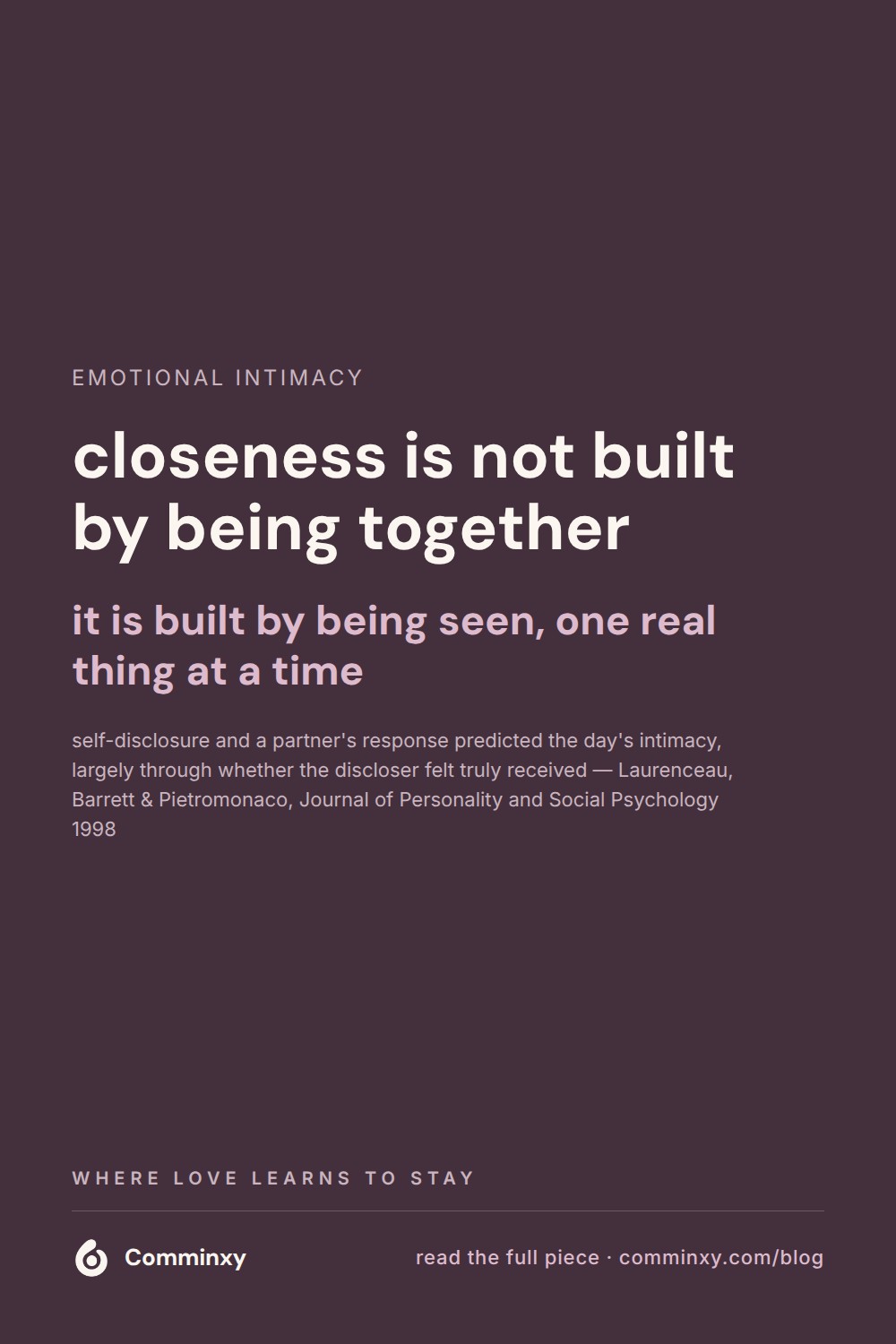
There is a finding that reframes what a lot of us assume about intimacy. Most people imagine closeness as something that accumulates through time, through years logged together, through a shared history that eventually becomes trust. But when researchers looked at what actually makes two people feel closer on any given day, they found it hinged on something smaller and more daily: one person disclosing something real, and the other responding in a way that felt understanding. Self-disclosure and a partner's response to it predicted the day's intimacy, largely through whether the discloser felt their partner had truly received them (Laurenceau, Barrett, and Pietromonaco, Journal of Personality and Social Psychology, 1998).
Sit with what that means for the quiet version of you. Closeness is not built by being together. It is built by being seen, and being seen requires the risky part, the disclosure, the thing behind your teeth. The years do not do it on their own. The withheld sentence, the one you decided was safer kept in, is the exact material closeness is made from.
Which puts the silence in a harder light. It does not just fail to build anything. It quietly removes the one thing that could.
And still. That does not make the fear wrong. It only makes it expensive.
The risk is real, and it is smaller than the story
Somewhere in you is a scene of how it goes badly. They shrug. They change the subject. They say something that lands like a slap, or worse, they say nothing at all and let it sit there in the open where you cannot take it back. That scene is not paranoia. If you have lived it once, your body filed it, and it will play the recording every time you reach for something honest again.
The recording is accurate about the past. It is not a reliable narrator of the next five minutes.
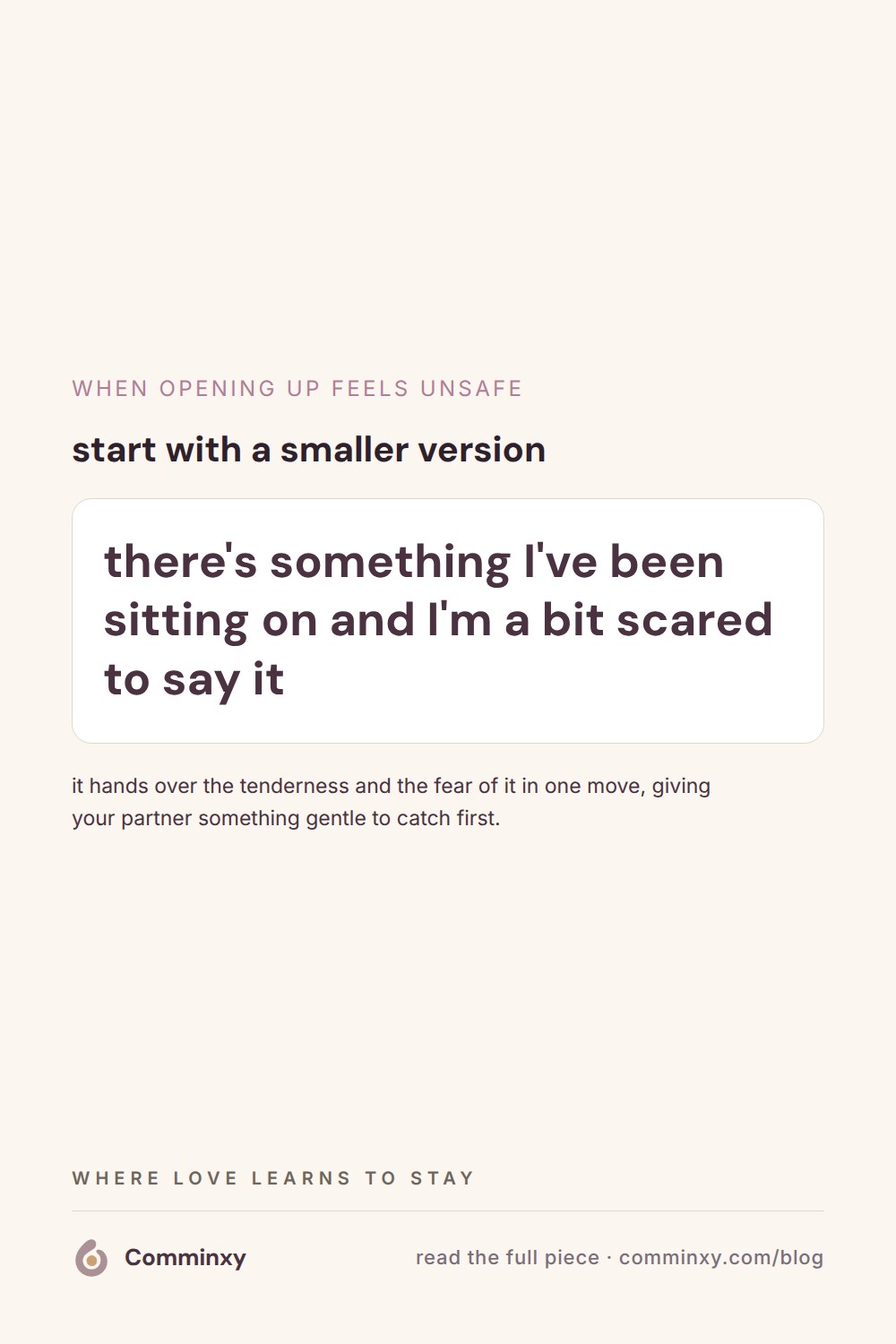
What tends to get lost is that vulnerability rarely needs to be complete to count. You do not owe anyone the whole unedited truth in a single sitting. A smaller version is still real. "There's something I've been sitting on and I'm a bit scared to say it" is itself the disclosure. It hands over the tenderness and the fear of handing it over, in one move, and it gives your partner something gentle to catch first. If you are finding your way back to talking at all, there is more on why couples stop talking and how to fix it, because the going-quiet often starts long before the thing you are now afraid to say.
What to do with a fear you cannot argue away
You will not think your way out of this. The fear does not respond to logic, because it was never built by logic. It was built by a moment, or a childhood, or a person who is no longer in the room. So the way through is not to feel safe first and then speak. It is to speak a little before you feel ready, and let the feeling of safety arrive, or not, afterward.
Start with the lowest-stakes true thing you have. Not the deepest wound. The one you could survive being met poorly. Watch what happens. Not to test them exactly, but to give your nervous system new footage, one small clip at a time, of reaching out and not being dropped. If it goes well, the recording updates. If it goes badly, you learned something real about where the two of you actually are, which is its own kind of ground to stand on.
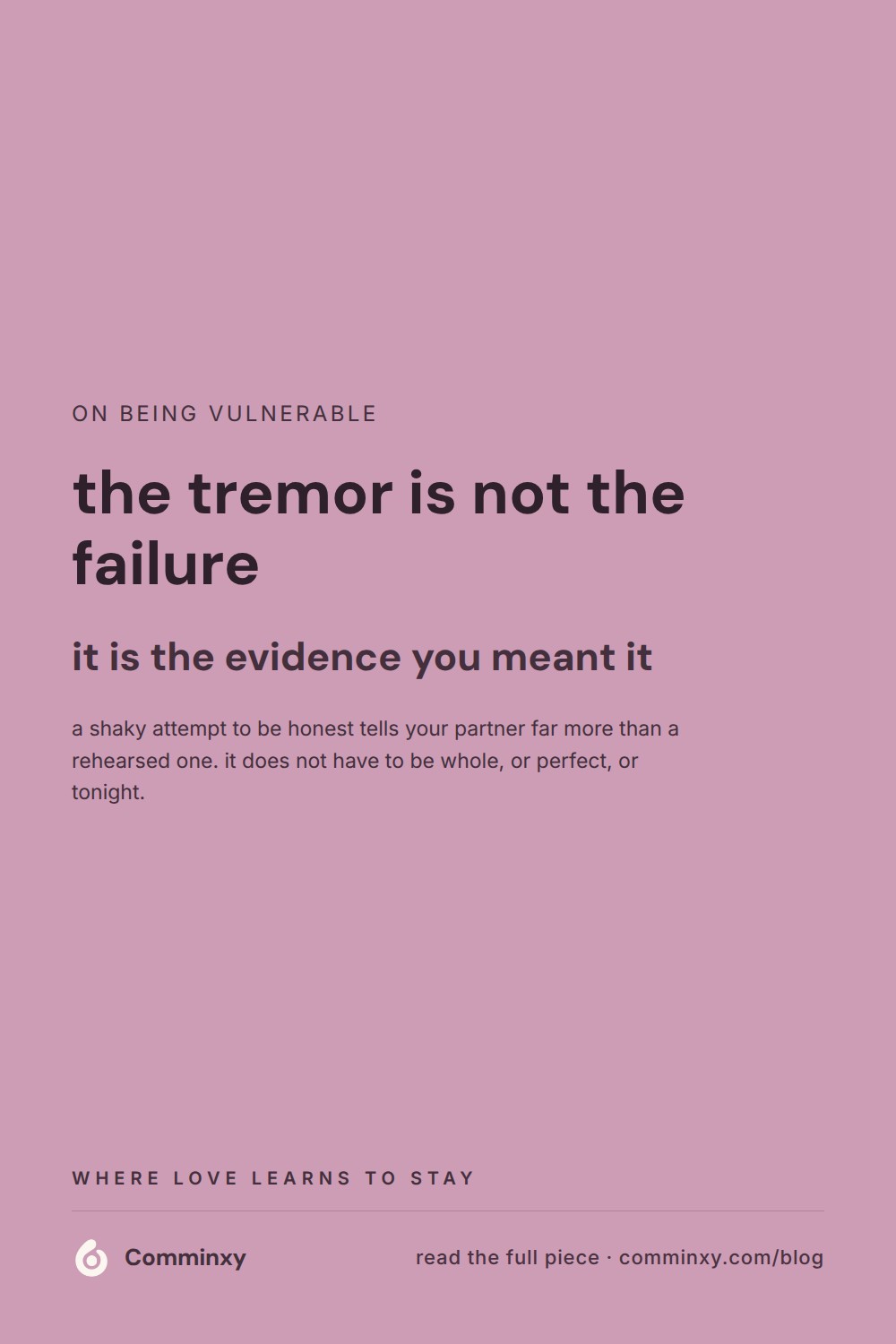
And when you do the clumsy version, the one that comes out wrong, or too fast, or with your voice doing something you did not plan, know that it still counts. Probably more. A shaky attempt to be honest tells your partner far more than a rehearsed one. The tremor is not the failure. The tremor is the evidence you meant it.
You will also do this badly sometimes. You will pick the wrong moment, or say the safe thing again, or lie awake having decided, one more time, to keep the fuller truth behind your teeth. That is not the end of anything. It is just Tuesday. The chance comes back around, because you live alongside this person, and there will be another quiet evening with another thing half-said.
Maybe tonight it stays behind your teeth, and that is allowed. But somewhere in you is a sentence that has been waiting a long time to be handed to someone. It does not have to be handed over whole, or perfectly, or tonight. It only has to be offered once, in some small trembling form, to a person who might just catch it. Comminxy exists for that reaching moment, the one where love is trying to find its way into words. Because that is where love learns to stay: not in the years, but in the sentence you finally decide to say out loud.
Questions people ask
why is it so hard for me to open up to my partner
Often it is because staying quiet once kept you safe, so your body learned to protect tender things by holding them back. That reaction is not weakness, it is a habit built by past moments where honesty was met poorly. The difficulty makes sense even when it is now costing you closeness.
how do i tell my partner something when im scared of their reaction
Start with the smallest true thing you can survive being met poorly, rather than your deepest wound. You can also name the fear itself out loud, saying you have something you are nervous to share. This hands your partner something gentle to respond to first.
does being vulnerable actually make a relationship closer
Yes, closeness tends to grow when one person shares something real and the other responds in a way that feels understanding. Time spent together alone does not build intimacy the same way. The risky part of speaking up is what the connection is actually made from.
what if i open up and it goes badly
If it goes badly you learn something honest about where you and your partner currently stand, which is still useful ground. A poor response does not erase the value of having reached out. If a pattern of harsh or dismissive reactions keeps repeating, talking with a couples therapist can help.
Keep the idea with you — pin it, or download the cards.


The sentence behind your teeth is waiting to be offered.
Get Comminxy free →