How to Ask for Space in a Relationship Without Making Your Partner Feel Abandoned
The word comes out wrong every time. You wanted a walk, an hour, a locked bathroom door and no one knocking. What you said was "I need some space," and you watched it land on your partner's face like a slammed door, like the beginning of the end they had been quietly waiting for. Now you are the one apologising, when all you wanted was to breathe. If you have ever tried to ask for space in a relationship and ended up in a longer, worse conversation than the one you were trying to step away from, you already know the strange trap of it. The request for distance becomes the thing that pulls you both closer in exactly the wrong way.
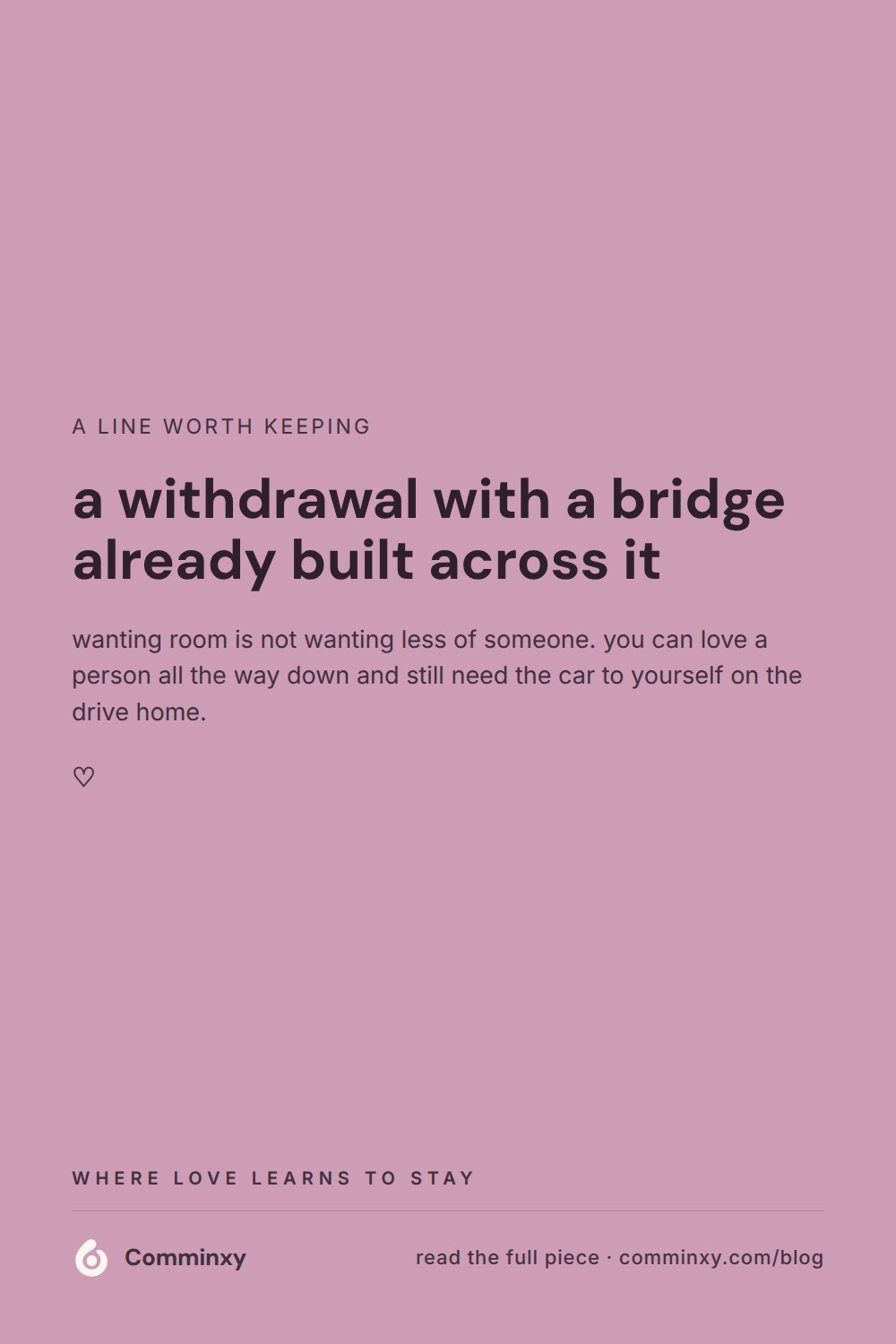
Here is something worth sitting with before anything else. Wanting room is not the same as wanting less of someone. You can love a person all the way down and still need the car to yourself on the drive home, still need twenty minutes where no one needs anything from you. The need is real and it is not a betrayal of the love. Both are true at once.
Why the word lands like a verdict
When you say you need space, your partner rarely hears the sentence you said. They hear the sentence they are afraid of. "Space" arrives wearing the costume of every time someone pulled away before they left for good, every parent who went quiet before they went absent, every version of the story where distance was the first chapter of goodbye.
This is not them being irrational. Their nervous system is doing a fast, ancient piece of maths. Distance has meant danger before, and some part of them cannot tell the difference between you stepping into the garden for an hour and you stepping out of the whole thing. The body does not read your intentions. It reads the movement.
So you can mean rest and they can hear rejection, and you can both be telling the truth. The gap between the two is where it all goes wrong.
The quiet kind of leaving that research actually warns about
There is a fear underneath all of this, usually unspoken, that asking for space is the first step down a road that ends somewhere cold. It helps to know what that road actually looks like, because it is not the one most people imagine.
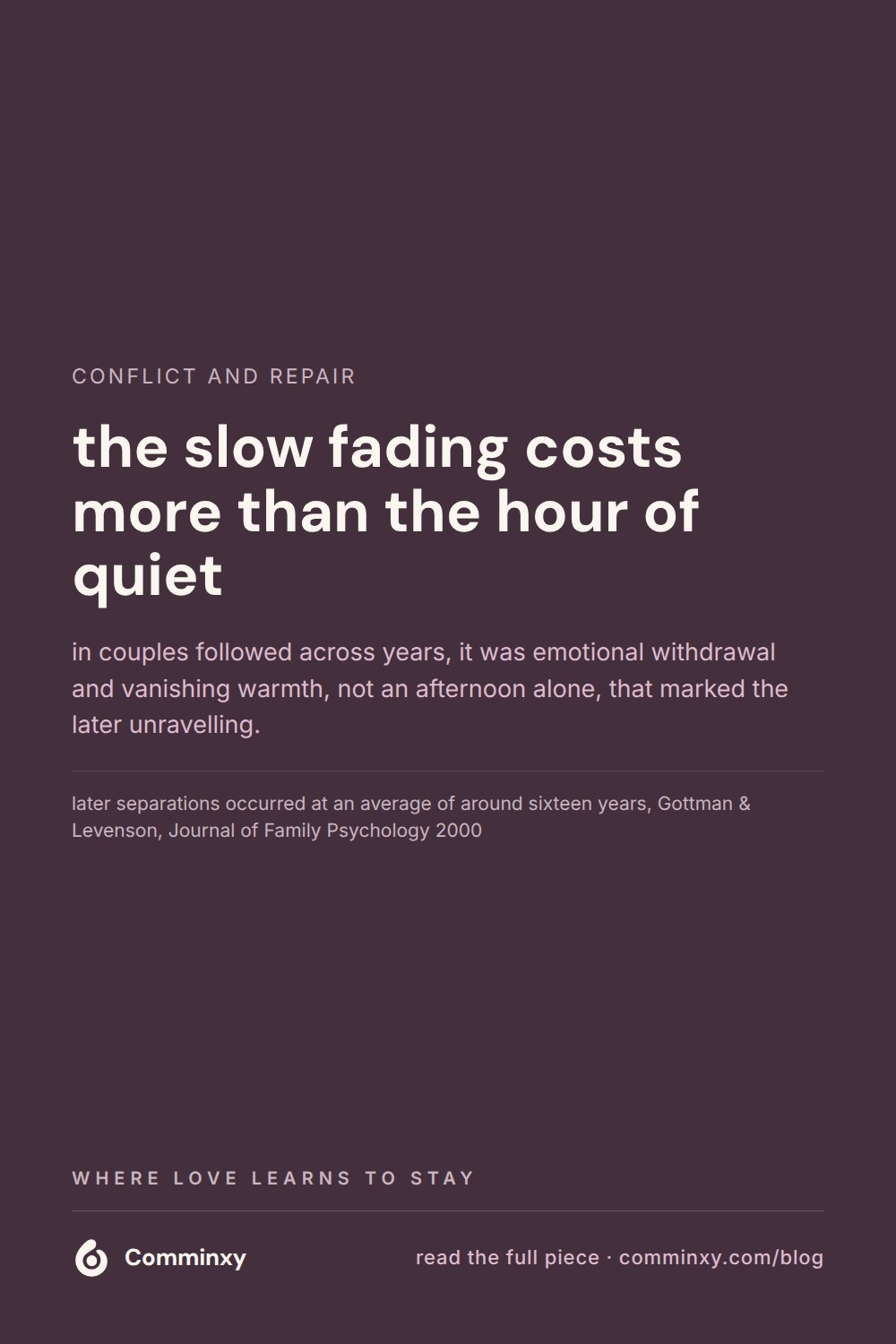
When researchers followed couples across years to understand how relationships come apart, they found two distinct patterns. Some marriages ended early and loudly, full of conflict. But others ended later, and those were marked not by fighting but by emotional withdrawal and the slow fading of warmth, with later divorces occurring at an average of around sixteen years (Gottman and Levenson, Journal of Family Psychology, 2000). The thing that erodes a bond over time is not someone taking an afternoon to themselves. It is the gradual disappearing. The affection that stops arriving. The two people who become polite strangers sharing a calendar.
Asking for space out loud, with care, is almost the opposite of that quiet vanishing. One is a door you close for an hour and tell them you are closing. The other is a door that drifts shut over years while you both pretend not to notice. The first protects the bond. The second is the thing to watch.
Which means the honest, clumsy "I need a bit of time" you keep feeling guilty about may be far healthier than the alternative you fear it resembles.
What they need to hear underneath the request
The difference between space that reassures and space that wounds often comes down to one missing piece of information. When you ask for distance and say nothing else, you hand your partner a blank, and they fill it with their worst guess. The silence does the damage, not the stepping away.
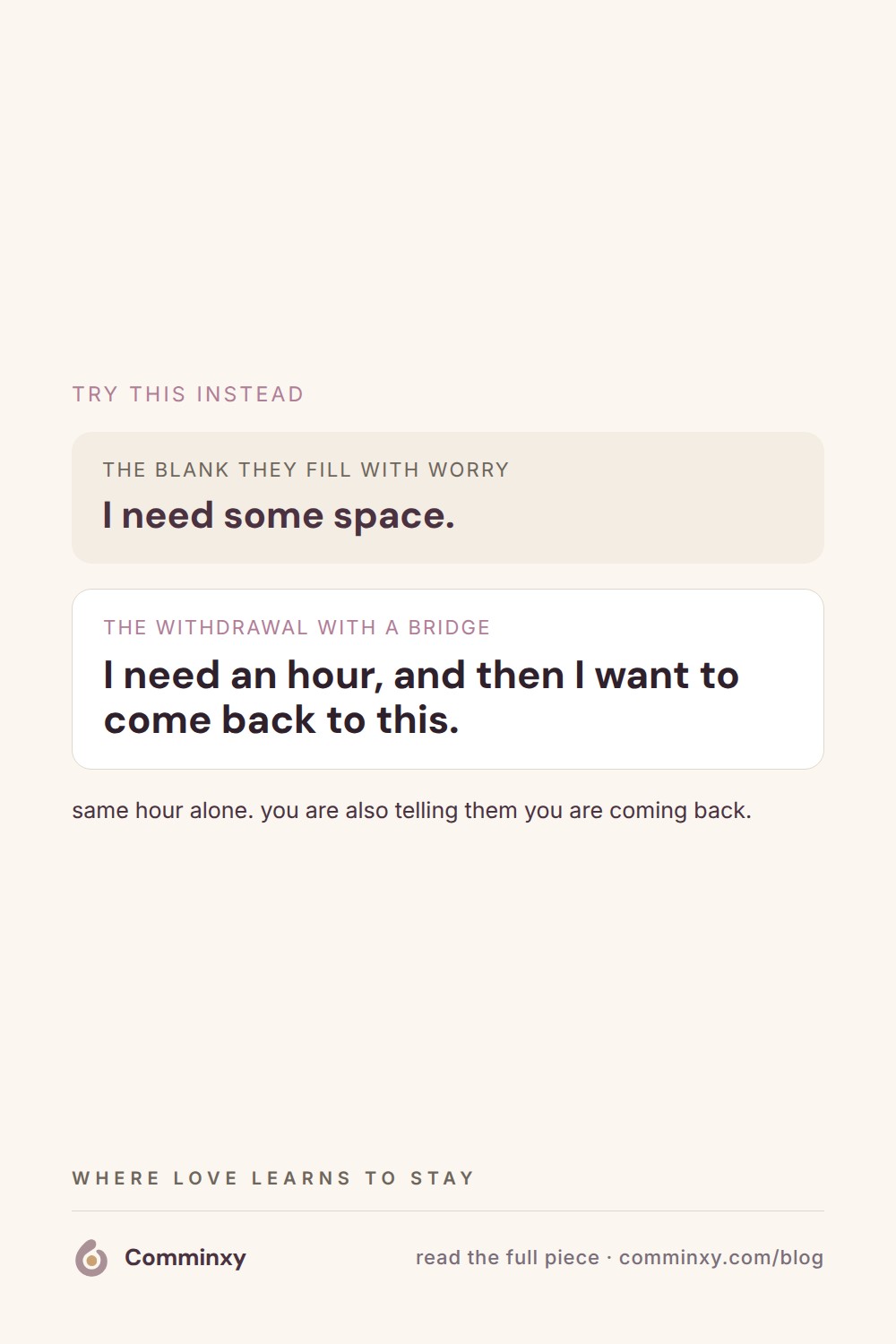
What changes everything is naming the return before you leave. Not "I need space," full stop, but "I need an hour on my own, and then I want to sit with you and I will feel more like myself." You are not just telling them you are going. You are telling them you are coming back, and roughly when, and that the going is in service of the two of you rather than against it.
Think about the texture of those two messages. One is a withdrawal. The other is a withdrawal with a bridge already built across it. Same hour alone. Completely different experience for the person left in the room.
You might say, "This isn't about you, and I know it can feel like it is. Give me till after dinner. I want to come back to this when I'm not so wound up." The phrasing does not need to be elegant. It needs to carry two facts: that you are stepping back on purpose, and that the stepping back has an end.
When you are the one who went quiet
Maybe you are reading this from the other side. You did not ask for space. You took it, suddenly, mid-sentence, and the silence you left behind is still sitting in the house like a coat someone forgot on a chair. You went cold because you were overwhelmed, and now the cold itself has become a second hurt, stacked on the first.
If that is you, the thing to know is that the withdrawal is often protecting something tender rather than attacking anything. When the body floods, going quiet can feel like the only way to not make things worse. But your partner cannot see the flooding. They see only the leaving, and they are left to wonder what they did.
The way back from that is smaller than the apology you think you owe. It can be a single sentence that names what happened. "I went quiet because I hit a wall, not because I stopped caring." You are not excusing the exit. You are giving them the information that turns a cold shoulder back into a person who got overwhelmed. If the silence between you has started to feel like a habit rather than a moment, there is more on how that pattern takes hold in why couples stop talking and how to fix it.
The repair is in the reaching, not the wording
You will do this badly sometimes. You will snap "I just need a minute" with an edge you did not intend, or disappear before you remember to build the bridge, and your partner will feel the old fear anyway. That is not failure. That is being a tired person who got it slightly wrong on a Tuesday.
What repairs it is not getting the sentence perfect. It is going back afterwards. "That came out sharper than I meant. I still needed the time, but I didn't need to leave you like that." A clumsy return often lands softer than a polished exit, because it shows them you noticed the gap and crossed it on purpose. If putting words to any of this feels hard, there is more on the mechanics of it in how to communicate better with your partner.
The aim was never to need less of each other. It was to find the version of closeness that has room in it, where one of you can step into the garden for an hour and the other can stay in the warm knowing the door is coming open again.
That walk you wanted, the locked door, the hour of quiet. None of it was ever a small leaving. It was you trying to come back to the relationship as a person who could actually be present in it. Comminxy exists for exactly this kind of moment, helping you find the few words that turn a withdrawal into a bridge, so that the space you need and the closeness they need can live in the same house. That is where love learns to stay.
Questions people ask
how do i ask for space without hurting my partner
Tell them you are stepping back on purpose and roughly when you will return. A short line like give me an hour and then I want to talk gives them certainty instead of a blank to fill with worry. The reassurance is in naming the return, not in getting the words perfect.
why does my partner freak out when i say i need space
For many people the word space echoes past moments when distance was the first sign someone was leaving for good. Their reaction is often an old fear being triggered rather than a judgment of you. Pairing the request with a clear return can ease that fear a lot.
is wanting time alone a sign my relationship is ending
Not usually. Wanting occasional time to yourself is normal and does not mean love is fading. The pattern worth watching is ongoing emotional withdrawal and warmth quietly disappearing, which is different from asking openly for an hour to recharge.
how do i fix things after i went silent and shut my partner out
Go back and name what happened in one honest sentence, such as I went quiet because I was overwhelmed, not because I stopped caring. This turns a cold silence back into a person your partner can understand. If shutting down has become a constant pattern that neither of you can shift, a couples therapist can help.
Keep the idea with you — pin it, or download the cards.


Find the words that let you step back without stepping away
Get Comminxy free →