Anxious and Avoidant Partner Needs: What Each Heart Requires to Feel Safe
You are standing at the edge of a party, coats piled on someone's bed in the next room, and your partner has drifted three conversations away. You keep glancing over. Not because anything is wrong, exactly. Just because there is a thin, humming wire running from your chest to wherever they are standing, and you can feel it stretch. Meanwhile, across the room, they have finally exhaled. The noise, the small talk, the closeness of the drive over, all of it softened by a little distance and a drink in hand. Two people at the same party. Two completely different ideas of what safety feels like.
Understanding anxious and avoidant partner needs starts here, in this ordinary gap (not in a fight, but in a moment where love is genuinely present and still somehow lands differently in each body). One heart calms down when it can feel the other close. One heart calms down when it can breathe a little space. Neither is wrong. They are just wired toward safety from opposite directions.
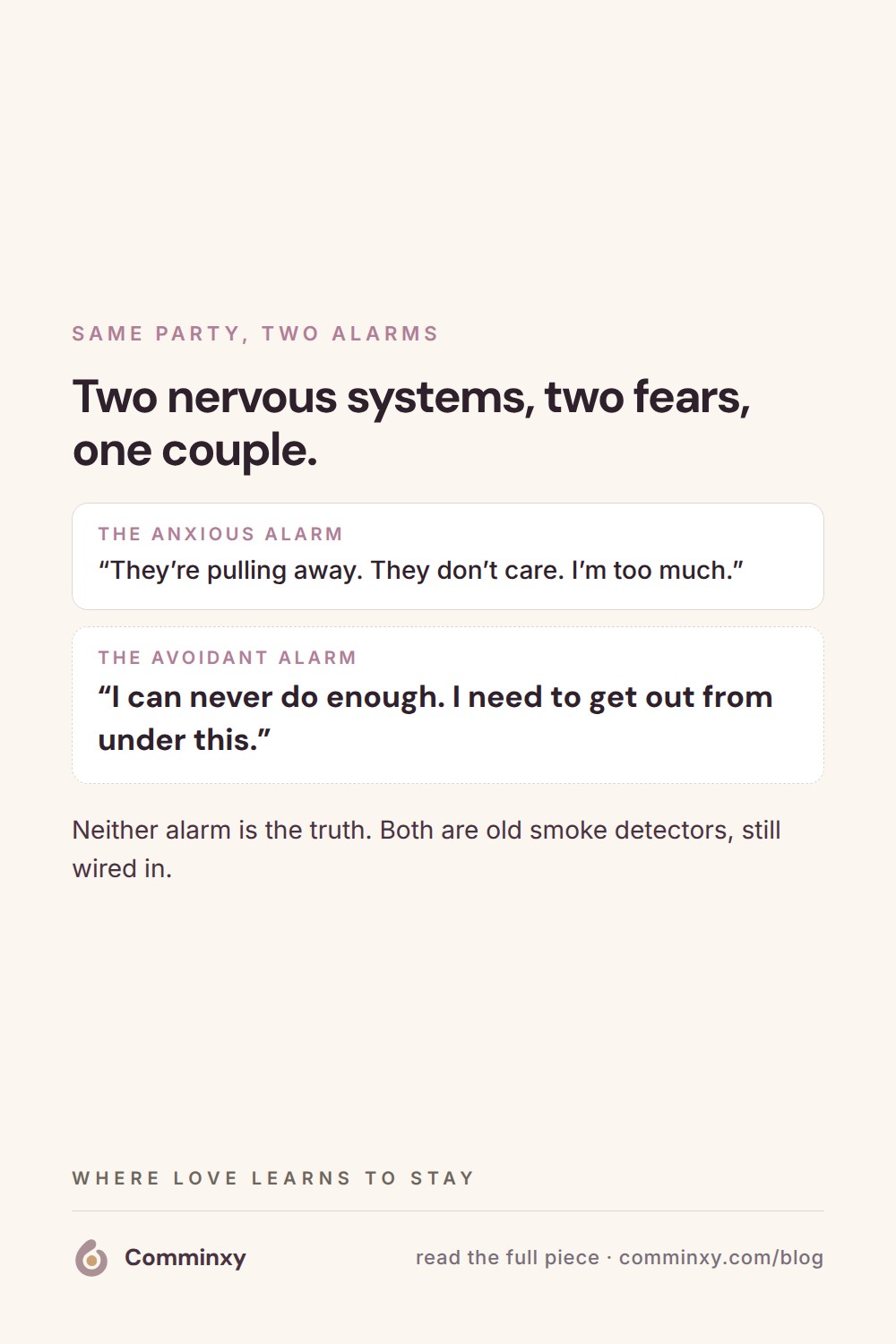
The same room, two different alarms
What makes this so quietly painful is that both of you are reaching for the same thing. You both want to feel okay. You are just reaching in ways that cancel each other out.
When the anxious partner senses distance, something old flickers awake: a small, urgent question about whether the connection is still there. So they move toward it. A text, a look across the room, a hand on the arm. Are we still good? And when the avoidant partner feels that reach as pressure, another old alarm sounds. The sense that they are about to lose themselves, that they need room to stay whole. So they step back. Not away from love. Away from the feeling of being needed more than they can give in that moment.
Hazan and Shaver, in their 1987 research published in the Journal of Personality and Social Psychology, described adult romantic love as an attachment process: the same deep machinery that makes a small child scan the room for a parent, still running quietly underneath grown love. Which means the reaching and the retreating are not character flaws. They are an old nervous system doing what it learned, long before either of you met.
The story each of you tells in the silence
The trouble is rarely the reaching or the retreating itself. It is the story that fills the space between.
The anxious partner watches the retreat and narrates: they're pulling away, they don't care, I'm too much. The avoidant partner feels the pursuit and narrates: i can never do enough i'm always failing them, I need to get out from under this. And each story feels like the truth. It feels like reading the room accurately. But it is often the old alarm supplying the words.
Fincham and Bradbury, in the Journal of Personality and Social Psychology, found something worth sitting with here. When we judge a partner's behaviour as intentional, selfish, and blameworthy, that judgment itself predicts more hostility and more conflict. The attribution comes first, and the fight follows. In other words, the story you tell about the distance shapes what the distance becomes. If you are carrying this same loop into text messages, you might recognise some of it in how fights escalate over text, where there is even less to go on and the story fills in everything.
What each heart is actually asking for
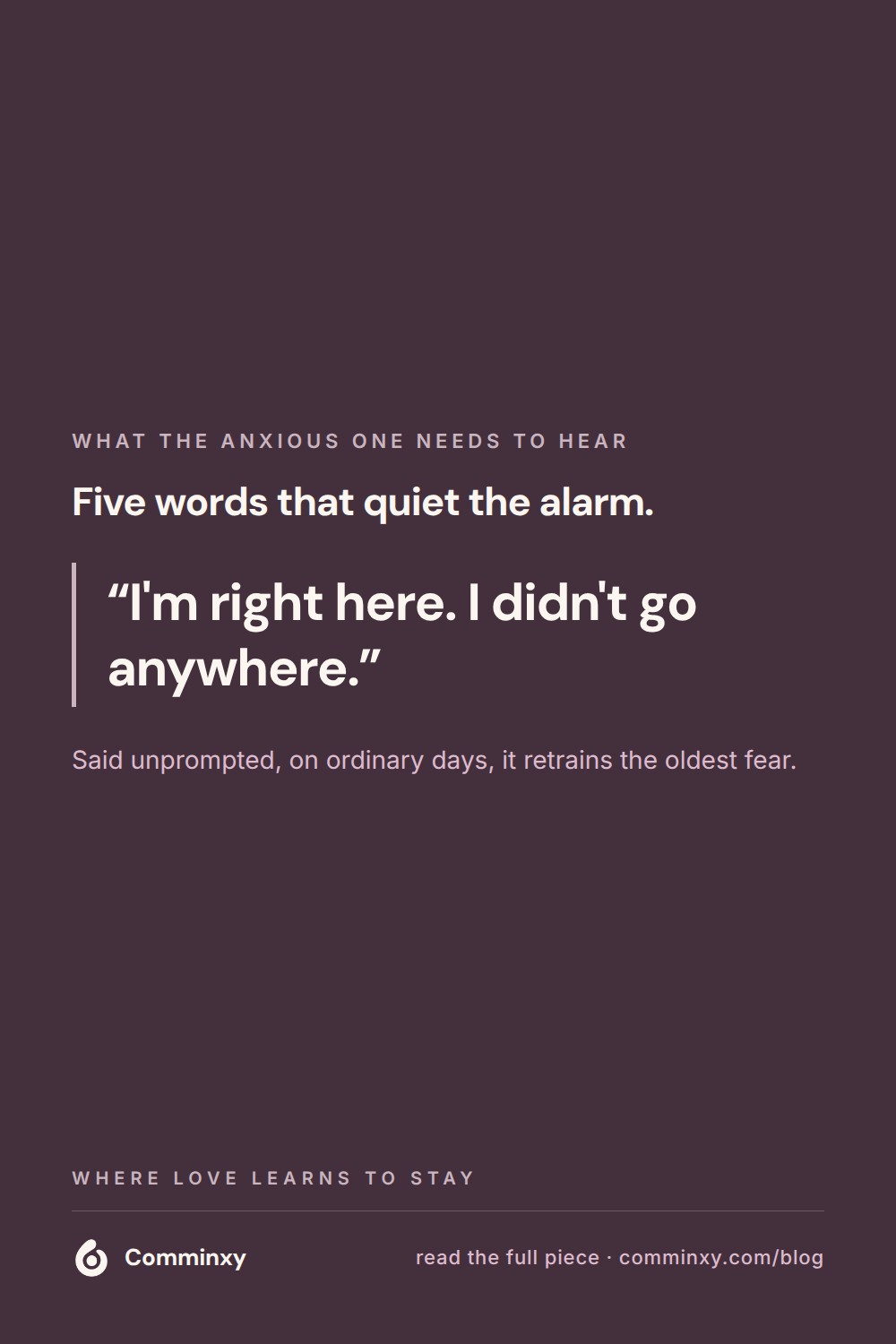
Underneath the pursuit, the anxious partner is not asking for constant contact. They are asking for a reliable signal: some small, repeated proof that the connection survives distance. A glance back across the party. A hand found in a crowd. im right here i didnt go anywhere. What settles them is not being held tighter. It is being able to trust that letting go will not mean losing.
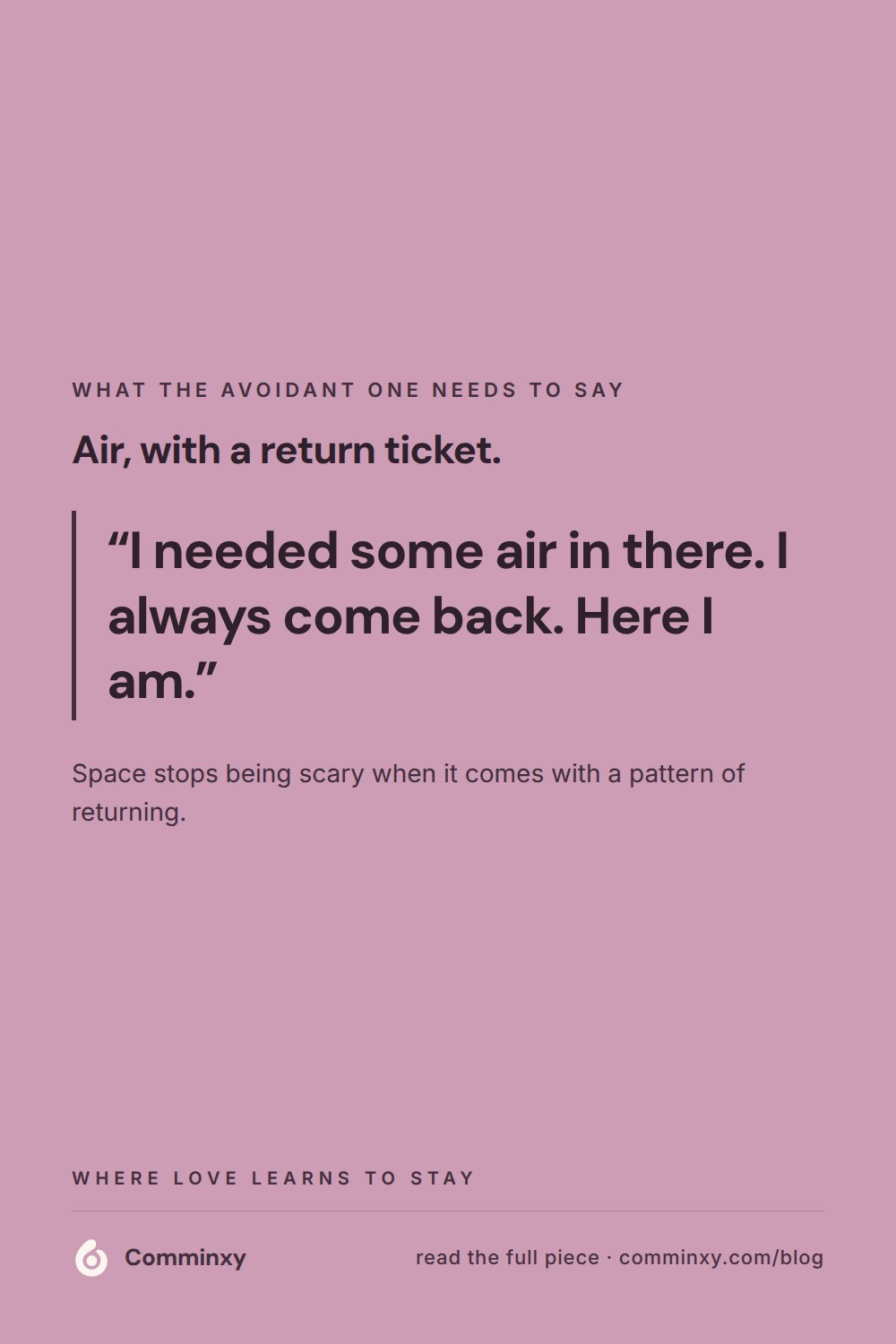
Underneath the retreat, the avoidant partner is not asking to be left alone. They are asking for space that is not punished. The freedom to step back and drift into another conversation without it becoming evidence of not loving. What settles them is discovering that they can move away and the relationship will still be there, unharmed, when they turn back around.
And here is the quiet, almost unfair beauty of it: those two needs are not actually opposites. The anxious heart needs to trust that distance is safe. The avoidant heart needs to prove that distance is safe. Given a little understanding, each one can become the other's teacher.
What the way back looks like
Repair between these two nervous systems rarely happens in the heat of it. It happens quietly, afterward, when you are driving home from the party and the tightness has eased.
For the one who pursues, the way back often sounds like naming the fear instead of acting it out. When you drifted off tonight, some part of me got scared we'd lost the thread. I know that's my old alarm. I'm telling you instead of chasing you. That single sentence does something remarkable: it turns pressure into information. It gives the avoidant partner something they can actually respond to, rather than something to flee.
For the one who retreats, the way back is usually a small return offered freely (not demanded, not extracted). i needed some air in there i always come back here im right here. When the return comes on its own, the anxious heart slowly learns the thing it most needs to know: that space is not abandonment.
These moves are small, and they take practice, and they will not feel natural at first. If you want a wider view of how partners learn to move differently around each other, the fundamentals of communicating better sit underneath all of it. But the heart of it is simply this: each of you learning to translate your own alarm into words the other can hear.
The distance was never the enemy
What softens over time is not the difference between you. Two people rarely wake up one morning with matching nervous systems. What softens is the meaning you give the difference. The pursuit stops feeling like an accusation. The retreat stops feeling like a rejection. You begin to recognise the alarm in each other (oh, there it is, the old thing) and instead of triggering your own, it calls up a strange tenderness. That is a person who learned, long ago, how to keep themselves safe. And now they are trying to do it while staying close to you.
So the next time you find yourself at the edge of a room, watching the wire between you stretch, you might notice something new. That distance is not the end of the thread. It is just the thread doing what threads do: holding across space. Comminxy exists to help you catch these moments a little sooner, to find the words for the alarm before it speaks for you, so that reaching and retreating slowly stop being a standoff and start being a conversation. That is where love learns to stay (not in becoming the same, but in finally understanding what the other heart has been asking for all along).
Questions people ask
why does my partner pull away when I try to get close
Your closeness may feel like pressure to someone wired to protect their autonomy, triggering an old alarm that says they need space to stay whole. They are not pulling away from love but from the feeling of being needed more than they can give in that moment. It is an automatic response, not a reflection of how they feel about you.
how do I stop being anxious when my partner needs space
You learn to trust that space does not mean abandonment by watching your partner return on their own, repeatedly, without you chasing. Name the fear out loud instead of acting on it, which turns pressure into information your partner can respond to. Over time, your nervous system updates its story about what distance means.
what do avoidant partners actually need in a relationship
Avoidant partners need the freedom to step back without it being treated as evidence they do not care. They need space that is not punished and the ability to return on their own terms. What settles them is discovering that moving away does not damage the relationship.
can anxious and avoidant partners make it work
Yes, when both learn to translate their alarm into words instead of actions that trigger the other. The anxious partner names their fear instead of pursuing, and the avoidant partner offers small voluntary returns. The difference between them softens when each stops interpreting the other's behaviour as rejection or accusation.
Keep the idea with you — pin it, or download the cards.


Comminxy helps you name the alarm before it speaks for you
Get Comminxy free →