AI Couples Communication: How Technology Is Teaching Us to Fight Fair and Love Better
You typed the message out, deleted it, typed it again. Then, before sending, you pasted it into an AI window and asked it to soften the tone. It gave you three versions. One was warmer. One was clearer. One said the thing you actually meant, but somehow better than you could have. You sat there looking at the three of them, cursor blinking, and felt something you did not expect: a small flush of relief, and right behind it, a small flush of doubt.
This is happening now, quietly, in kitchens and on commutes and in the ten minutes before someone comes home. AI couples communication has stopped being a novelty and become a thing people reach for at the exact moment a real message needs to go to a real person they love. And it raises a question with no clean answer. When the words land well, whose words were they.
Two people looking at the same softened sentence
Picture the sentence you were going to send, and the version the machine handed back. Both are true. Both are worth holding.
One way to read it: the help let something through that would otherwise have stayed stuck. You were angry, or hurt, or scared, and the raw version carried all of that in a way that would have started a fight instead of a conversation. The AI did not put words in your mouth. It cleared the ones that were already fighting each other. What reached your partner was closer to what you meant than what you would have managed alone, tired, at the end of a long day.
The other reading sits right beside it, just as real. Your partner did not hear from you. They heard from a version of you that had been edited to be more bearable. And some part of you knows it. The next time they read something kind from you, a small question might open in them, or in you: was that theirs, or was it the machine. The softness that helped the message land might also make the person on the other end trust the softness a little less.
Neither of these is the correct one. You can be genuinely helped and quietly uneasy at the same time, and most people using these tools are living in exactly that overlap. Both readings are standing. Neither has to fall for the other to be true.
Why the first words matter more than the polish
There is a reason the opening of a hard message carries so much weight, and it is not about grammar.
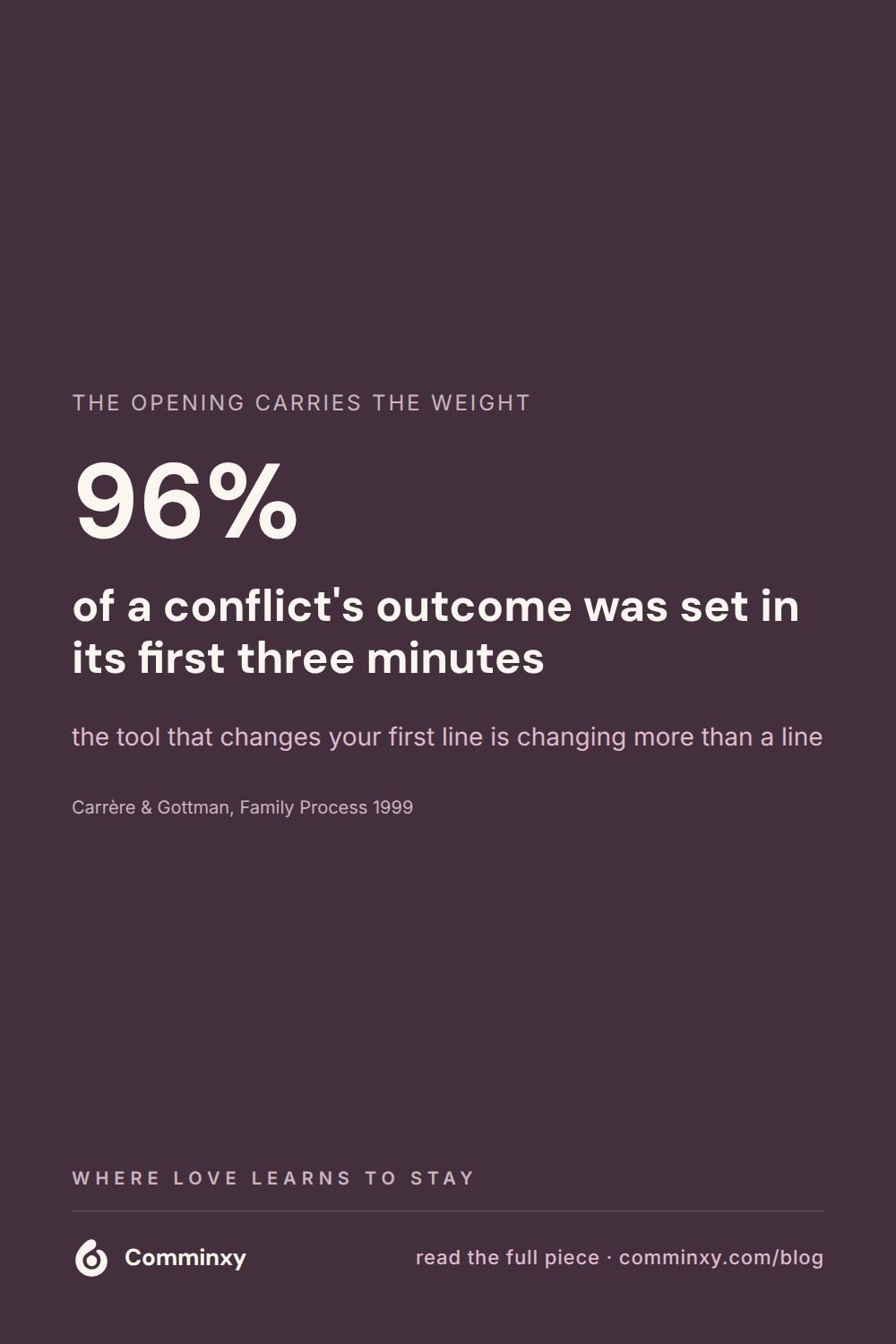
When researchers watched newlywed couples begin a conflict conversation, they found something almost unnerving. The way the discussion started in its first three minutes predicted the outcome of the whole fifteen-minute conversation about ninety-six percent of the time (Carrère and Gottman, Family Process, 1999). How you open decides most of what follows. The first breath of a difficult exchange sets the temperature of everything after it.
That is the thing AI is quietly touching. When it helps you replace a sharp opening with a softer one, it is not just being polite. It is intervening at the exact hinge the research says matters most. A message that begins you never and a message that begins I have been sitting with something send the same person into two different conversations. The tool that changes your first line is changing more than a line.
Which is also why the unease is worth taking seriously rather than dismissing. If the opening carries that much, then handing it to something outside yourself is not a small thing. It is worth noticing what you are handing over, and to whom, and why.
What the machine can reach, and what stays out of its reach
An AI can hear your words. It cannot hear the twenty years, or the two, behind them.
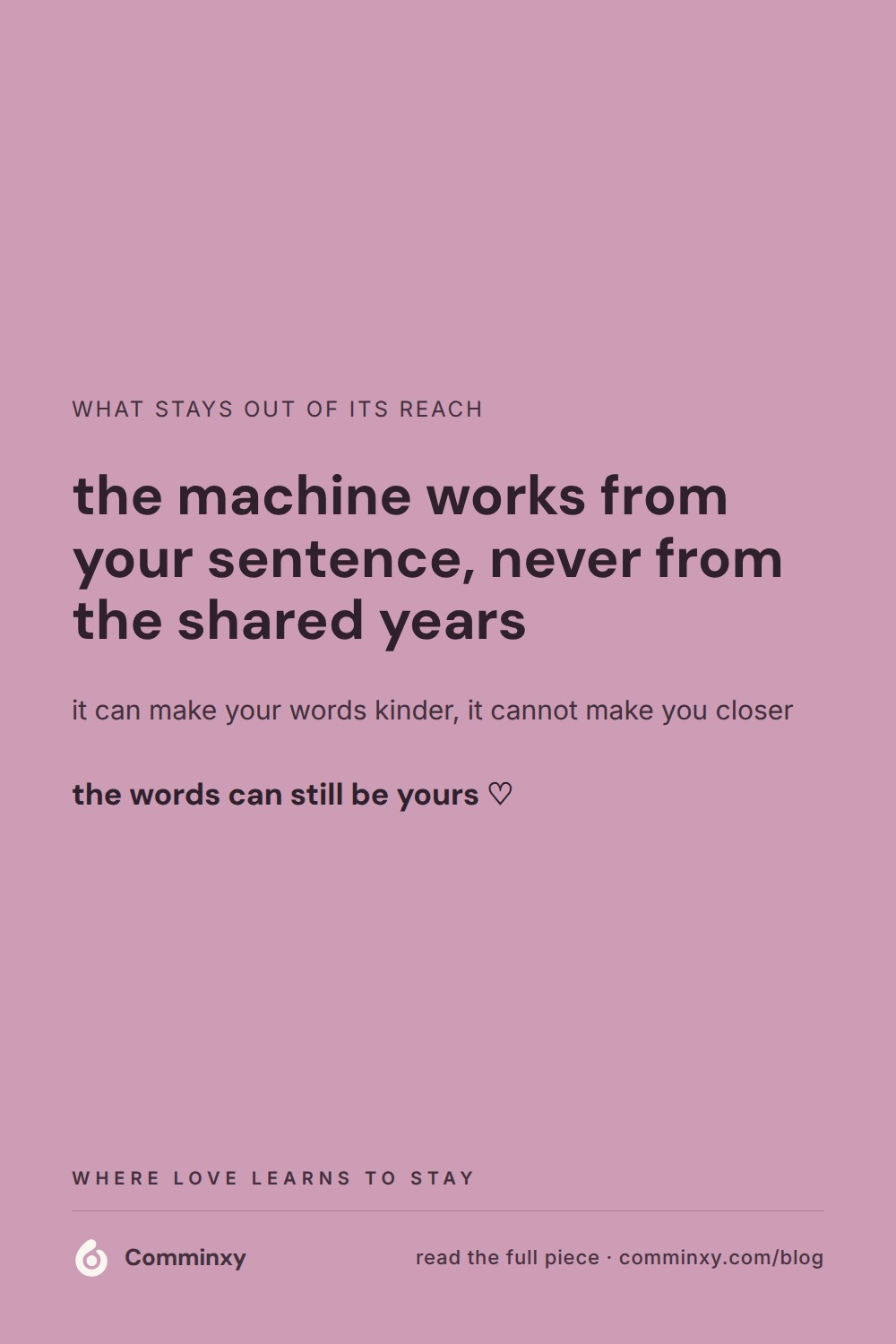
It does not know that fine from your partner means something different at nine at night than it does at nine in the morning. It does not know which apology of yours they have stopped believing, or which one they have never once doubted. When it makes your sentence gentler, it is working from the sentence, not from the history the two of you have built and bruised and rebuilt across a hundred ordinary Tuesdays.
That history is not a small variable. When researchers listened to how couples told the story of their own relationship, the way they narrated it predicted whether they would stay together with striking accuracy (Buehlman, Gottman and Katz, Journal of Family Psychology, 1992). What holds two people together lives in how they hold the shared story, the fondness they still reach for, the moments they choose to remember as us. No tool can write that for you, because it is not made of sentences. It is made of the years you were both there for and the machine was not.
So the help has an honest edge to it. AI can make your words kinder. It cannot make you closer. Those are different jobs, and it is easy, at eleven at night with three polished versions on the screen, to mistake one for the other. If you want to sit with the wider question of what actually keeps couples talking, there is more on why couples stop talking and how to find the way back.
Using the help without disappearing behind it
Here is where the two readings can finally stand together instead of pulling against each other.
The help is not the problem, and hiding inside it is not a moral failure. Most people who reach for it are not trying to deceive anyone. They are trying, at the end of their capacity, to not make things worse. That is a tender thing, not a shameful one. Reaching for a hand when you are about to say something you cannot take back is closer to love than to cheating.
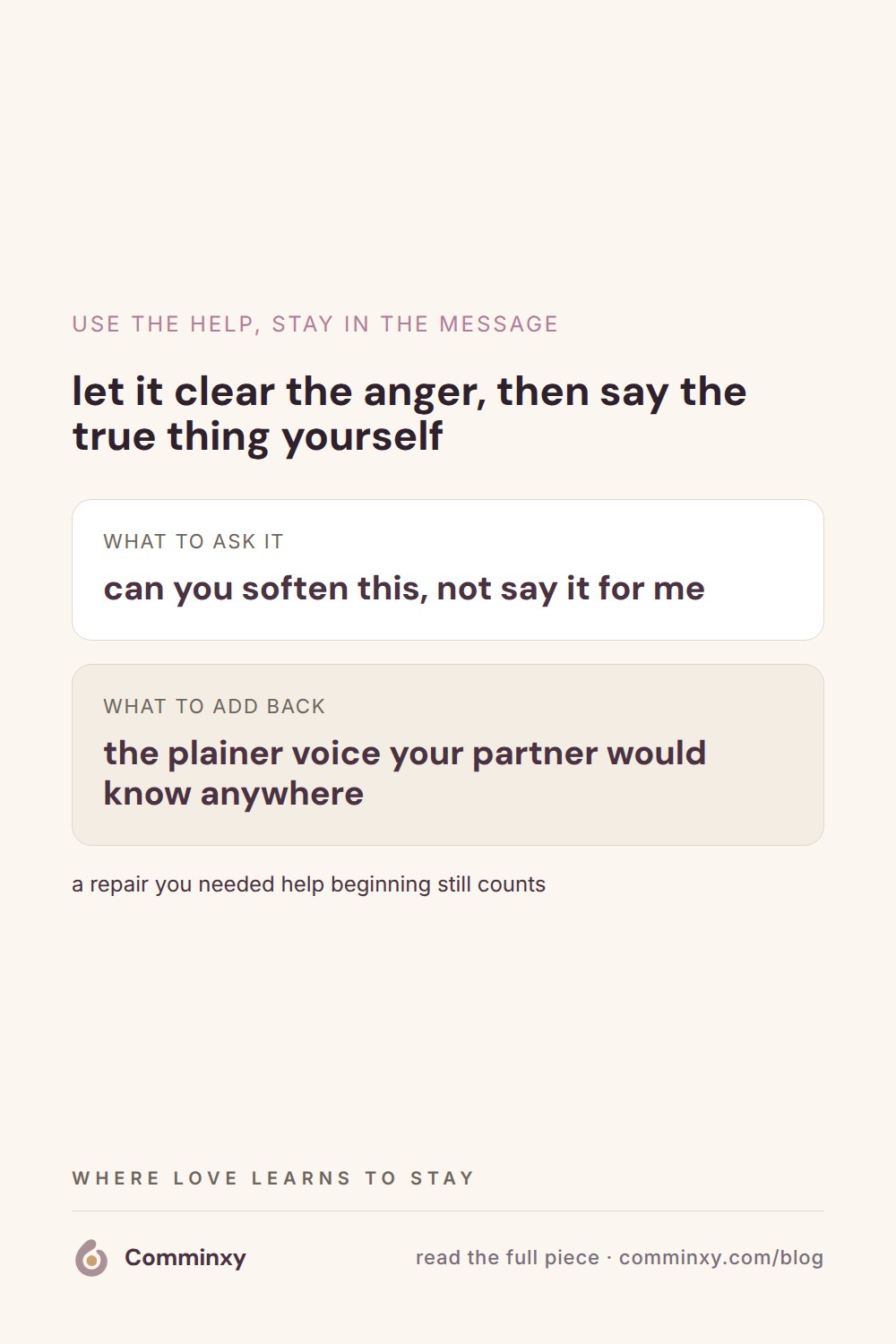
What seems to matter is whether the words still feel like yours by the time they leave. You can let a tool clear the anger out of an opening and still put your own truth back in before you hit send. You can take the version that helped you see what you actually meant, and then say it in your own plainer voice, the one your partner would recognise anywhere. The softness reached the message. You can decide it does not get to replace the person.
And when it does help you say the true thing more gently, that is not something to feel caught out by. A clumsy repair still counts. A repair you needed help beginning still counts. There is no version of this where getting assistance with the hard first sentence disqualifies the care underneath it.
Go back to that screen, three versions glowing, cursor still blinking. Whichever one you send, the relief and the doubt can both come with you, and neither one means you did it wrong. Tools like Comminxy exist for exactly this in-between: not to speak for you, but to help you begin, so the thing you most needed to say has a gentler door to walk through. The words can still be yours. That is where love learns to stay.
Questions people ask
is it wrong to use AI to text my partner?
It is not wrong, especially when you are trying to avoid saying something you cannot take back. The thing that matters is whether the message still feels like your own truth before you send it. Trouble tends to start only when the tool replaces you rather than helping you begin.
should I tell my partner I used AI to write a message?
That depends on your relationship, but honesty usually protects trust more than a perfectly worded message does. If the words are genuinely yours after editing, there is often little to hide. The risk grows when the help does the feeling for you and your partner senses it.
why does how I start an argument matter so much?
How you open a hard conversation sets the tone for everything that follows, and often decides where it ends up. A softer first line sends the same person into a very different exchange than a harsh one. That is why changing your opening changes more than just the words.
can AI actually help a struggling relationship?
AI can help you say something more gently, but it cannot make two people closer, since closeness lives in shared history a tool cannot access. It can be a useful door into a hard conversation. If a relationship is in deep distress, a couples therapist is the right kind of help.
Keep the idea with you — pin it, or download the cards.


Let a gentler opening still carry words that are truly yours
Get Comminxy free →