Why Do I Shut Down During Arguments With My Partner? The Quiet Truth About Overwhelm
The words are still hanging in the air and you have already gone somewhere else. Not out of the room. You are still sitting there, your face arranged into something that looks like listening, but the part of you that forms sentences has quietly stepped out. Your partner is saying your name now, maybe a little louder, asking why you are just sitting there, why you won't say anything, and the louder it gets the further away you drift. Later you will have twenty things you wish you'd said. In this moment, there is nothing. Just a kind of white noise where your voice used to be.
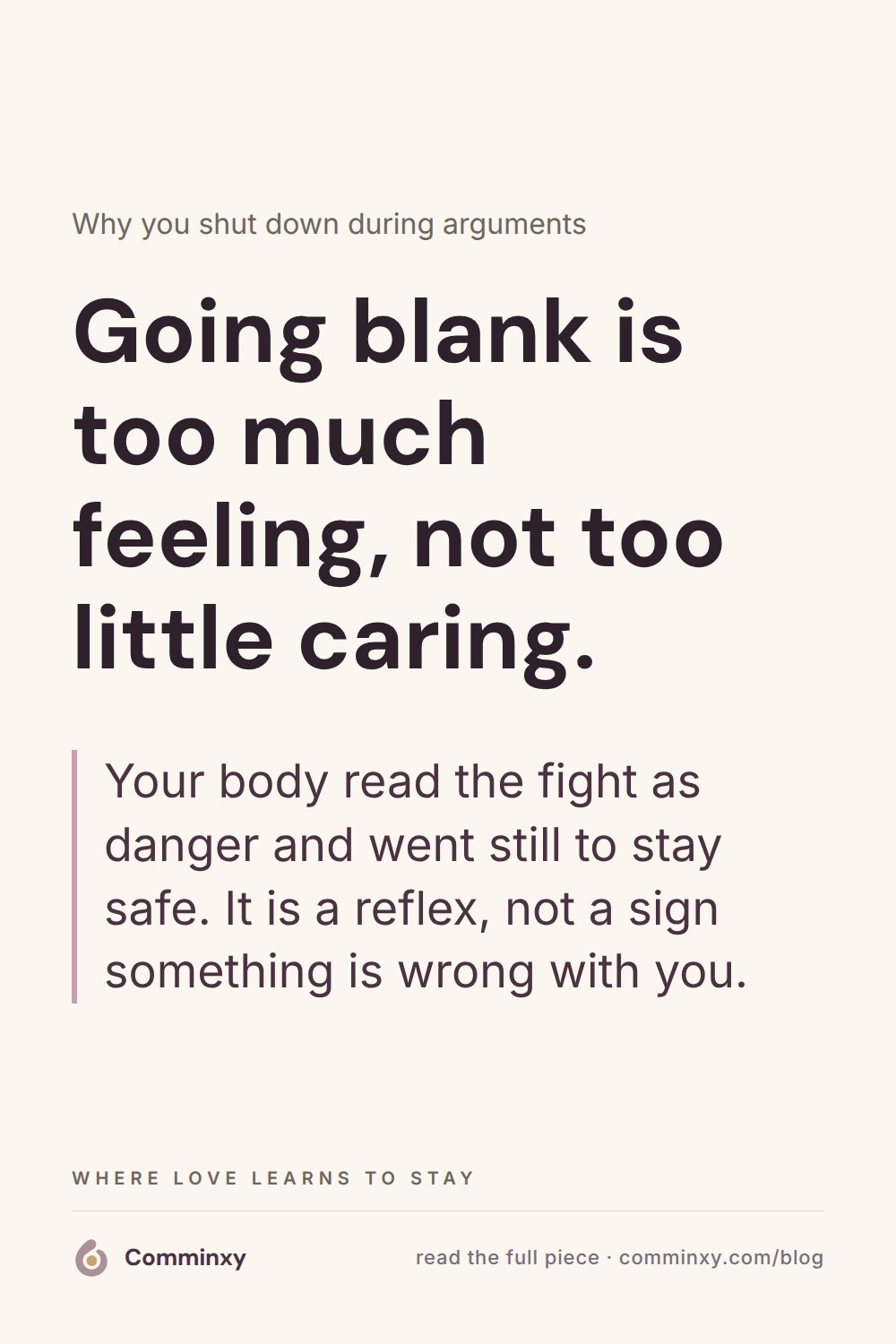
If you want the plain answer before anything else: you shut down during arguments because your nervous system has registered the conflict as a threat and switched into a protective state that makes talking feel impossible, not because you don't care and not because something is broken in you. The going-blank is a reflex, older and faster than any decision you could make. It is trying to keep you safe. It is just using a very old map.
Why you shut down when your partner is upset
The shutting down is not the absence of feeling. It is too much of it.
From the outside, going quiet can look like coldness, like you have checked out, like you don't care enough to fight. Inside, it is often the opposite. Your heart rate is climbing, your thoughts are scattering, and some part of your body has decided the fastest way through is to go still and wait for the danger to pass. Researchers have a word for this flood: physiological overwhelm. When it hits, the brain's capacity for language and problem-solving genuinely dips. You are not refusing to engage. You have, for a moment, lost the equipment to.
Which raises a gentler question than the one you have probably been asking yourself. Not "what is wrong with me that I go blank," but "what did going blank once protect me from." For a lot of people, stillness was the safest thing to be when someone bigger was angry. A child who learns that disappearing ends the shouting is a child who survives it. That learning does not expire. It just shows up decades later in a kitchen, with the person you love, when their voice rises and your whole system decides, without asking you, that the safest move is to vanish in place.
Two ways to read the silence
The hard part is that your partner is living a completely different version of this moment, and both versions are true.
To the person who shuts down, the silence is a brake. It is the only way to stop the car before it goes off the road. You are not withholding. You are managing something that feels like it might otherwise flatten you, and staying quiet is the most you can do.
To the person on the other side, that same silence can feel like a door closing. They reached for you and found a wall. The more they push, the blanker you get, and to them the blankness reads as not caring, as being shut out, as being left alone in the middle of something that matters. So they raise their voice, which to your body is more threat, which makes you quieter, which to them is more abandonment. Both of you are now trapped inside the same loop, each one's protection feeding the other's fear.
Neither reading is the wrong one. You really are overwhelmed. They really are being left. Seeing both at once does not fix the moment, but it does dismantle the story that one of you is the problem. You are two people with mismatched alarm systems, going off at the same time. This is one of the patterns that quietly wears couples down, and it is also one of the most changeable, precisely because it is a pattern and not a verdict on either of you.
How to stop shutting down during arguments
You cannot reason your way out of a flood while you are in it. The thinking part of you is offline. So the work is not about finding the perfect thing to say mid-argument, because in that state there is no perfect sentence waiting to be found. The work is about giving your body a way to signal "I am still here, I just can't do this right now" before the shutdown swallows the words entirely.
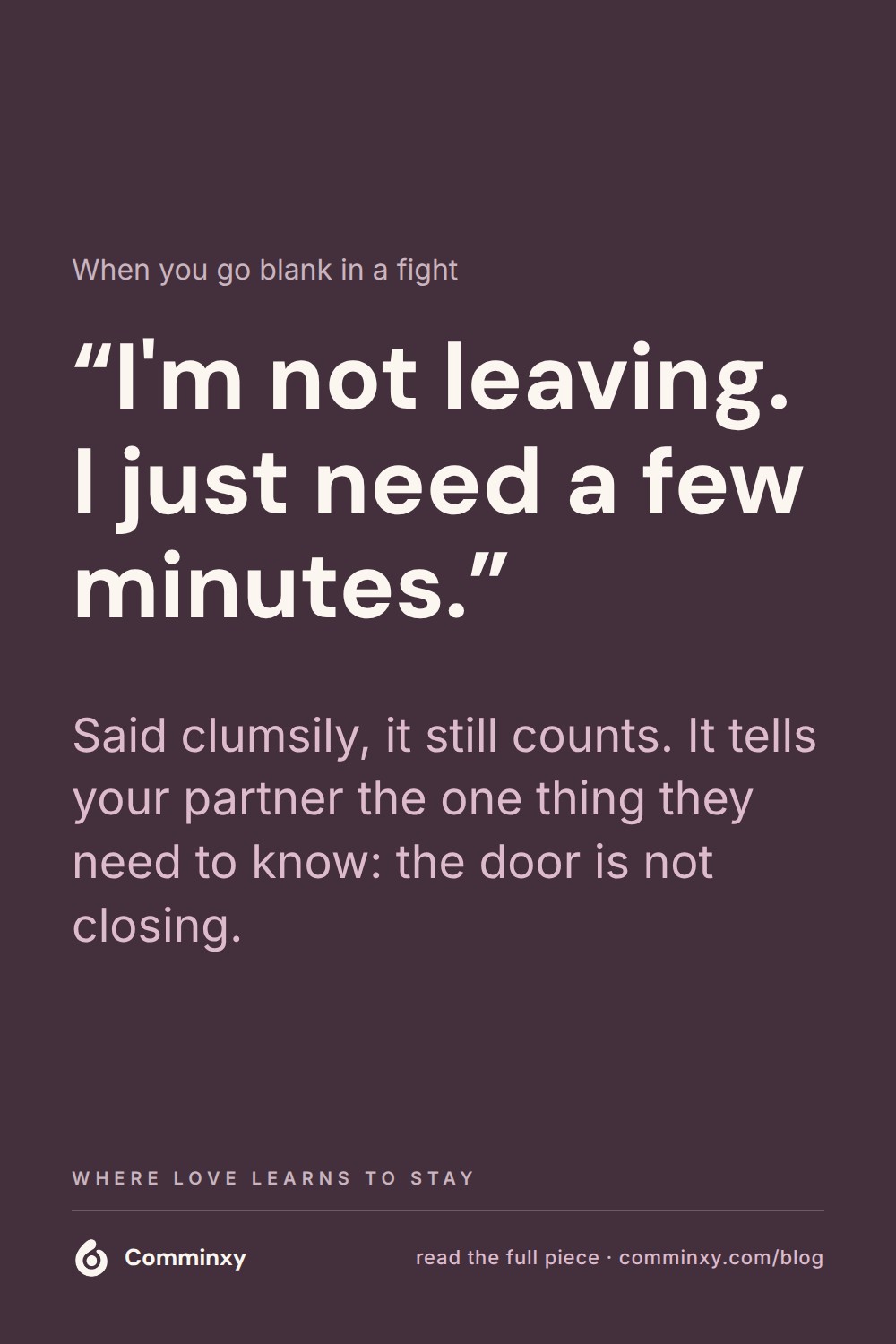
That can be smaller than you think. A hand on their arm. A sentence you agree on ahead of time, when you are both calm, that means pause rather than quit. Something as plain as "I'm not leaving, I just need a few minutes." Said clumsily. Said badly. It still counts. A fumbled signal that you are overwhelmed does more than a flawless silence ever could, because it tells the other person the thing they most need to know: the door is not closing.
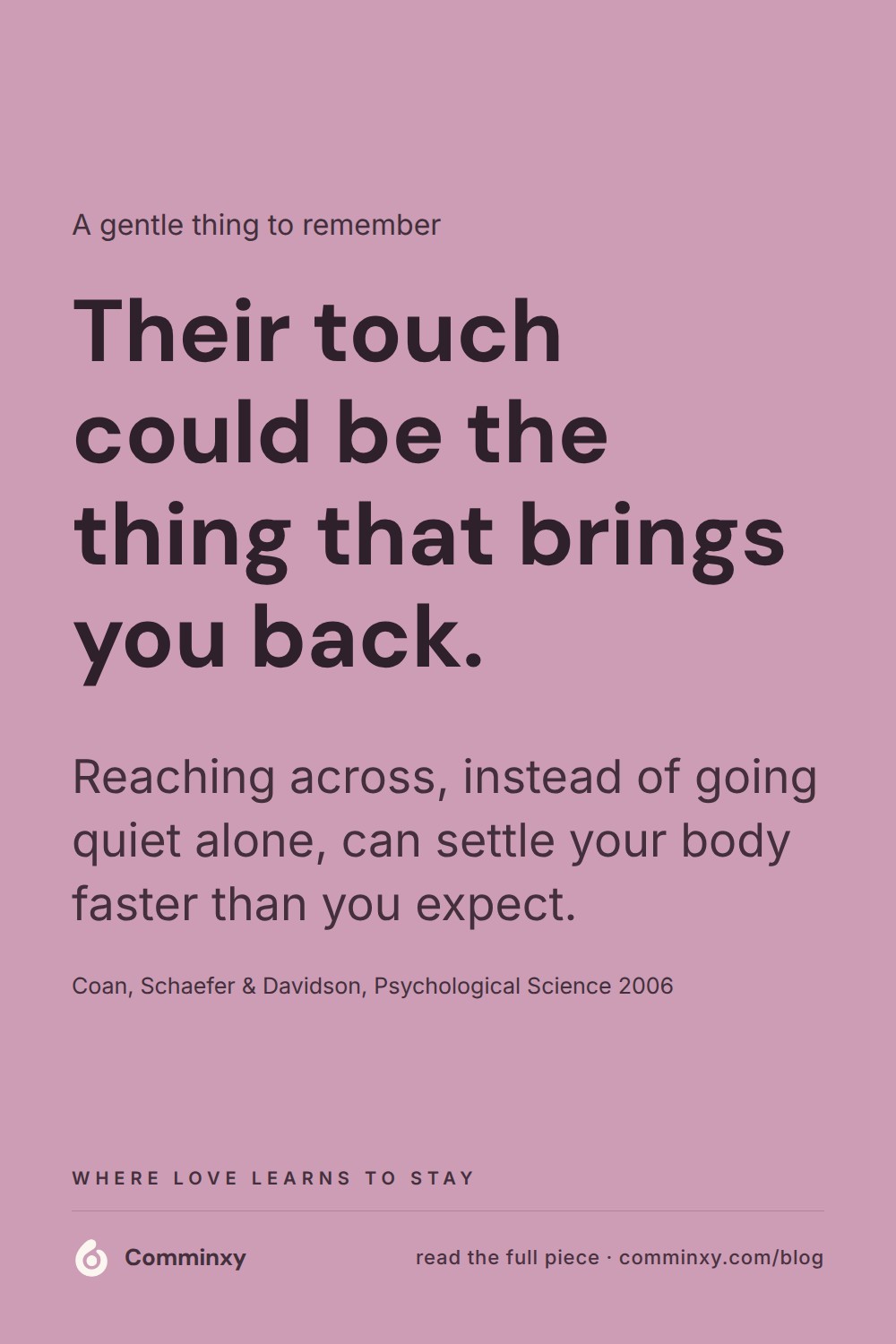
A body can be settled by another body more than most people expect. When women were warned they might receive an electric shock, holding their partner's hand measurably reduced the threat response in their brains, and the effect was stronger in the happier marriages (Coan, Schaefer, and Davidson, Psychological Science, 2006). What that means for an argument is quietly radical. The person whose upset is flooding you may also be the person whose touch could bring you back down. Not always. Not when things are too hot. But often enough that reaching across, rather than retreating inward, is worth trying before the wall goes up.
And the hands do not have to be steady for this to work. You will forget all of it by Thursday. You will go blank again in some argument that matters, and catch yourself halfway down, and only remember the pause five minutes too late. That is not failure. That is what learning a new reflex over an old one actually looks like. Slow, uneven, and real.
What stays after the argument ends
The shutdown has a long tail. Even after the voices drop, you can stay numb for hours, unable to find your way back to warmth, which is often why you shut down after an argument is a separate ache from the argument itself. The other person reads the lingering flatness as more distance. You experience it as a system still coming back online.
This is the part worth naming out loud, to each other, on a calmer day: what the numbness is, and what it isn't. That the quiet was never contempt. That coming back takes you a little longer than it takes them, and that longer is not the same as never. Couples who find their way through this rarely do it by arguing better in the heat. They do it by repairing afterward, in the softer hours, when both nervous systems have finally let go.
Go back to that kitchen. Your name in the air, the white noise where your voice should be, your partner certain you have left them standing there alone. You had not left. You were underwater, and underwater has no words. Comminxy exists for exactly that gap, to help two people name what their bodies are doing in real time so the silence can finally be read for what it is, and not for what it looks like. The blankness was never the end of your caring. It was the shape your caring took when it got scared. That shape can soften. It is already softening, a little, in you reading this at all. Love stays not in the arguments you win, but in the moments you come back.
Questions people ask
why do i shut down during arguments with my partner
Because your nervous system reads the conflict as a threat and flips into a protective state that makes talking feel impossible. It is a reflex meant to keep you safe, not a sign you don't care or that something is wrong with you. In that flooded state your capacity for language genuinely drops.
why do i shut down when someone yells at me
A raised voice can register to your body as danger, especially if going quiet once ended the shouting when you were younger. Your system chooses stillness as the fastest way through, often before you can decide anything. The louder it gets, the further you tend to drift.
how to stop shutting down during arguments
Agree on a simple pause signal when you are both calm, something that means I need a few minutes, not I am leaving. You cannot reason your way out mid-flood, so the goal is signaling you are still there before the words vanish. Expect it to come out clumsy and late at first, which is normal.
why do i stay numb for hours after an argument
Your nervous system is still coming back online, which usually takes longer than the argument itself. The flatness you feel is a system resetting, not lingering contempt, even though a partner may read it as more distance. Naming this to each other on a calmer day can help.
Keep the idea with you — pin it, or download the cards.


The two of you may need opposite things in that moment. Take the two minute repair quiz and send it to your partner, to see how your two ways fit together.
Help each other read the silence for what it really is
Get Comminxy free →