Why Couples Fight About Small Things When Its Never Really About the Dishes
The wet towel was on the bed again. Not folded, not hung, just dropped where it landed, soaking a dark patch into the duvet you had both climbed out of an hour before. And something in you tightened, out of all proportion, hot and immediate, the kind of anger that arrives too fast to be about a towel. You said something sharper than you meant. They looked at you like you had lost your mind. Maybe you had, a little. Because you knew, even as it came out of your mouth, that this was not really about the towel.
Why couples fight about small things is one of the most quietly confusing parts of loving someone. You are not a petty person. You do not, in general, care about laundry with this much feeling. And yet here you both are, standing over damp cotton, further apart than the fight seems to warrant.
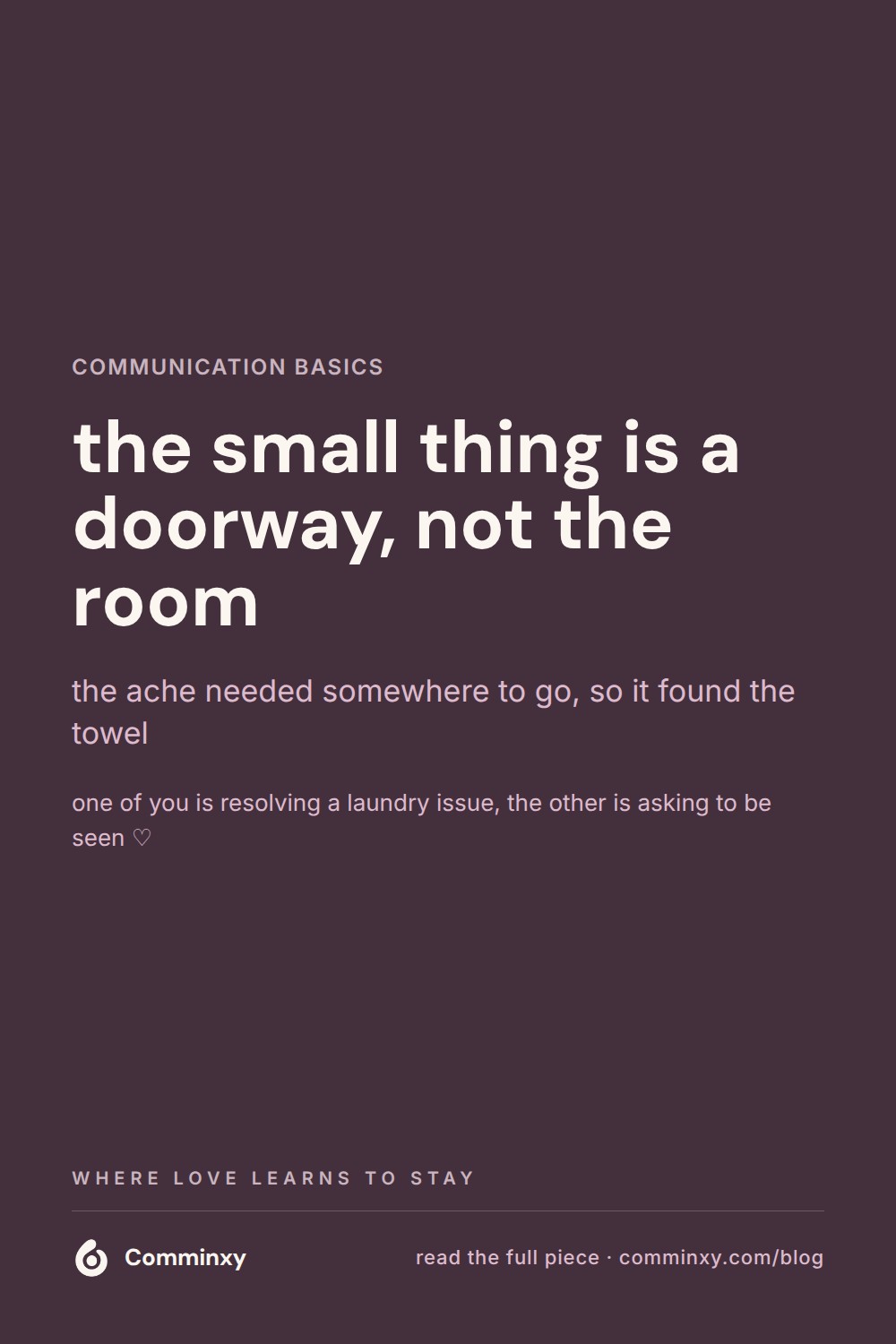
The small thing is a doorway, not the room
The towel is real. The tightening in your chest is real. But if you follow the feeling back, past the towel, it usually leads somewhere older and less convenient to say out loud.
Underneath most small fights is a large question, and the question is almost always the same one, in different clothes. Do you see how much I am carrying? Do I matter to you when it is not convenient? Am I in this alone? The towel is just the nearest object to hand when that question goes unanswered for the fifth time this week. It becomes the place the ache lands, because the ache needed somewhere to go.
This is why the argument feels strangely unwinnable. One of you is trying to resolve a laundry issue. The other is asking, without the words for it, to be reassured that they are not invisible. Those two conversations cannot meet. They are not even happening in the same room.
Your body decided before you did
There is a reason the anger arrives before the thought. Long before you have consciously named what bothers you, your nervous system has already registered the pattern and started bracing.
Gottman and Levenson, tracking couples' heart rates and stress responses during conflict, found that physiological arousal, the flood of the body going into alarm, is one of the clearest lines between couples who stay steady and couples who slide into decline (Gottman and Levenson, Journal of Personality and Social Psychology, 1992). Once that flood hits, the part of you that could have said something generous is more or less offline. You are not choosing your worst response. You are reacting from a body that already thinks it is under threat.
So when you snapped over the towel, you were not being unreasonable for no reason. Your system had been quietly keeping a tally, and the towel tipped it. The tragedy of the small fight is that it looks like the whole problem when it is only the last straw made visible.
What the first three minutes are really carrying
Here is something that reframes the whole thing. It is not the size of the disagreement that shapes where it goes. It is how the two of you enter it.
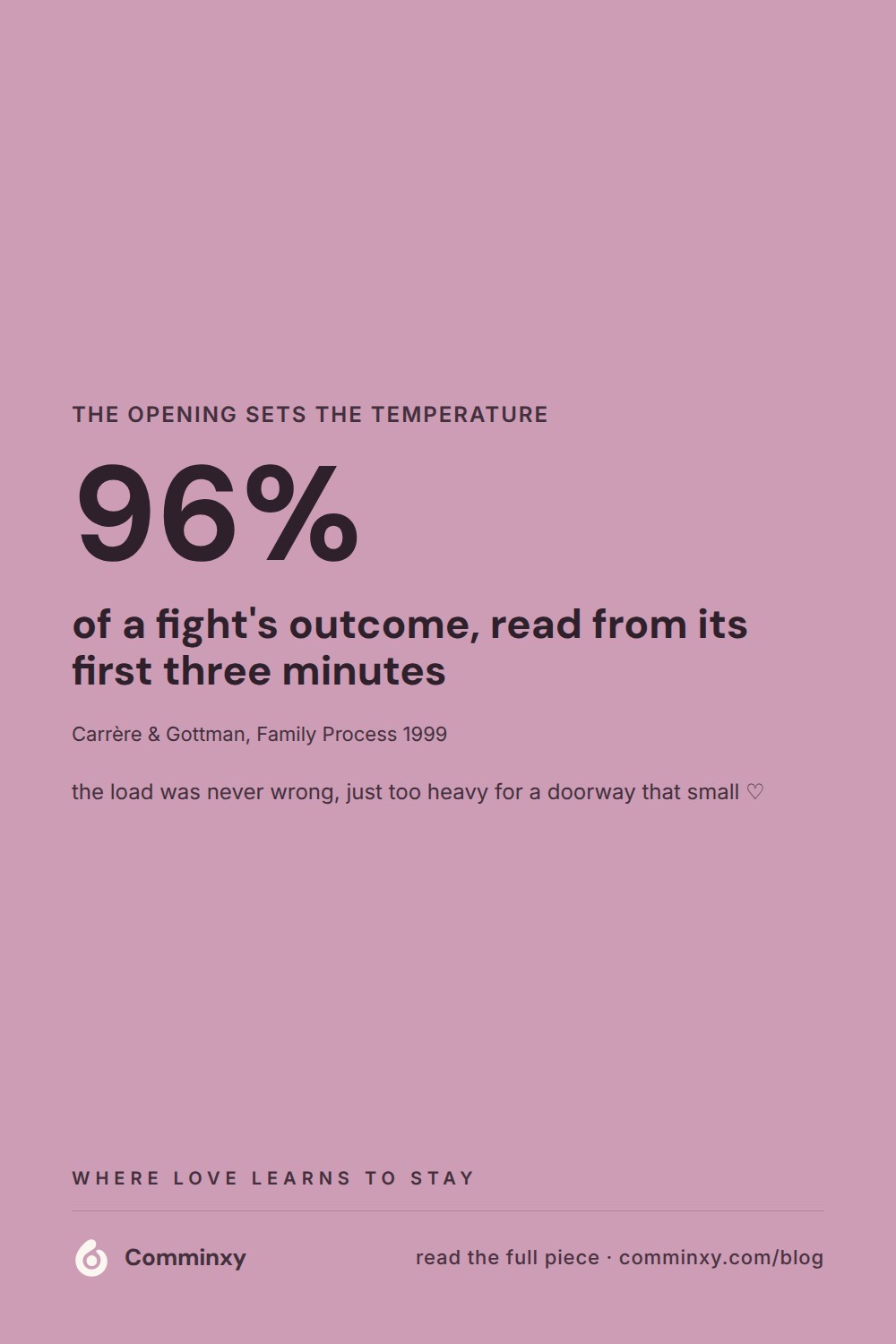
Carrère and Gottman found that they could predict the outcome of a fifteen-minute conflict conversation from just its first three minutes, with startling accuracy, around ninety-six percent of the time (Carrère and Gottman, Family Process, 1999). The opening sets the temperature, and the rest tends to follow.
Sit with what that means for the towel. If you come in with the accumulated weight of every unnoticed thing behind your voice, the fight is already half decided before either of you has said anything true. Not because you are bad at this. Because you were carrying so much into a doorway that small. The load was never wrong. It was just too heavy for the towel to hold.
None of this means you have to open perfectly. Nobody does. But it does mean the small thing deserves a smaller entrance than the giant feeling underneath it, and that gap is worth knowing about.
Saying the real thing, badly, on purpose
The way back is not a better argument about laundry. It is naming the question that was actually knocking.
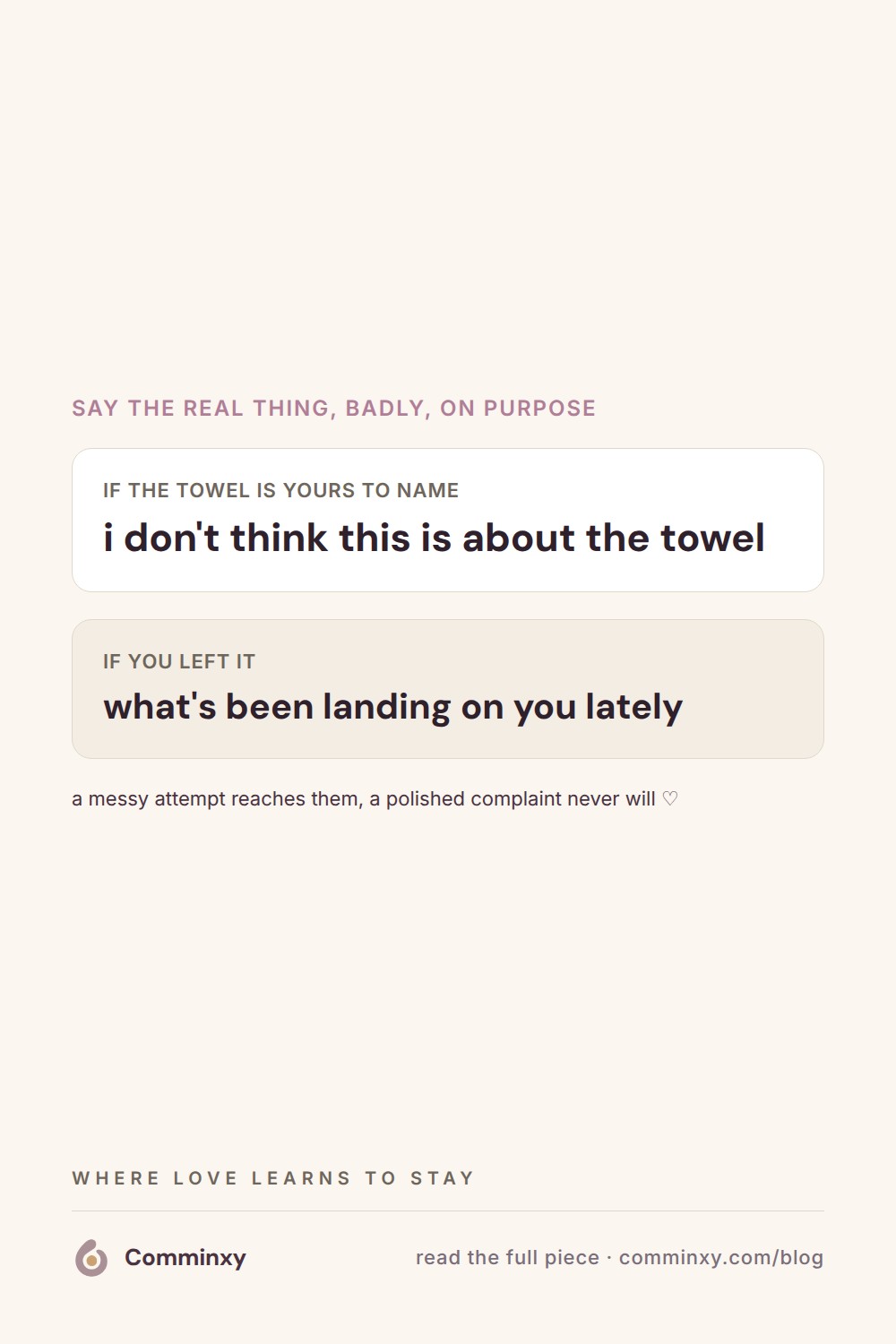
That might sound like putting the towel down for a second and saying, out loud, the unglamorous truth. I don't think this is about the towel. I think I've been feeling like I'm holding everything and nobody sees it, and the towel was just where it landed. Clumsy. Vulnerable. Probably said with a shake in your voice. It will not come out clean, and it does not need to. A messy attempt at the real thing reaches your partner in a way a polished complaint about housework never will.
And if you were the one who left the towel, the way in is different but no smaller. It is hearing the disproportion not as an attack but as information. The size of their reaction is telling you how long they have felt alone in this. You can reach for that instead of defending the towel. I don't think you're really angry about a towel. What's been landing on you lately? That question, offered gently, can turn a fight into the first honest conversation you have had in weeks. If defensiveness is where you both tend to go, it is worth understanding why the softest opening can still set someone off, because that reflex is rarely about the words.
You will forget all of this by Thursday. You will snap at something small again, and feel the flood come, and only realise afterward what it was really about. That is not failure. That is what it looks like to be two tired people learning a slower way of reaching each other, one imperfect attempt at a time.
What changes when the small thing gets small again
Something quiet happens when a couple learns to hear the question under the complaint. The towels do not necessarily get folded better. But they stop carrying so much. The laundry becomes laundry again, because the real conversation has somewhere else to go now, somewhere that is not the bedroom floor.
You start to catch it earlier, sometimes. The heat rises over something tiny, and instead of following it all the way down, one of you says, wait, what is this actually about. Not every time. You are human. But often enough that the small things stop standing in for the large ones, and the large ones finally get spoken while they are still small enough to hold.
That damp patch on the duvet was never the problem. It was a person asking to be seen, using the only object within reach. The next time it happens, and it will, you might be able to look past the towel to the question underneath, and answer that instead. Comminxy was built to help you catch that question in the moment, before it hardens into a fight, so the smallest things stay small and the true thing gets said while there is still warmth in the room. That is where love learns to stay: not in never fighting about the towel, but in finally understanding what the towel was trying to say.
Questions people ask
why do me and my partner argue over the stupidest things
Because the small thing is usually standing in for something bigger that has gone unspoken. The dishes or the towel become where a built up feeling lands, since it needed somewhere to go. If you follow the anger back, it often leads to a deeper question about feeling unseen or alone.
why do i get so angry over tiny things with my boyfriend
Your nervous system often reacts before your conscious mind catches up, so the anger arrives faster than the thought. Small irritations pile up quietly, and one tiny thing tips the whole tally over. The reaction feels out of proportion because it is carrying everything that came before it.
how do i stop small arguments turning into big fights
Try to catch the moment the heat rises and ask what the fight is actually about before following it down. Naming the real feeling, even clumsily, gives the argument somewhere honest to go. If the same painful patterns keep repeating no matter what you try, a couples therapist can help.
is it normal to fight about chores in a relationship
Yes, it is very common, and the chore is rarely the whole story. Fights about housework often carry a hidden question about whether one person feels alone in the load. When that question gets heard, the chore tends to become just a chore again.
Keep the idea with you — pin it, or download the cards.


Catch the real question before it hardens into a fight over the towel
Get Comminxy free →