What Predicts a Happy Marriage: What Decades of Data Actually Reveal
For decades, researchers went looking for the thing that separates the marriages that last from the ones that come apart, and the answer they kept finding was not the one most people expect. When you ask what predicts a happy marriage, the mind reaches for the obvious suspects. How often a couple fights. Whether they share values. Money, sex, the in-laws, the division of the housework. Those things matter. But when the numbers are laid out across thirty years of study, the strongest predictors turn out to be quieter, less dramatic, and much closer to something you can actually reach.
What follows is not a scorecard. Nobody has ever loved another person by getting the metrics right. But there is real relief in knowing which things carry weight and which things only feel like they do at two in the morning.
Boredom does more damage than conflict, and it does it slowly
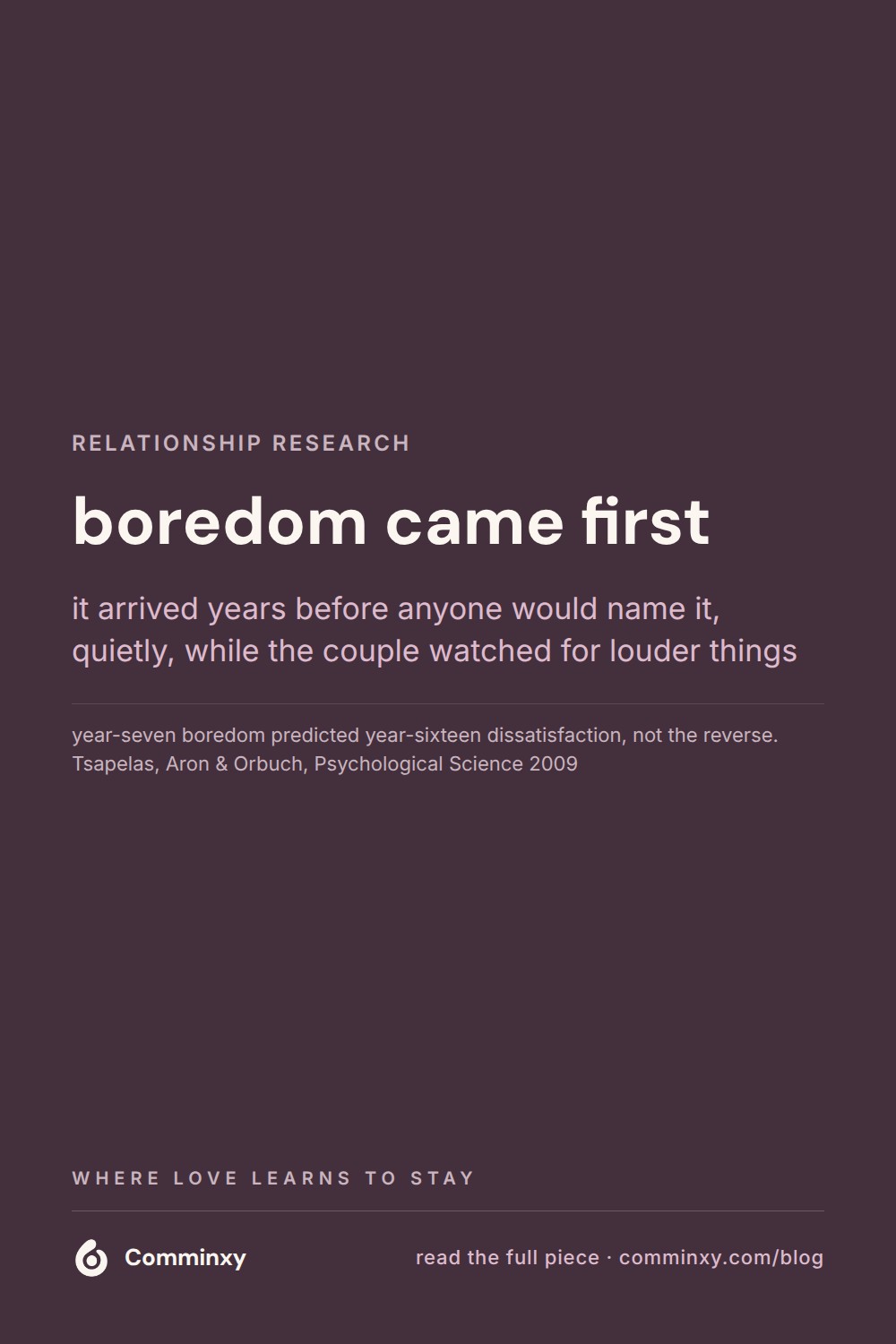
Here is something that unsettles the usual story. Researchers followed married couples over nine years and tracked two separate things: how bored they felt, and how satisfied they felt. Boredom at year seven predicted dissatisfaction at year sixteen. The reverse was not true. Feeling dissatisfied at year seven did not predict boredom later (Tsapelas, Aron, and Orbuch, Psychological Science, 2009).
Sit with the direction of that for a second. Boredom came first. It arrived quietly, years before anyone would have named a problem, and it did its work in the background while the couple was busy watching for louder things.
Most people brace for the fight. They think the danger is the argument that goes too far, the sentence that cannot be taken back. Those moments are real and they hurt. But the flat stretch, the sense that nothing new happens between you anymore, that you could narrate each other's next sentence, that turns out to be the thing worth paying attention to sooner. Not because it is a crisis. Because it is so easy to live inside without noticing.
The thing that holds people together is smaller than a grand feeling
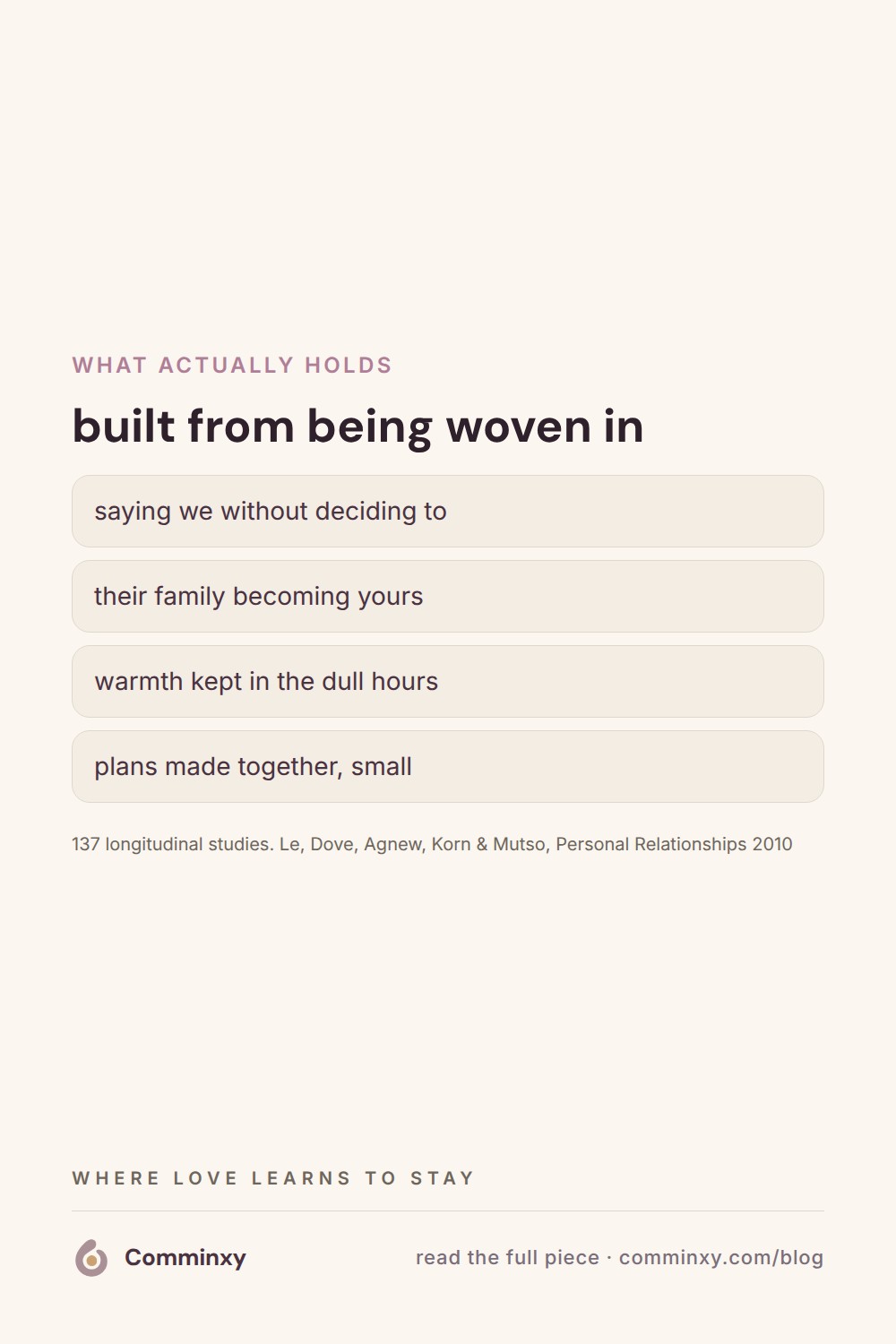
A meta-analysis pulled together 137 longitudinal studies spanning three decades to find what actually predicts whether a relationship dissolves. The strongest predictors were commitment, love, dependence, and something with an awkward clinical name: inclusion of the other in the self, meaning the degree to which your partner has become part of how you understand who you are (Le, Dove, Agnew, Korn, and Mutso, Personal Relationships, 2010).
That last one is worth slowing down on. It is not a feeling you generate on a good night. It builds from the ordinary overlap of two lives. The way their family becomes your family. The way you catch yourself saying "we" without deciding to. The inside references nobody else would understand. It grows in the accumulation of shared days, and it is quietly one of the things holding the whole structure up.
Which is oddly hopeful. It means the marriages that last are not built from constant high feeling. They are built from being woven in. If some of that weave has come loose, the repair is not a dramatic rekindling. It is the slow rebuilding of shared texture, one real conversation, one plan made together, at a time.
How you start a hard conversation predicts more than how you finish it
When couples sat down to discuss a point of conflict, researchers found they could predict, with striking accuracy, which marriages would remain stable and which would end, just from the first few minutes of that conversation. The opening set the whole trajectory (Carrère and Gottman, Family Process, 1999).
The first minutes. Not the resolution, not who was right, not whether the issue got solved. The way one person turned toward the other to begin.
You know the difference in your own body. There is the version where you walk in already sharpened, where the first sentence carries the weight of everything that came before it. And there is the version where you name the hard thing while keeping the person in front of you. The words can be clumsy. The tone can wobble. What seems to matter is whether the opening says you and I have a problem rather than you are the problem. If that distinction feels difficult to hold when you are hurt, it is. Nobody does it cleanly. There is more on the shape of those first moments in how to communicate better with your partner, if it helps to see it laid out.
Nobody keeps this weave alive by accident
There is a quiet assumption underneath a lot of unhappy marriages: that a good relationship, once built, mostly holds itself up. The research points the other way. Studies of what keeps relationships healthy identified a handful of ordinary behaviours couples actually do, and found they accounted for a large share of the difference between the relationships that flourished and the ones that thinned out (Stafford and Canary, Journal of Marriage and the Family, 1991).
What stands out is how unglamorous they are. Small assurances that you are in this. Staying open about what is actually going on inside you. Keeping the tone warm even in the dull hours. Sharing the running of a life without keeping score. None of it is the stuff of anniversaries. All of it is the stuff of Tuesdays.
The reason this matters for a tired person is that it takes the pressure off the big gesture. You do not have to engineer a transformation. The marriages that stay happy are maintained in the small, repeatable turns toward each other, the ones that feel too minor to count. They count.
What the data cannot tell you
All of this describes patterns across thousands of couples. It does not describe yours specifically, and it was never meant to. The research can tell you that boredom creeps and that beginnings matter and that being woven in holds. It cannot tell you what your particular marriage needs on a Thursday when one of you is exhausted and the other feels unseen.
That gap is not a failure of the science. It is the space where the actual relationship lives.
If there is one thing worth carrying away from decades of data, it is this: the things that predict a happy marriage are almost all things you can still reach for. Boredom answers to newness. Distance answers to being let back in. A sharp beginning can be softened by the next one. None of it requires you to have done it well so far. It only asks whether you are willing to turn toward the person again now, however clumsily, and begin.
That turning is quiet work, and it is easy to lose track of whether you are still doing it. Comminxy was built to sit alongside that, to help two people notice the small turns toward each other before the flat stretch settles in. The predictors are not a verdict on what you have built. They are a map of the ways back. And love, it seems, does not stay because it was made perfectly. It stays because someone keeps choosing, on ordinary days, to reach.
Questions people ask
what actually keeps a marriage happy long term
The strongest factors are commitment, love, and how deeply your partner is part of your sense of self. These build slowly through shared days rather than big romantic moments. Everyday warmth and small assurances turn out to matter more than dramatic gestures.
is being bored in my marriage a bad sign
Boredom is worth paying attention to because research links it to dissatisfaction years down the line. It tends to creep in slowly and can go unnoticed while couples watch for louder problems. The good part is that boredom responds to newness and shared experiences you can still create together.
why do my arguments with my spouse go so badly
How a conflict conversation starts often shapes where it ends up more than how it finishes. Opening with the sense that you both share a problem tends to go better than opening as if the other person is the problem. If arguments regularly turn hostile or leave you feeling unsafe, talking with a couples therapist can help.
can a marriage get better after growing distant
Yes, distance can often be rebuilt through small repeated steps rather than one big reconciliation. Real conversations, plans made together, and ordinary moments of turning toward each other slowly restore shared closeness. It usually happens gradually rather than all at once.
Keep the idea with you — pin it, or download the cards.


Notice the small turns toward each other before the flat stretch settles in
Get Comminxy free →