How to Stop Interrupting Your Partner and Finally Hear What They Mean
The interruption almost always arrives before the thought is finished. Your partner is halfway through a sentence, and you already know where it is going, and some part of you leaps ahead to meet it. You finish their line for them. Or you correct one detail. Or you have your answer loaded and waiting, and the moment there is a gap you fire it in. If you have been trying to stop interrupting your partner and cannot work out why it keeps happening even when you swear you will not, there is something worth understanding first, and it has almost nothing to do with rudeness.
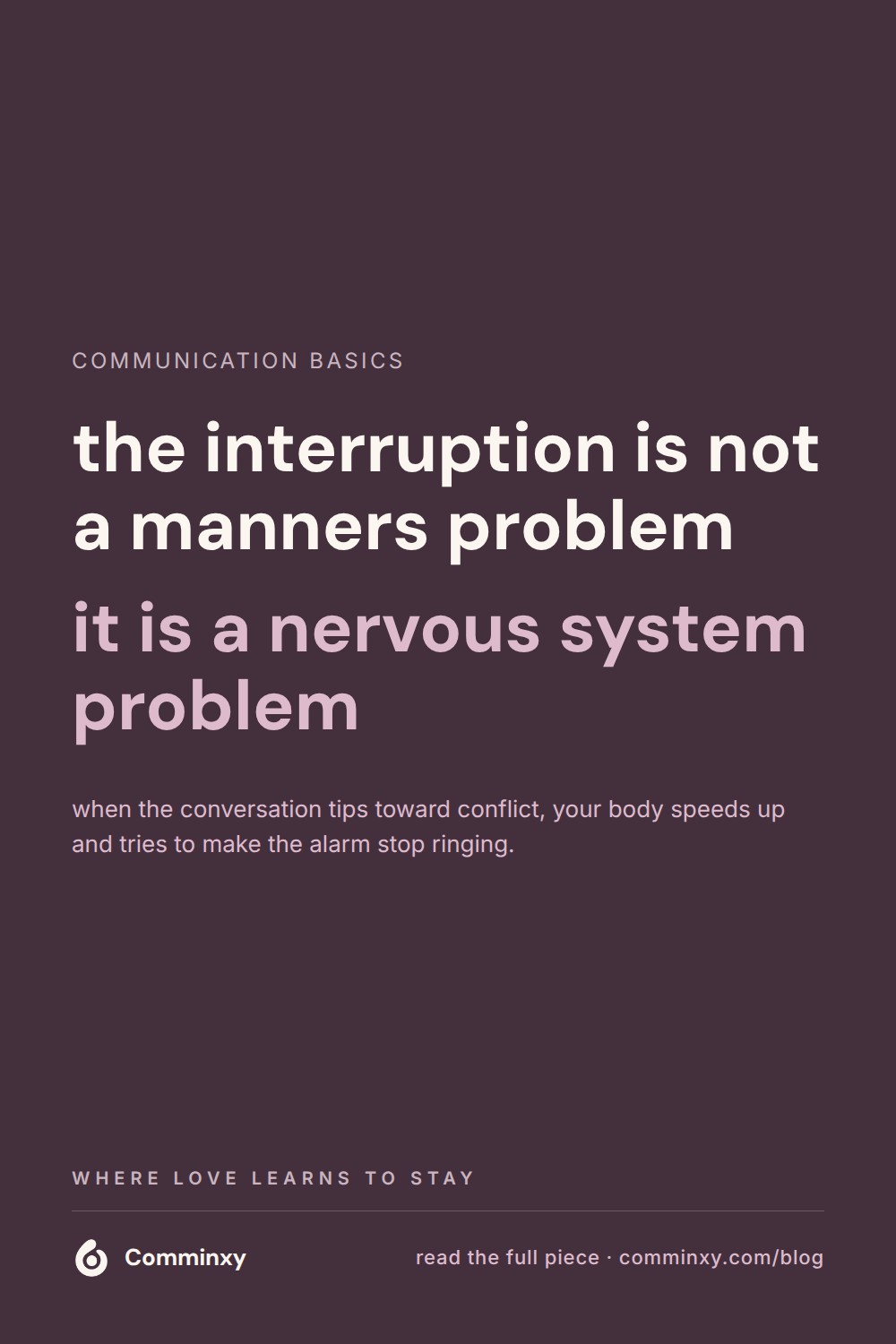
The interruption is not a manners problem. It is a nervous system problem.
What is actually happening in your body when you cut them off
When a conversation with someone you love starts to tilt toward conflict, your body registers the shift long before your mind catches up. Heart rate climbs. Attention narrows. The part of you built for threat comes online, and it is not interested in nuance. It wants the discomfort to stop.
Gottman and Levenson spent years tracking exactly this, wiring couples up and watching their autonomic nervous systems light up during disagreement. They found that physiological arousal, the flooding of the body during conflict, is one of the things that separates couples who stay steady from couples who slide toward decline (Gottman and Levenson, Journal of Personality and Social Psychology, 1992).
What that means in the kitchen, or the car, or the ten minutes before you both fall asleep, is that the interruption is a small act of self-protection. When you are flooded, listening feels dangerous. Their sentence feels like it is building toward something you will have to defend yourself against, so you get there first. You are not trying to silence them. You are trying to make the alarm stop ringing in your own chest.
Why finishing their sentence feels like helping
Sometimes the interruption does not feel like defence at all. It feels like closeness. You know this person. You know how they take their tea, which cousin they cannot stand, what they are about to say because you have heard the shape of it a hundred times. Filling in their words can feel like proof of how well you know them.
The trouble is what it does on the other side. When someone is cut off mid-thought, again and again, they slowly stop bringing you the unfinished ones. The tentative feelings, the ideas that arrive half-formed, the things they were only just working out as they said them. Those are exactly the parts that need room to breathe.
There is research on how intimacy actually gets built between two people, and it is quieter than most of us imagine. Laurenceau and colleagues found that closeness grows through a specific loop: one person discloses something, and the other responds in a way that makes them feel understood. The whole thing hinges on feeling that your partner heard you and got it (Laurenceau, Barrett and Pietromonaco, Journal of Personality and Social Psychology, 1998).
An interruption breaks that loop at its most fragile point. Not because you did not care. Because you cared enough to answer before you had finished receiving.
The gap you are so afraid of
Most interruptions live inside a very short window. There is a pause, a half-second where your partner is finding the next word, and that pause feels unbearable. So you fill it. The silence between their sentences reads, to a flooded body, like a space where something might go wrong.
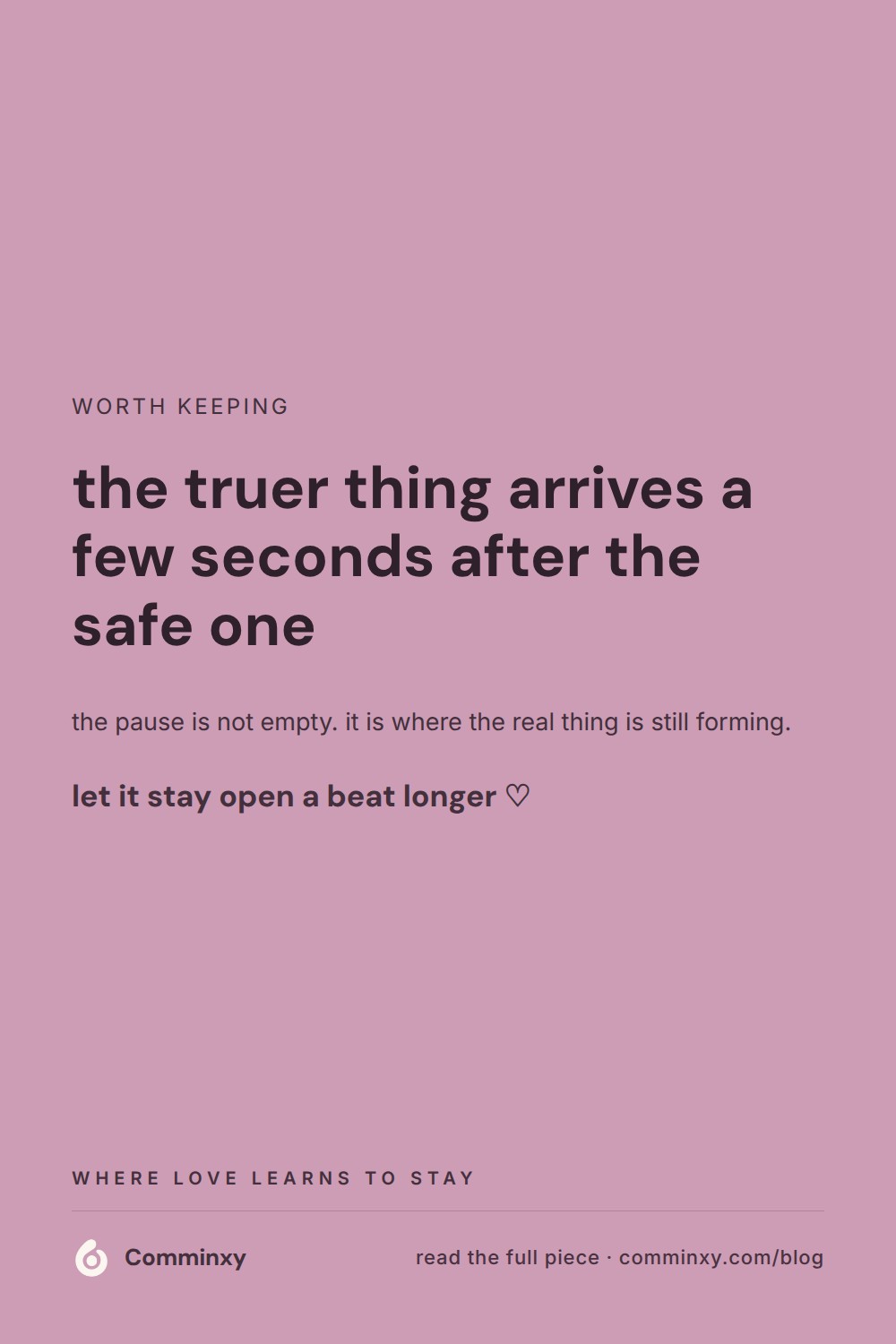
That gap is not empty. It is where the real thing is often still forming. People say the safe version of what they mean first, and then, if the room stays open, they say the truer one. I'm annoyed about the weekend becomes, three seconds later, I think I felt left out. But only if the three seconds are allowed to exist.
Learning to leave that gap is one of the hardest small skills in a relationship, and nobody does it cleanly. You will manage it on a Tuesday and blow straight through it on a Wednesday. That is not failure. That is what changing a reflex looks like from the inside.
How to hear what they mean, not just what they said
Since the interruption starts in the body, that is where the way back begins too. Before the words, before the technique, there is the simple act of noticing the moment your chest tightens and you feel the leap coming. Just catching it. Not stopping it every time, only seeing it.
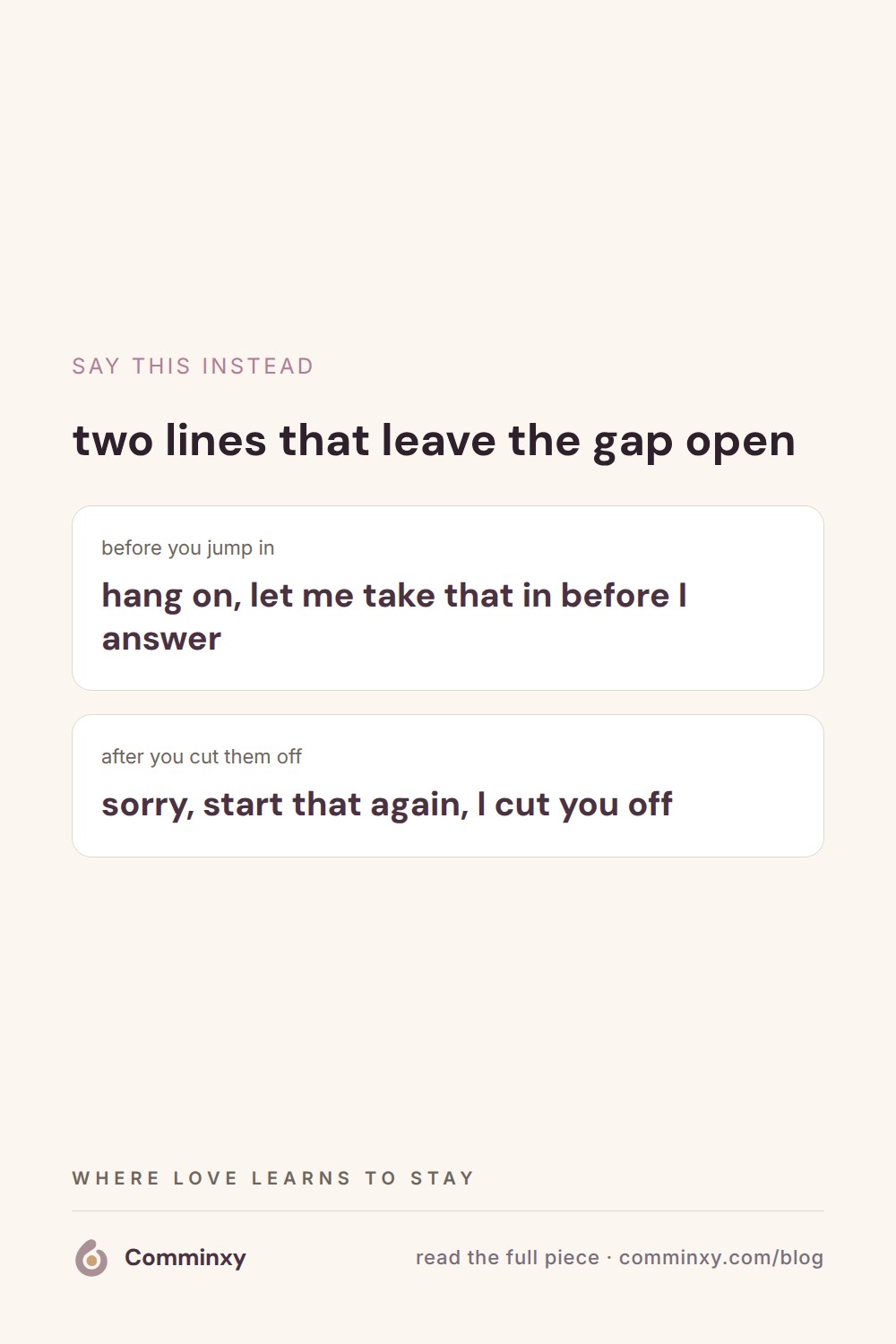
Then, one breath. Not to calm down into sainthood, just to buy your slower self a second to arrive. Some couples find it helps to say the thing out loud: hang on, let me actually take that in before I answer. It sounds clumsy. Clumsy is fine. Clumsy is often better than smooth, because it tells your partner you are trying, and trying is the part they can feel.
And when you do lose it, when you talk over them again and see their face close a little, the repair is smaller than you think. Sorry. Start that again, I cut you off. Six words. It hands the floor back. It says the gap is theirs again. This is the same muscle underneath so much of what makes two people able to keep communicating well over years, the willingness to hand a moment back once you have taken it.
The goal was never to become a person who never interrupts. Nobody is that person. The goal is to become a person who notices, and comes back, and lets the sentence finish the second time.
What listening actually gives them
When someone finally gets to finish a thought in front of you, something in them settles. You can see it. The shoulders drop half an inch. The voice loses its rush. They stop bracing for the moment you take over, because it did not come.
That settling is not only theirs. A conversation where nobody is being cut off is a conversation where two nervous systems slowly stop treating each other as a threat. The listening does the soothing. Not the agreement, not the solution, just the staying-put while they reach the end of themselves.
So the next time their sentence trails off and you feel that familiar pull to jump in, you might remember that the pause is not a problem to solve. It is the door they were about to walk further through. Let it stay open a beat longer. Comminxy exists for exactly these small, hard moments, the ones where you feel the old reflex rising and want, this time, to do it a little differently, because those are the moments where love learns to stay.
Questions people ask
why do i keep interrupting my partner even when i try not to
Because interrupting is often an automatic stress response, not a choice you are making on purpose. When a conversation tips toward conflict your body speeds up and tries to end the discomfort fast, which shows up as talking over them. Noticing the pull before you act on it is where change slowly starts.
how do i stop finishing my partners sentences
Start by catching the moment you feel the urge to jump in and let one breath pass before you speak. It helps to leave the small pause where they are still finding their words, since that gap is often where their real point forms. You will not do it perfectly, and that is normal.
is interrupting a sign i dont respect my partner
Not usually. Most interrupting comes from anxiety or from feeling you already know what they mean, rather than from disrespect. What matters more than never slipping up is whether you notice, apologise, and hand the conversation back.
what do i say after i talk over my partner
A short honest acknowledgement works better than a long explanation. Something like admitting you cut them off and asking them to start again gives the floor back to them. Keeping it brief tells them you want to hear the rest.
Keep the idea with you — pin it, or download the cards.


Notice the reflex, leave the pause, and let the sentence finish
Get Comminxy free →