The Soft Startup Conversation: How the First Three Minutes Decide Everything
You have practised it in your head all afternoon. On the walk from the bus stop, in the queue at the chemist, standing over the sink rinsing a mug you did not need to rinse. By the time your partner gets home, you know exactly what you want to say and how reasonable it will sound. Then they walk in, drop their keys in the bowl, and the first words out of your mouth are nothing like the rehearsal. Something sharper. Something with an edge you did not plan. And you watch their face close over before you have even finished the sentence.
That opening is where a soft startup conversation lives or dies, and most of us have never been shown that it is a skill at all. We think the hard part is the topic. Really it is the first thirty seconds, the tiny window where your partner decides, mostly without knowing it, whether they are being invited in or braced against.
If you have ever felt a conversation curdle before you got to the point, you are not bad at talking. You are human, and you were flooded, and the words came out carrying more heat than you meant them to.
Why the beginning refuses to obey you
Here is what nobody mentions. By the time you open your mouth, your body has usually already chosen the tone. If you have spent the day rehearsing a grievance, you are not walking in neutral. Your jaw is set. Your shoulders are somewhere near your ears. The nervous system reads all of this before a single word lands, and it responds to the temperature, not the content.
So the gentlest possible phrasing can still arrive hot, because the delivery leaks. And the harshest complaint can occasionally land soft, if the person saying it is genuinely reaching for you rather than aiming at you. Your partner is not really responding to the sentence. They are responding to whether they feel like a problem to be solved or a person being spoken to.
This is worth sitting with, because it takes the pressure off getting the words perfect. There is no magic sentence. There is only whether the first move is a hand held out or a case being made.
What the first three minutes are actually deciding
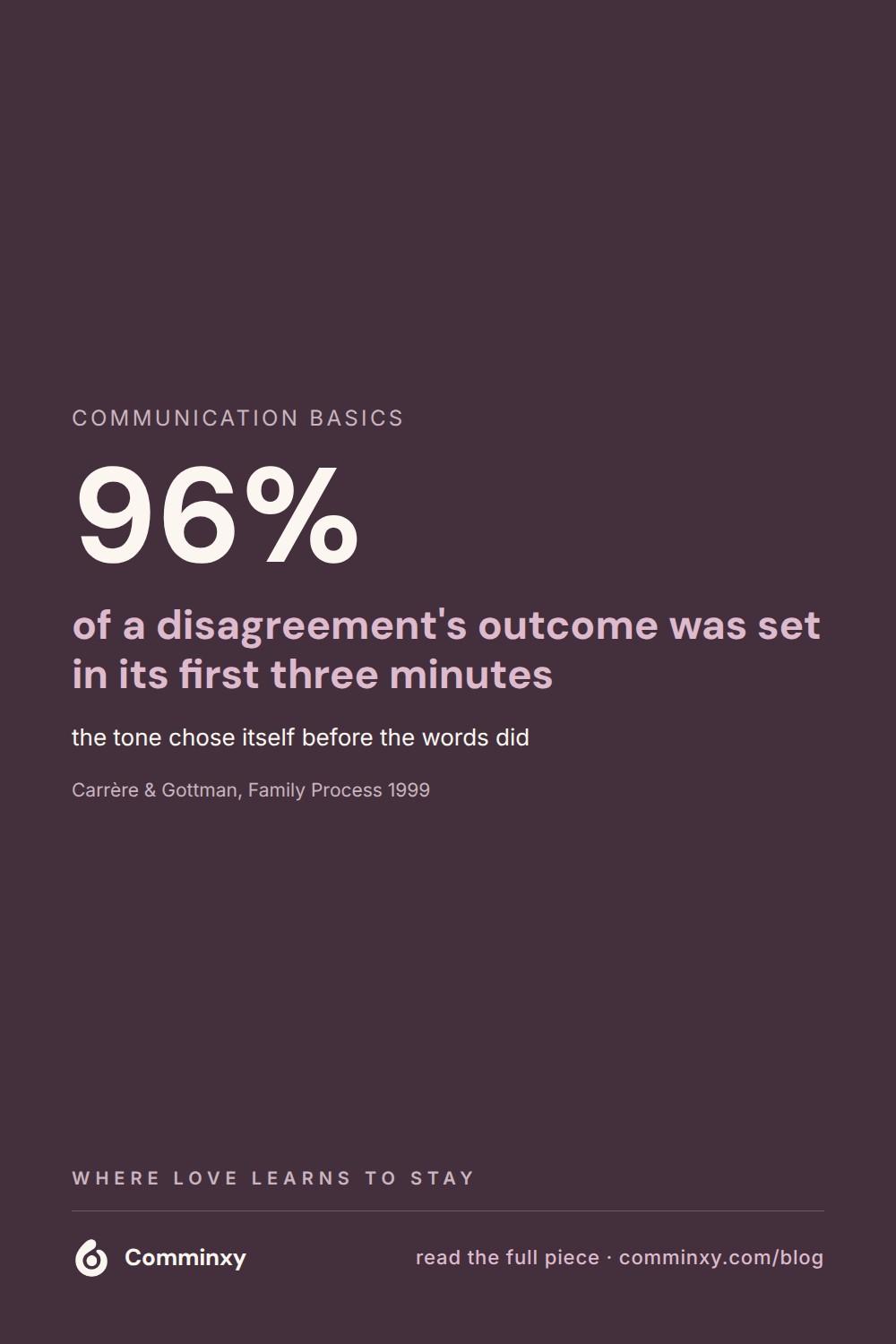
There is a study that changes how a lot of people hear their own arguments once they know about it. Researchers watched newlywed couples have a fifteen-minute disagreement, and found that how the conversation started in its first three minutes predicted the outcome of the entire discussion ninety-six percent of the time (Carrère and Gottman, Family Process, 1999). Not the topic. Not who was right. The opening.
Sit with that for a second, because it is quietly enormous. It means the fight you had last Tuesday was, in a real sense, mostly over in the first few sentences. Everything after was the two of you living out a direction that got set almost before you noticed. The escalation you blamed on the argument itself was often just the opening playing forward.
This is not a reason to panic about every word. It is closer to relief. It means the whole hour does not rest on your ability to stay flawless under pressure. It rests on something much smaller and much more within reach: the tone you start with, before either of you is activated, while there is still room to move.
The complaint that reaches instead of accuses
A soft startup is not a softer voice. You can whisper something that lands like a slap. It is more that the opening carries what you feel and what you need, without a verdict attached about who your partner is as a person.
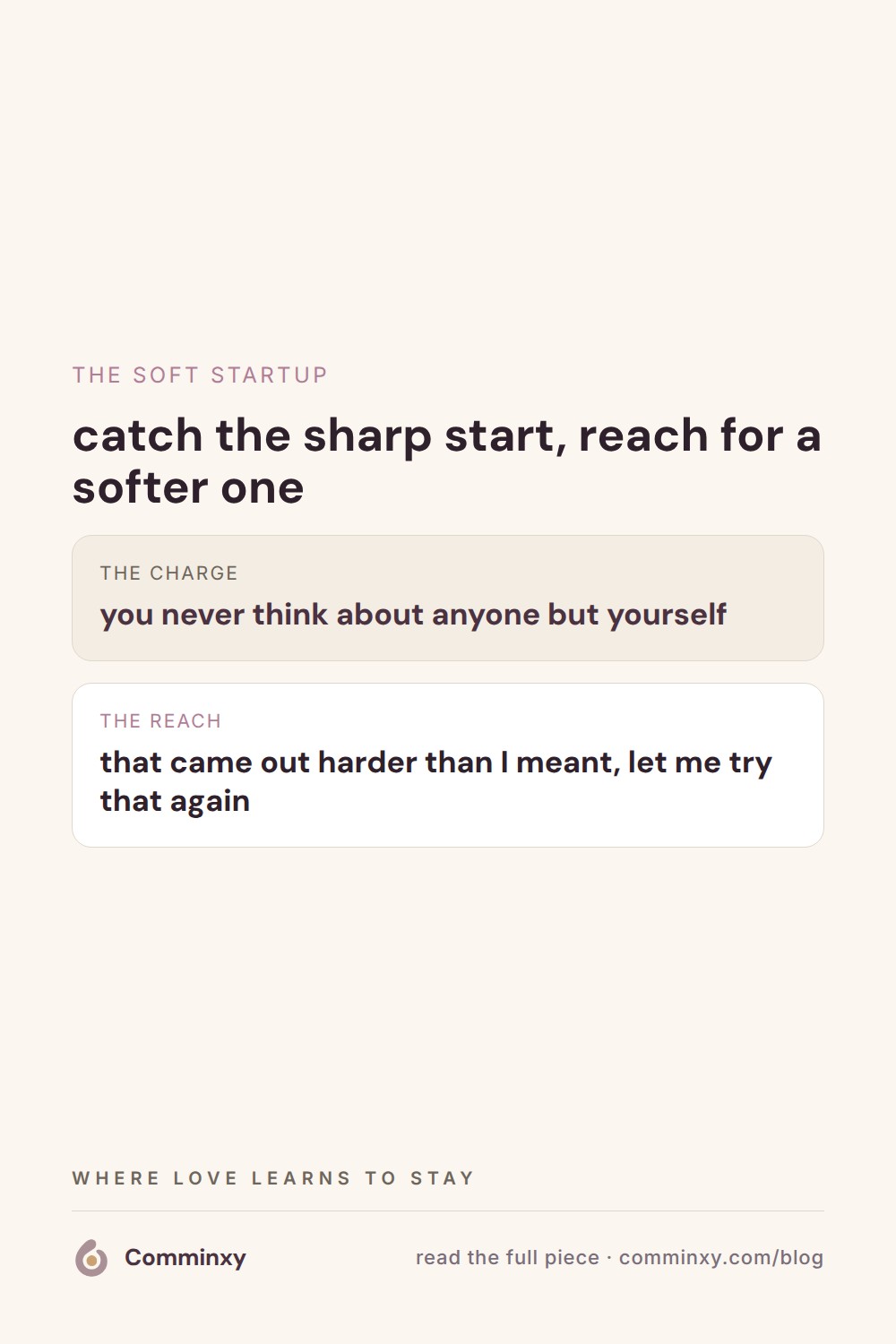
Picture the difference. "You never think about anyone but yourself when you make plans" walks in already holding a judgment, and there is nowhere for your partner to stand except in defence of their whole character. Compare it to something clumsier and truer: "I felt really alone when the weekend got planned without me, and I need to be part of that next time." The second one is not smoother. It is just pointed at the feeling and the need instead of at the person.
Most people worry that saying it this way makes them sound weak, or lets their partner off the hook. It does the opposite. Naming what you actually felt is far harder to argue with than a character charge, because your partner cannot dispute your own experience the way they can dispute an accusation. There is more on this in how to communicate better with your partner, if you want to sit with it longer.
The shape underneath most soft startups is simple. Here is what I feel. Here is the thing that happened. Here is what I need. No lawyer's opening, no list of every prior offence, no "you always". Just the small honest core of it.
When it comes out wrong anyway
You will get this wrong. Not once, in some early clumsy phase you graduate out of. On a Thursday when you are tired and someone leaves a coat over the back of the good chair and you hear yourself say the sharp thing you swore you would not say. This is not a sign you have failed to learn it. It is just what being a person under strain looks like.
The thing that matters more than a clean start is what happens twenty seconds after a bad one. You can stop, mid-sentence, and say: "That came out harder than I meant. Let me try that again." That single move, catching the harsh startup and reaching back for a softer one, does more repair than most polished speeches ever will. It tells your partner the tone was not the truth of how you feel about them.
Couples who stay close over decades do something a bit like this without naming it. A long study of older married couples found that the ones who lasted used small warmth in the middle of conflict, a bit of humour, a touch of affection, to bring their own bodies back down from the edge (Carstensen, Gottman and Levenson, Psychology and Aging, 1995). Not to dodge the argument. To keep the two of them human inside it.
You do not have to be good at any of this yet. Nobody starts good at it. The point is that a botched opening is not a locked door. You can always turn around and say the next thing more gently than the last.
What loosens when you stop needing the perfect start
Something eases once you understand that the whole conversation is not riding on your composure. You stop over-rehearsing. You stop waiting for the flawless moment that never arrives. The pressure that made you sharp in the first place, the sense that this had to go exactly right or not happen at all, is often what was hardening your tone before you spoke.
Go back to the doorway. Keys in the bowl. Your partner has not even taken their coat off, and you already feel the sharp version rising in your throat. There is a smaller move available there than the whole speech you prepared. You can wait until the coat is off. You can say their name first, plainly, the way you would if nothing were wrong. You can start with the feeling instead of the charge. None of it has to be smooth.
Learning to notice that first heat, and to reach for something gentler while there is still time, is a slow thing, and a repeated one. This is part of why we built Comminxy: to sit with you in the small window before the words come out, so that the way love begins a hard conversation can stay soft enough for love to stay.
Questions people ask
what is a soft startup in a relationship
A soft startup is beginning a difficult conversation by naming what you feel and need without attacking your partner's character. It focuses on the specific situation rather than a judgment about who they are. The goal is to reach for your partner rather than aim at them.
why do my arguments always start badly
Often your body has already set the tone before you speak, especially if you have spent time rehearsing a grievance. Your jaw, shoulders and breathing leak into your delivery, so even gentle words can arrive hot. The heat is usually a sign of feeling overwhelmed, not of being bad at talking.
how do you fix a conversation that started off harsh
You can stop mid sentence and say the tone came out harder than you meant and that you want to try again. This small move signals that the sharpness was not the truth of how you feel about them. It tends to repair far more than trying to push through the argument.
is it too late once an argument has already escalated
It is rarely too late to change direction, since you can always say the next thing more gently than the last. Small moments of warmth or affection during conflict can bring both people back down. If arguments regularly turn to contempt or feel unsafe, speaking with a couples therapist can help.
Keep the idea with you — pin it, or download the cards.


Notice the first heat before the sharp words arrive
Get Comminxy free →