The Quiet Cost of Saying Im Fine in Your Relationship
"I'm fine" is usually true in the smallest possible way. You are upright. You are functioning. Nothing is actively on fire. But saying "I'm fine" in a relationship when you are not fine is one of the quietest ways two people can drift, because it is a door closing while it looks like a door staying open.
You probably did not mean it as a wall. You meant it as a mercy. They had a long day, or you did not have the energy for the whole thing, or you were not even sure yet what the real answer was. So you handed them the easy version and kept the rest.
And they took it. That is the part that stings later. They took it because you gave them no reason not to.
Why the easy answer feels kinder than it is
"I'm fine" buys you a calm evening. Nobody has to decode anything. Nobody has to sit in the discomfort of a real problem with no tidy ending. For one night, that trade looks generous.
The cost does not show up that night. It shows up in the accumulation. The fifth time, the twentieth time, your partner slowly learns that your words and your interior do not match, and they stop reaching for what is underneath. Not out of coldness. Out of politeness. You trained them, gently, to leave you alone.
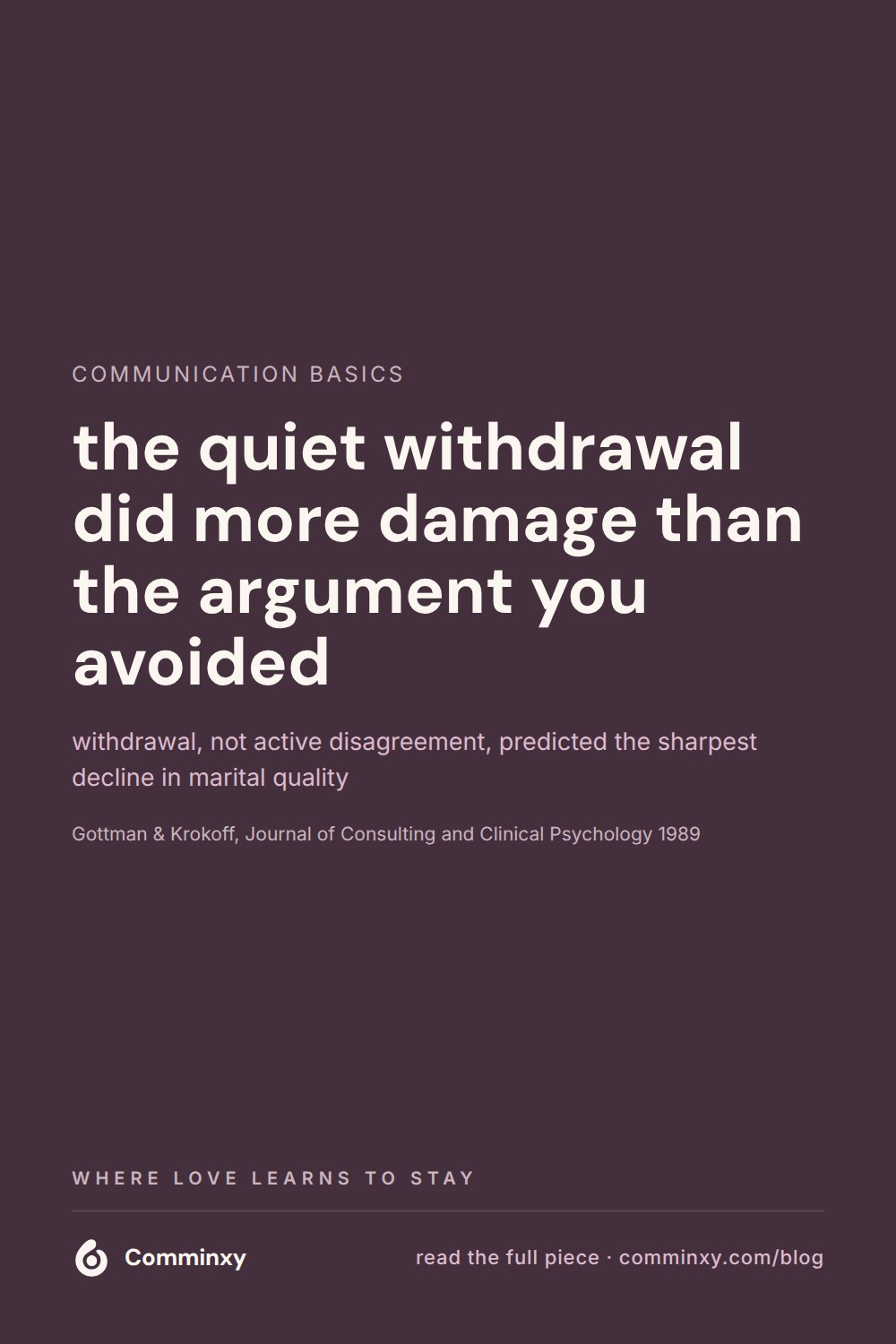
There is a long-running thread in the research that makes this sharper. When Gottman and Krokoff studied couples over time, they found that conflict withdrawal, the pulling back from a hard conversation, predicted serious decline in how couples felt about each other down the line (Gottman and Krokoff, Journal of Consulting and Clinical Psychology, 1989). What surprised the researchers was the other half of it: active disagreement, the messy kind, sometimes led to things getting better.
Which means the quiet "I'm fine" may be doing more damage than the argument you were avoiding. The thing you thought was keeping the peace was keeping the distance.
What they actually hear
Here is what "I'm fine" sounds like from the other side of the bed, or the other end of the phone. It sounds like: there is something here, and you are not allowed in.
Your partner is not stupid. They can hear the flatness. They notice you went quiet after your sister called, or that you have been reading the same page for ten minutes. They ask. You say you are fine. Now they have a choice that is not really a choice. Push, and risk being told they are imagining it. Retreat, and carry the unease alone.
Most people retreat. And then two people lie next to a problem that both of them can feel and neither of them is naming. This is often how couples stop talking: not in one dramatic silence, but in a hundred small ones that each felt reasonable at the time. If that pattern feels familiar, there is more on why couples stop talking and how to find the way back.
A smaller, truer thing to say instead
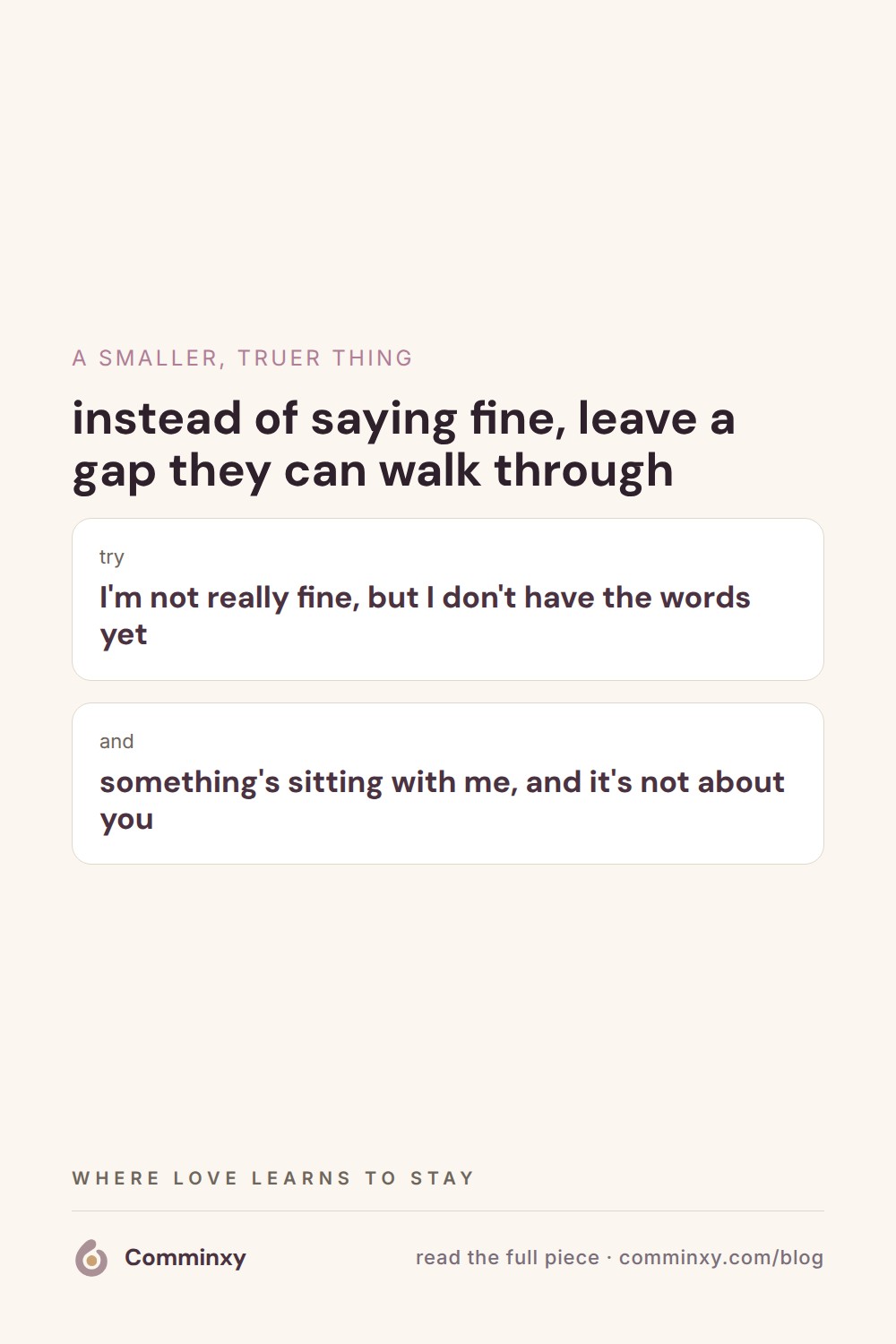
You do not have to swing from "I'm fine" to a full confession. The repair is much smaller than that, and it starts with one honest sentence that leaves the door open instead of shutting it.
Something like: "I'm not really fine, but I don't have the words yet." Or: "Something's sitting with me and I'm not ready to talk about it, but it's not about you." Both of those are true even on a night when you have nothing left. Both tell your partner the real thing, which is that there is a real thing, and that they are not being pushed out of it.
That second line matters more than it looks. "It's not about you" releases them from the worst story they were about to tell themselves. You are not asking them to fix anything. You are letting them stay in the room with you while you are still figuring it out.
You will still say "I'm fine" sometimes. Probably this week. Old habits do not dissolve because you read about them, and some nights the honest answer really is too heavy to lift. Saying the small true thing even half the time changes what your partner learns about you. It teaches them that the door is sometimes open, which is the only reason anyone keeps knocking.
The next time the easy answer rises up and you catch it, you do not need the perfect words. You just need to leave a gap they can walk through. Learning to say the smaller true thing, over and over, clumsily, is a lot of what a tool like Comminxy is built to help with. It is where love learns to stay: not in the fine evenings, but in the ones where you let them in anyway.
Questions people ask
why do I always say im fine when im not
Often it feels like the kinder choice because it spares your partner and avoids a hard conversation you do not have energy for. The problem is it slowly teaches them your words and your real feelings do not match. Over time they stop asking what is underneath.
is saying im fine bad for a relationship
It can be, because repeated avoidance of real feelings tends to build distance rather than keep the peace. One study found that pulling back from hard conversations predicted couples feeling worse over time. The habit matters more than any single instance.
what to say instead of im fine to my partner
Try naming that something is there without forcing yourself to explain it all. For example, you can say you are not really fine but do not have the words yet, and that it is not about them. That keeps the door open without demanding a full conversation.
my partner says fine but I know somethings wrong
They may be overwhelmed or unsure of their own feelings rather than shutting you out on purpose. You can let them know you noticed and that you are around when they are ready, without pushing. If the silence becomes a lasting pattern that worries you, talking with a counselor can help.
Keep the idea with you — pin it, or download the cards.



Start with one small true sentence instead of fine
Get Comminxy free →