The Repair Attempt: The Small Move That Saves a Relationship Mid-Argument
You were mid-argument about something that started small, the booking neither of you made, the weekend that got away from both of you, and somewhere in the rising voices one of you did something strange. Reached over. Made a terrible joke that landed sideways. Said the other person's name, just their name, in a softer register than the fight deserved. For half a second there was a door. Then it closed, because the other one was still too far inside the heat to walk through it, and the argument carried on as though the door had never opened at all.
That small move has a name. In the research it is called a repair attempt, and understanding it changes how you see almost every fight you have ever had. A repair attempt relationship researchers describe is not a grand gesture or a worked-out apology. It is the clumsy, badly-timed, often slightly embarrassing thing one of you does in the middle of conflict to say we are still on the same side here. The question that decides so much is not whether the attempt is good. It is whether it gets caught.
The move you already make without noticing
Most couples make repair attempts constantly and never once call them that. The weak joke. The sudden shift to a practical question. Reaching for a hand that is not quite ready to be held. One person going quiet, then saying, in a smaller voice, "can we start this over." These are not polished. Half of them barely work as sentences. And that is exactly what they are supposed to be, a flare sent up from inside the argument, not a solution to it.
What they share is a direction. Every real repair attempt points toward the other person, even when the fight is still pointing away. You can usually feel the difference between a jab dressed as a joke and a joke that is actually a hand reaching out. The reaching ones tend to come out worse. A person trying to soften a fight they are still angry about rarely does it gracefully.
Why the good ones get missed
The painful part is that the attempt often fails not because it was poor, but because the other person could not receive it. And there is a physical reason for that, one worth knowing before you decide your partner was just being cold.
When a conflict escalates, the body floods. Heart rate climbs, attention narrows, and the nervous system shifts into something closer to threat than conversation. Gottman and Levenson, studying the physiology of couples in conflict, found that this autonomic arousal is one of the things that most clearly separates couples who stay regulated from those who spiral (Gottman and Levenson, Journal of Personality and Social Psychology, 1992). A person in that flooded state is not choosing to ignore the olive branch. They often genuinely cannot see it. The signal arrives, and there is no one home to catch it.
Which reframes the whole thing. The nights your repair attempt bounced off your partner and left you feeling foolish for trying, you were not rejected so much as early. The door you opened was real. They just could not reach it in time.
What the first three minutes already know
There is a reason repair matters so much, and it sits further back than the moment itself. How a conflict begins tends to decide how it ends. Carrère and Gottman, watching newlyweds discuss a disagreement, found they could predict the outcome of a fifteen-minute conversation from its first three minutes with striking accuracy (Carrère and Gottman, Family Process, 1999). The opening sets the weather for everything after.
Read one way, that is a grim finding, as though a fight is lost before you have a chance to save it. Read another way, it is the best news in this whole article. If the start carries that much weight, then a repair attempt is not a small thing you do at the end to clean up. It is a way of reaching back and changing the temperature of the thing while it is still happening. You are not stuck with the conversation you began. You can interrupt it.
That interruption is what humour and tenderness are doing when they appear mid-fight. In their study of long-married couples, Carstensen, Gottman, and Levenson found that satisfied partners used affection and even humour during conflict to soothe their own bodies back down (Carstensen, Gottman, and Levenson, Psychology and Aging, 1995). The joke was not a distraction from the argument. It was how they stopped the flood from rising.
Learning to catch what your partner throws
Most advice about repair tells you how to make a better attempt. The quieter skill, the one that saves more arguments, is learning to catch the ones your partner is already making.
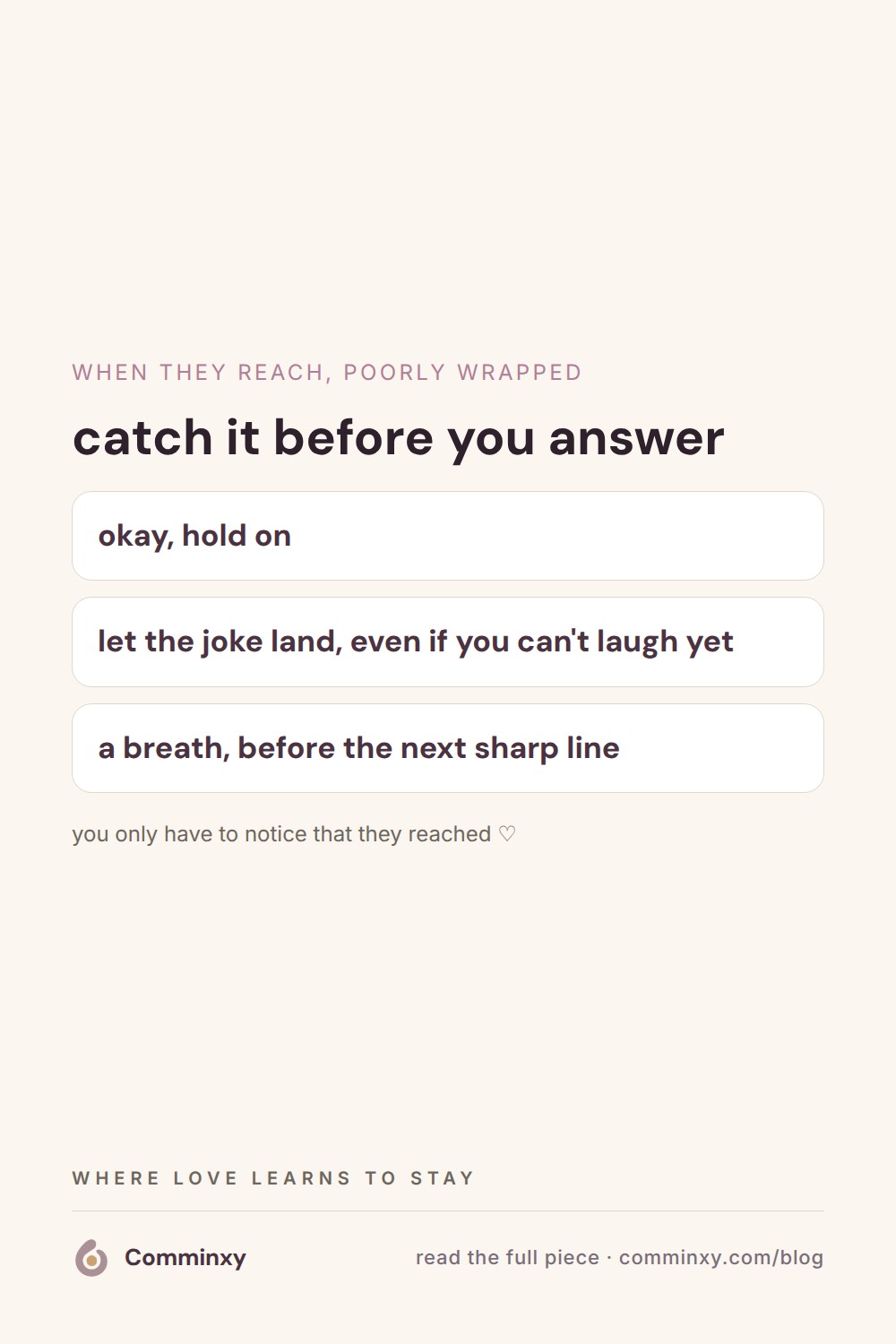
This asks something hard of you, because catching a repair means lowering your guard at the exact moment you least want to. Your partner makes a weak joke while you are still hurt, and everything in you wants to say "this isn't funny." The offer is right there, poorly wrapped, and the flooded part of you wants to swat it away. Catching it looks like something small. A breath. Letting the joke land even though you are not ready to laugh. Saying "okay, hold on" instead of firing the next line. You do not have to forgive anything yet. You only have to notice that they reached.
And when you are the one reaching, it helps enormously to know that the attempt can be bad and still count. You do not need the right words. You can say "I hate this, can we stop for a second." You can put your hand flat on the table. You can use their name the way you use it when things are good. If it lands wrong, you are allowed to try again a minute later, because one missed attempt is not a verdict on whether the two of you can find your way back. Some of this is simply learning to communicate better with your partner under pressure, which almost nobody does well at first.
What changes when you both start trying
You will get this wrong. You will miss an obvious attempt on Thursday because you were tired and already two sentences into your defence. Your partner will fumble one on Sunday and you will both feel the door close again. That is not failure. The couples who do this well are not the ones who never miss. They are the ones who have agreed, somewhere underneath, that the reaching is allowed, that a hand across the table during a fight will not be slapped away for sport.
Once that agreement exists, the fights change shape. They still happen. They just stop running quite so far before someone pulls the cord. The argument about the booking is still an argument, but now it has an exit, and both of you know roughly where it is.
Think back to that half-second door, the name said softly, the joke that fell flat. It was never nothing. It was one of you saying, through the worst of it, that the two of you were still worth reaching for. Comminxy exists to help you notice those moments as they happen and catch the ones you would otherwise miss, because that is usually where love learns to stay. Not in the fights you avoid. In the small reaching, caught in time.
Questions people ask
what is a repair attempt in a relationship
It is any small move one partner makes during an argument to reconnect and lower the tension. It can be a joke, a touch, a change of tone, or saying can we start over. It is not a full apology, just a signal that you are still on the same team.
why does my partner ignore me when I try to make peace during a fight
Often they are too overwhelmed to register the gesture rather than deliberately rejecting it. When conflict escalates the body floods and attention narrows, so the signal arrives but there is no space to receive it. Trying again a minute later often works better than reading the first miss as a verdict.
how do I calm down a fight with my partner before it gets worse
Slow the opening and interrupt the escalation early rather than waiting until the end. A breath, a softer tone, or pausing before the next sharp line can shift the direction. The way a conflict begins tends to shape how it ends, so small early moves carry real weight.
is it bad that I use humor during arguments
Not necessarily, as long as the humor is reaching toward your partner rather than jabbing at them. Gentle humor can soothe both people and ease the tension in the moment. The difference is direction, whether the joke is a hand reaching out or a disguised attack.
Keep the idea with you — pin it, or download the cards.




Comminxy helps you notice the small reaching before it slips past.
Get Comminxy free →