How to Protect Your Relationship From the Speed of Modern Life
You said goodnight to each other through a bathroom door tonight. One of you was brushing teeth, the other was already half under the covers with the phone charger cord in hand, and the words night, love you passed between you the way a relay baton passes. Quick, functional, barely looked at. Neither of you meant anything by it. That's almost the point. It was the ninth or tenth thing that had passed between you today that neither of you fully turned toward.
If you're lying there now, feeling a small ache you can't quite justify, you're not alone in it. Because the question of how to protect a relationship from the speed of modern life isn't really about doing more. You already do so much. It's about what happens to the two of you in the gaps you never chose, the ones that just filled in, the way water fills a low place.
The days don't end. They just get handed off.
There was a time, not so long ago, when the day had edges. Work ended. The commute was a kind of decompression chamber. The evening was a room you both stepped into, tired but arriving. Now the day doesn't end so much as thin out. The email answered at 9:40. The school WhatsApp buzzing during dinner. The half-thought about tomorrow's logistics spoken out loud into the dark because there was no other moment to say it.
What gets lost isn't the big conversation. It's the small return: the glance that says I'm still here, I still see you. You didn't decide to stop offering it. The speed just kept you both facing outward, toward the next thing, so that the two of you started living side by side like commuters on the same platform, waiting for different trains.
It's not that you stopped caring. You stopped being able to catch it.
What predicts whether a couple thrives isn't how well they handle the hard moments. It's how they handle the good ones. De Netto, Quek, and Golden, writing in Frontiers in Psychology in 2021, found that of all the ways a partner can respond to your good news, the one that most strongly shapes how satisfied you feel in the relationship is the active-constructive response. The turning-toward, the genuine tell me more.
And this is exactly what the speed takes first. Not your patience during a fight. Your capacity to catch the small good thing your partner hands you. She mentions the compliment her manager gave her, and you're already three tabs deep, so you say that's great without lifting your eyes. He tells you the tomatoes he planted finally came up, and it lands into the middle of you packing lunches. Nobody was cruel. The moment just arrived at a full platform and couldn't find a place to stand.
That's the quiet erosion. Not conflict. Missed catches.
What you protect is smaller than you think
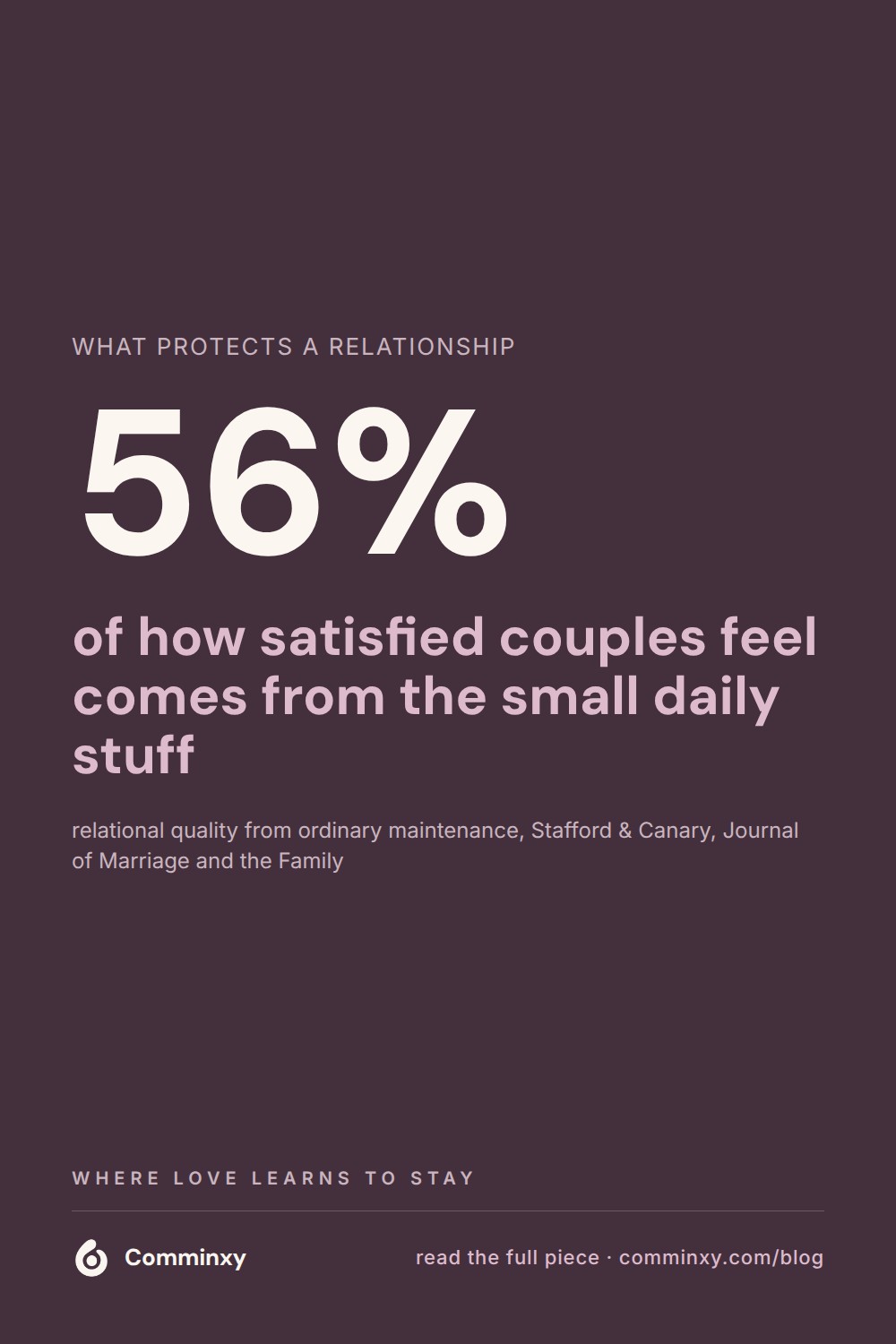
Couples who stay close over years don't do it through grand gestures. Stafford and Canary, studying what actually keeps relationships alive, found that ordinary maintenance (positivity, openness, offering assurance, sharing tasks, staying woven into each other's networks) accounts for a striking share of how satisfied couples feel, their measure explaining up to 56% of relational satisfaction. Fifty-six percent, from the small stuff. From the daily texture, not the anniversary.
Which means the thing you're trying to protect from the speed of modern life is not some fragile, precious centre. It's the ordinary. The four seconds where you actually look up. The reply that carries a little warmth instead of just information. If you've ever wondered whether the small ways you speak to each other matter more than you let yourself believe, they do. There's a whole conversation to be had about how to communicate better with your partner in the cracks of a full life.
The way back is a doorway, not a rebuild
You don't need to slow your whole life down. Most of us can't. What you can do is choose one doorway a day and actually walk through it instead of past it.
The doorway is usually a moment your partner offers you. Small, easy to miss. The tomatoes. The compliment. The you'll never guess what happened. When one of those arrives, the repair is simply to stop and turn all the way toward it. Put the thing down. Ask the second question. Let them see it land in your face. It costs you ninety seconds and it tells them the truest thing there is: even at this speed, you are still the one I turn toward.
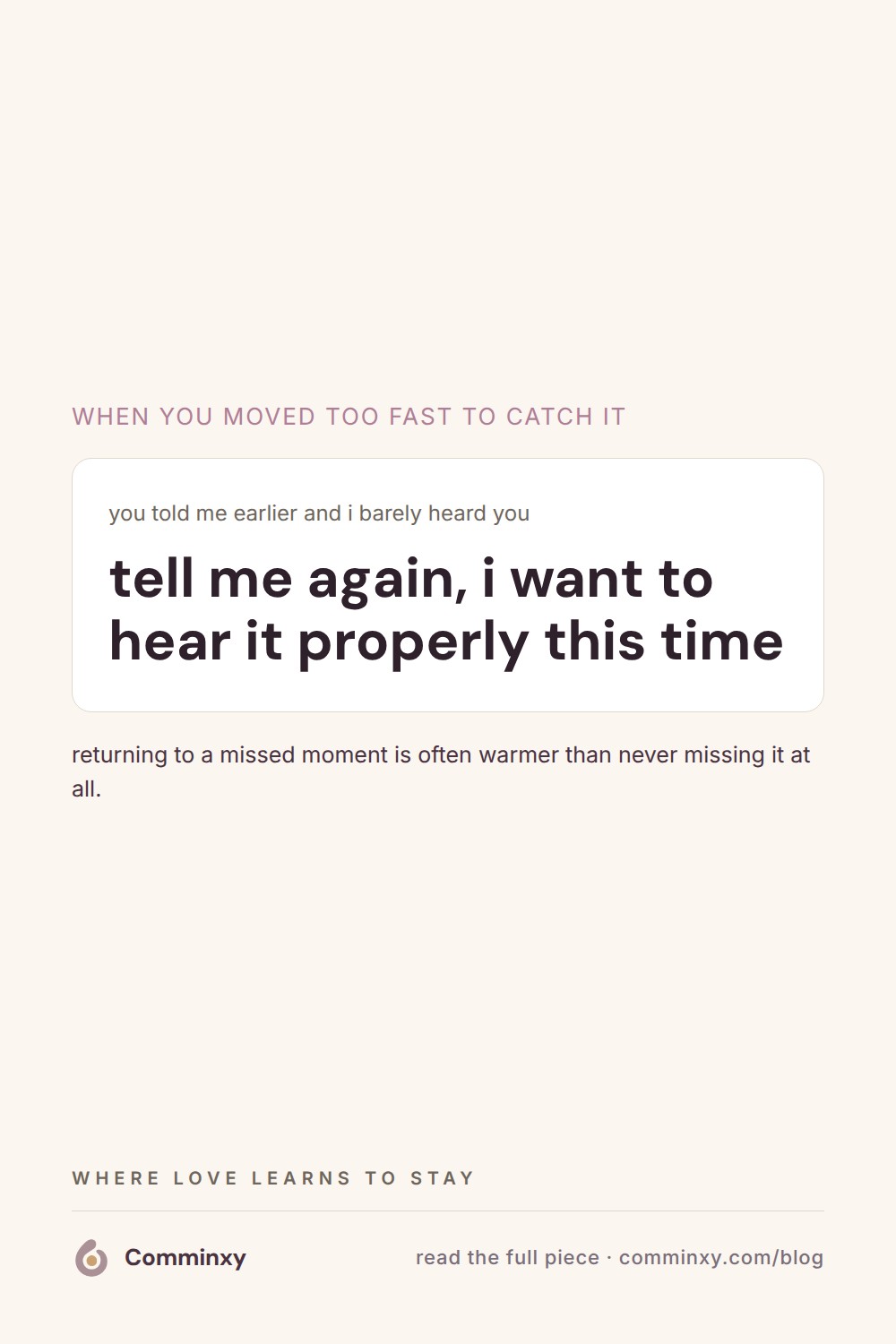
And when you miss it (because you will, because the day was too fast and you gave someone their good news the same flat that's great you'd give a stranger) you can come back later. You told me about the tomatoes earlier and I barely heard you. Tell me again. I want to hear it properly this time. That sentence undoes more than you'd expect. Returning to a missed moment is often warmer than never missing it at all.
The story you tell about these years matters more than the years themselves
Buehlman, Gottman, and Katz, in the Journal of Family Psychology, found that how a couple tells the story of their relationship (the way they narrate their history together) predicted whether they'd stay married with 94% accuracy over three years. Not what happened to them. How they held it.
What this means is gentle and enormous. The speed of these years isn't the verdict on your love. Two couples can live the same overloaded, hand-off-the-day, brushing-teeth-goodnight season. One remembers it as the time they lost each other. The other remembers it as the time they kept finding their way back: the ninety-second turns, the tell me again, the small returns that added up. The difference isn't the pace. It's whether you kept reaching for each other inside it.
So the next time you say goodnight through a half-closed door, let it not be the tenth handoff. Let it be the one moment you turn all the way around. Hey. Come here a second. How are you, really? That's the whole thing. Not a slower life, just a truer few seconds inside the fast one. If it helps to have something quietly beside you, noticing the moments you're both moving too fast to catch, that's what Comminxy is for: a small companion for the busy years, holding the door open just long enough for love to learn to stay.
Questions people ask
how do I protect my relationship when we're both so busy
Choose one small moment each day when your partner offers something and turn fully toward it instead of multitasking through it. Put down your phone, ask a second question, and let them see it land in your face for ninety seconds. If you miss a moment, come back to it later and ask them to tell you again properly.
why does my relationship feel distant even though we don't fight
Distance builds not from conflict but from repeatedly missing the small moments your partner offers you throughout the day. When good news or small stories get flat responses because you're distracted, your partner stops feeling seen, and you both end up living side by side instead of together. The erosion happens in missed catches, not arguments.
what is active constructive responding
Active constructive responding means turning fully toward your partner when they share good news and responding with genuine interest and follow-up questions, not just a distracted acknowledgment. Research shows this type of response predicts relationship satisfaction more strongly than how couples handle conflict. It requires putting down what you're doing and letting your face show you actually heard them.
can you repair a moment you missed with your partner
Yes, you can come back later and say you missed what they told you earlier and ask them to tell you again properly. Returning to a missed moment with full attention is often warmer than never missing it at all, and it shows your partner they still matter even when the day got too fast. The repair sentence can be as simple as asking to hear it again because you want to listen properly this time.
Keep the idea with you — pin it, or download the cards.



A quiet companion for noticing the moments worth turning toward
Get Comminxy free →