Perceived Partner Responsiveness: The Quiet Feeling That Keeps Love Alive
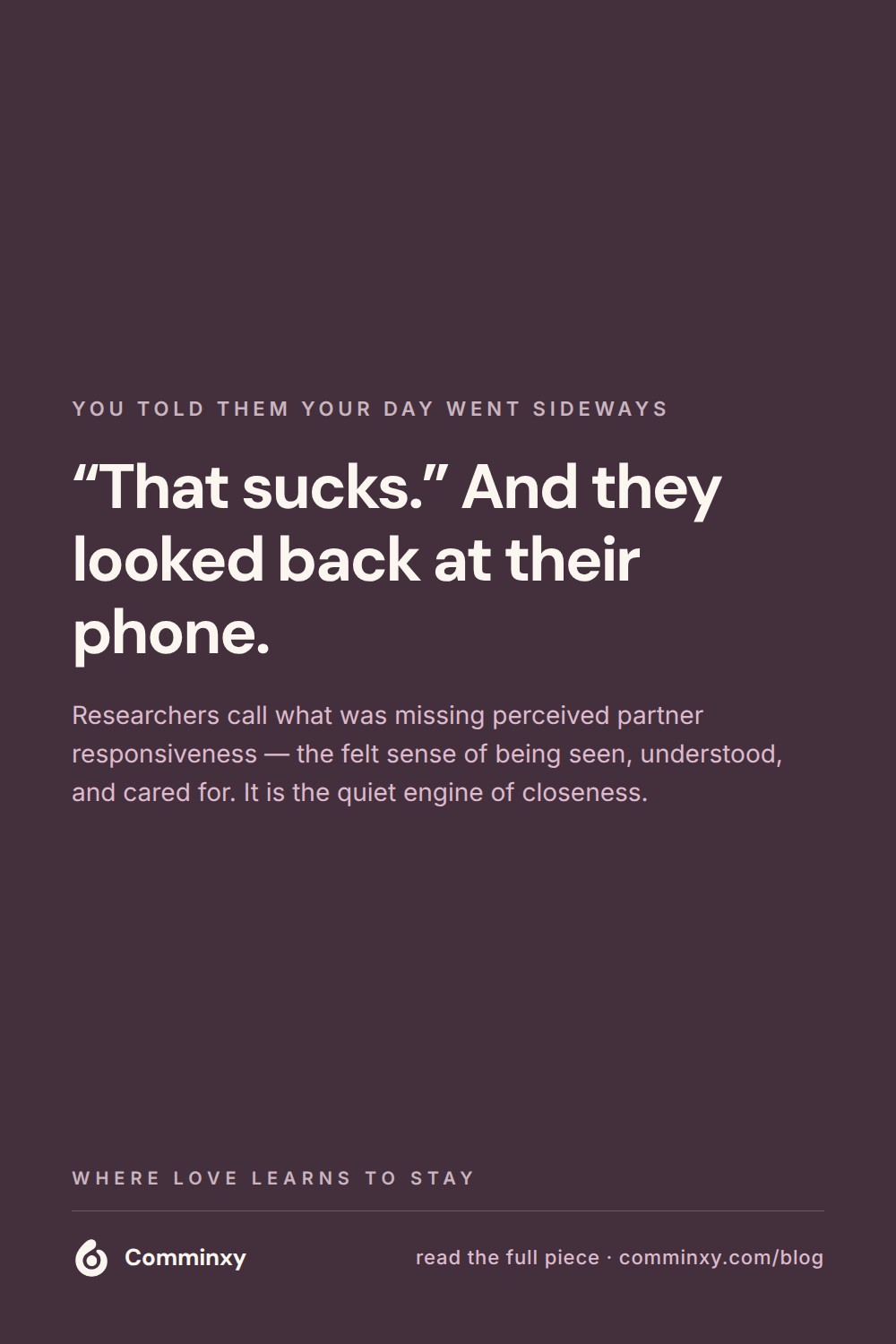
You told them something small. Not a crisis. Just that your day went sideways, that a meeting ran long, that you felt off. And they nodded. Said "that sucks." Looked back at their phone. Nothing cruel happened. Nobody raised their voice. But you walked away from that moment feeling a little more alone than before you opened your mouth. And you couldn't quite explain why, because on paper, they responded.
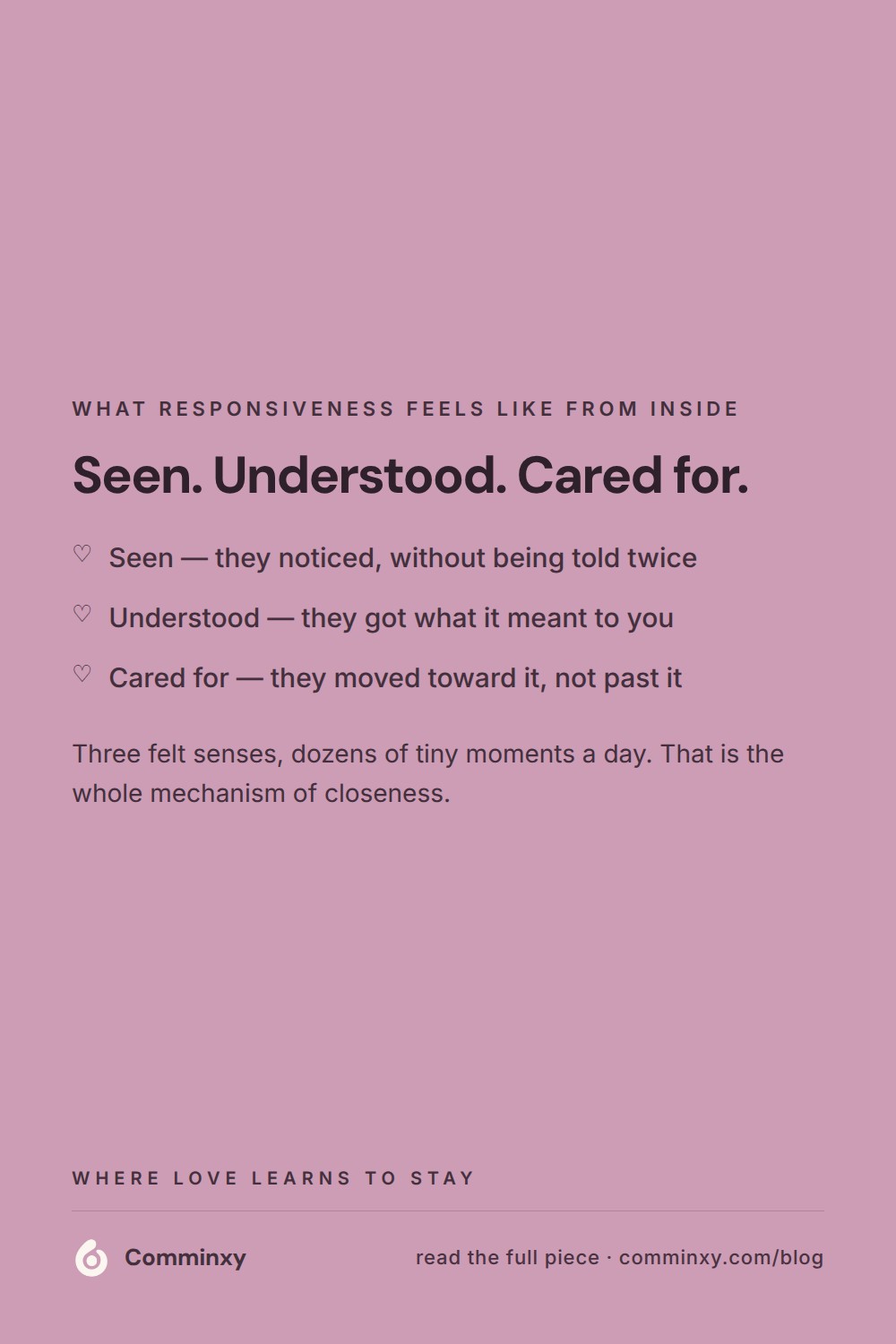
That gap — between being answered and being felt — is the whole thing. Researchers call it perceived partner responsiveness: the sense that your partner understands you, values who you are, and cares about what you're going through. Not whether they technically replied. Whether you felt met.
The difference between being heard and being reached
Here is what makes this so hard to talk about. The moments that erode a relationship are rarely the loud ones. They're the quiet misses. You share something you were a little proud of, and they say "nice" without looking up. You mention you're worried, and they immediately hand you a solution instead of sitting with you for one second first.
None of it looks like a fight. That's exactly why it's easy to miss. You can't point to it later and say this is where it went wrong. There's no scene. Just a slow accumulation of small moments where you reached and didn't quite land. And over time, you stop reaching. Not out of anger. Out of a quiet learning that reaching doesn't get you much.
The good news you didn't get to share
We assume the danger zone is conflict. It isn't only that. Some of the most telling moments are the good ones — the times you come home with something to celebrate.
When De Netto, Quek, and Golden studied how partners respond to each other's good news in Frontiers in Psychology (2021), they found that an active, engaged, genuinely-interested response to a partner's happiness had the strongest influence on relationship satisfaction of any response style they measured. Not the comforting during hard times. The showing up during the good times.
Sit with that for a second, because it's counterintuitive. The moment your partner tells you something went well is not a small moment. It's one of the most important ones. When they light up with you — ask a question, lean in, actually want the details — you feel seen at your best. When they say "that's great, babe" and move on, something in you deflates a little, even though nothing wrong technically happened. That deflation is real. The research just gives it a name.
Why the kindest partners still miss
This is the part that matters, because it isn't about a bad partner. Most people who miss these moments aren't careless. They're tired. They're distracted. They're solving a problem at work in the back of their mind while you're telling them about yours. Responsiveness asks for presence, and presence is the first thing stress steals.
There's also the quieter machinery underneath it — the story we tell ourselves about why our partner did what they did. Fincham and Bradbury found that when someone reads a partner's behaviour as intentional, selfish, or blameworthy, it reliably predicts more hostility and more conflict in the interaction that follows (Journal of Personality and Social Psychology, 1992). So the half-hearted "nice" doesn't just sting on its own. It gets filed. It becomes evidence. They don't care about me. And the next time you reach, you're already braced.
Neither of you is doing this on purpose. You're both responding to a version of the other that lives partly in your head. Which is oddly hopeful, because a story is a thing that can be rewritten.
What turning back toward each other looks like
The repair here is smaller than you'd think, and it doesn't require anyone to become a different person. It starts with catching the moment while it's still happening.
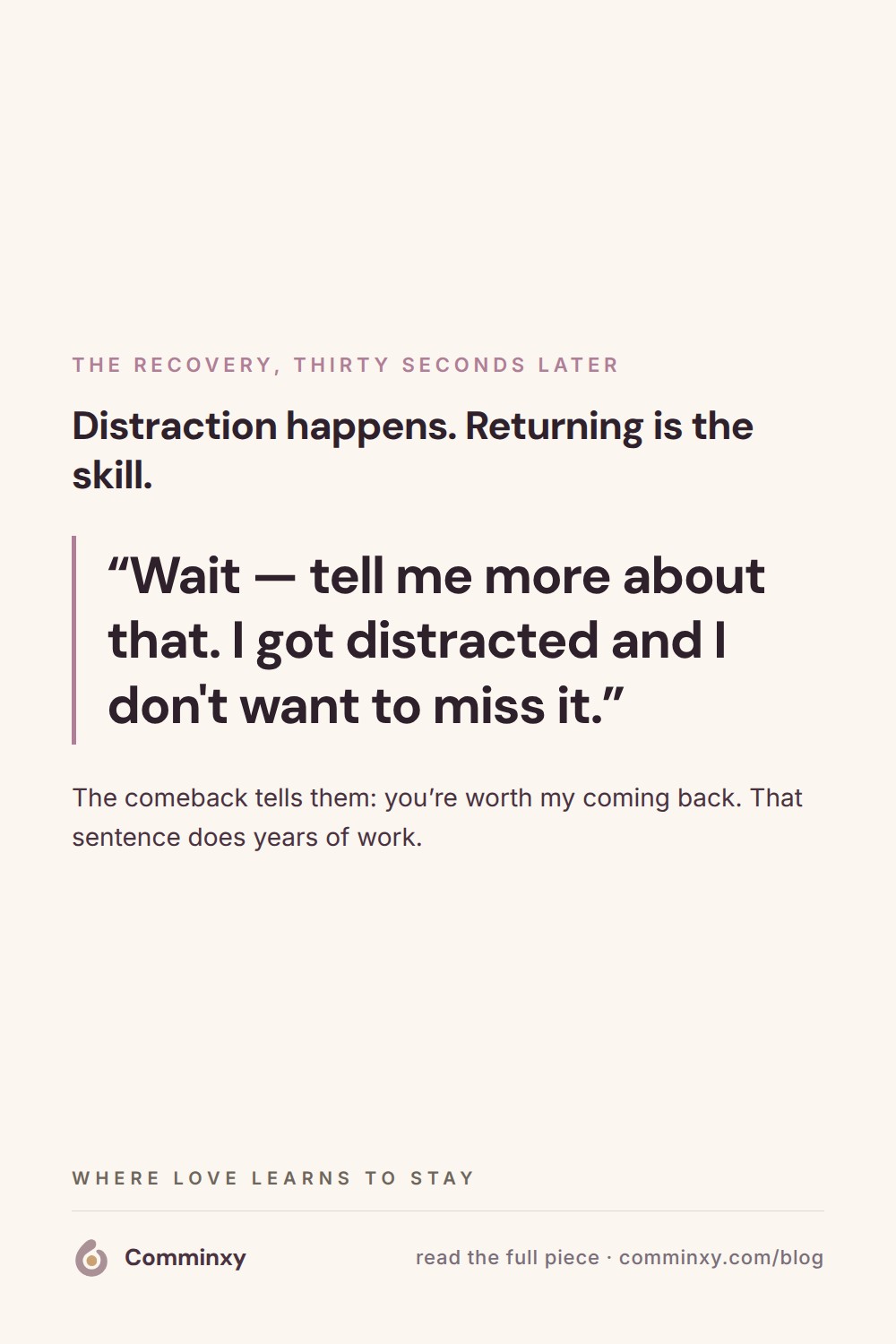
Sometimes that's the person sharing, saying the quiet part out loud — hey, I actually really wanted you to be excited about this with me. Not as an accusation. As information. Sometimes it's the person who missed, noticing the small deflation and circling back thirty seconds later. Wait, tell me more about that. I got distracted and I don't want to miss it. That single act of returning does more than getting it right the first time ever could. It says: you're worth my coming back.
Gratitude turns out to be a surprisingly direct route in. Algoe, Haidt, and Gable found that when someone noticed and appreciated a partner's thoughtfulness, it set off a cycle that predicted better interaction quality a full month later (Emotion, 2008). Saying thank you for asking about my day, it actually meant a lot isn't just polite. It shows your partner where the door is. It tells them, plainly, that they reached you — which makes them far more likely to reach again.
If you want a broader look at how these small returns compound over time, we've written more about how to communicate better with your partner. But the core of it is almost embarrassingly simple: responsiveness is a loop. One person leans in, the other feels it and leans back, and the whole thing warms by a degree.
The feeling underneath everything else
Here's what I've come to believe after a long time sitting with couples. When people say they've grown apart, they rarely mean they stopped loving each other. They mean they stopped feeling felt. The love was still there. The responsiveness quietly left the room. And because no single moment caused it, no one thought to fix it.
Which means the way back is also made of small moments. Not grand gestures. Just the willingness to look up when someone you love is speaking. To ask the second question. To come back thirty seconds later when you realise you missed it.
Think back to that moment — you, sharing something small, watching them nod and glance away. What you wanted wasn't much. You wanted them to look up. And the quiet, ordinary truth is that they still can, and so can you, more often than either of you has lately. That's the work of noticing these moments as they pass — something a companion like Comminxy can gently help you catch, so the reaching doesn't go unanswered. This is where love learns to stay. Not in the big declarations. In the looking up.
Questions people ask
What is perceived partner responsiveness?
It is the sense that your partner understands you, values who you are, and cares what you are going through. The word perceived matters. What counts is whether you felt met, not whether they technically answered.
Why do I feel lonely even when my partner is right there?
Usually because the small reaches are not landing. You share something and get a reply rather than a response. Nothing looks wrong from outside, which is exactly why the loneliness is hard to explain or point at.
Why does my partner not react much when I share good news?
Often distraction rather than indifference. It matters more than most people realise: research on how partners respond to each other s good news found an engaged, genuinely interested reaction had the strongest influence on satisfaction of any response style measured.
How can I be more responsive to my partner?
Slow down by one beat before answering, and ask one question before offering anything else. Most misses happen because someone jumps to a solution or a nod. Presence is the first thing stress takes, so this is hardest exactly when it matters most.
Keep the idea with you — pin it, or download the cards.


The good news they bring you is a bigger moment than it looks.
Get Comminxy free →