The Pause Before You Reply, Partner: Why Three Seconds Can Save a Whole Fight
The reply is already loaded before they finish the sentence. Your mouth is a fraction open, the words waiting behind your teeth, and some part of you knows it will not help. You say it anyway. This is the moment the whole thing turns, the pause before you reply that you and your partner keep skipping, the three seconds you never take because taking them feels like losing.
Maybe it happened this morning at the school gate, one of you passing the other the wrong bag through the car window, a small correction landing like a verdict. Maybe it was a text sent from a work bathroom. The particulars change. The mechanism does not. Something arrives, your body reacts, and the reaction is out of your mouth before the thought behind it has finished forming.
You are not impulsive. You are not bad at this. Your nervous system is simply faster than your better judgment, and it always has been.
What those three seconds are actually for
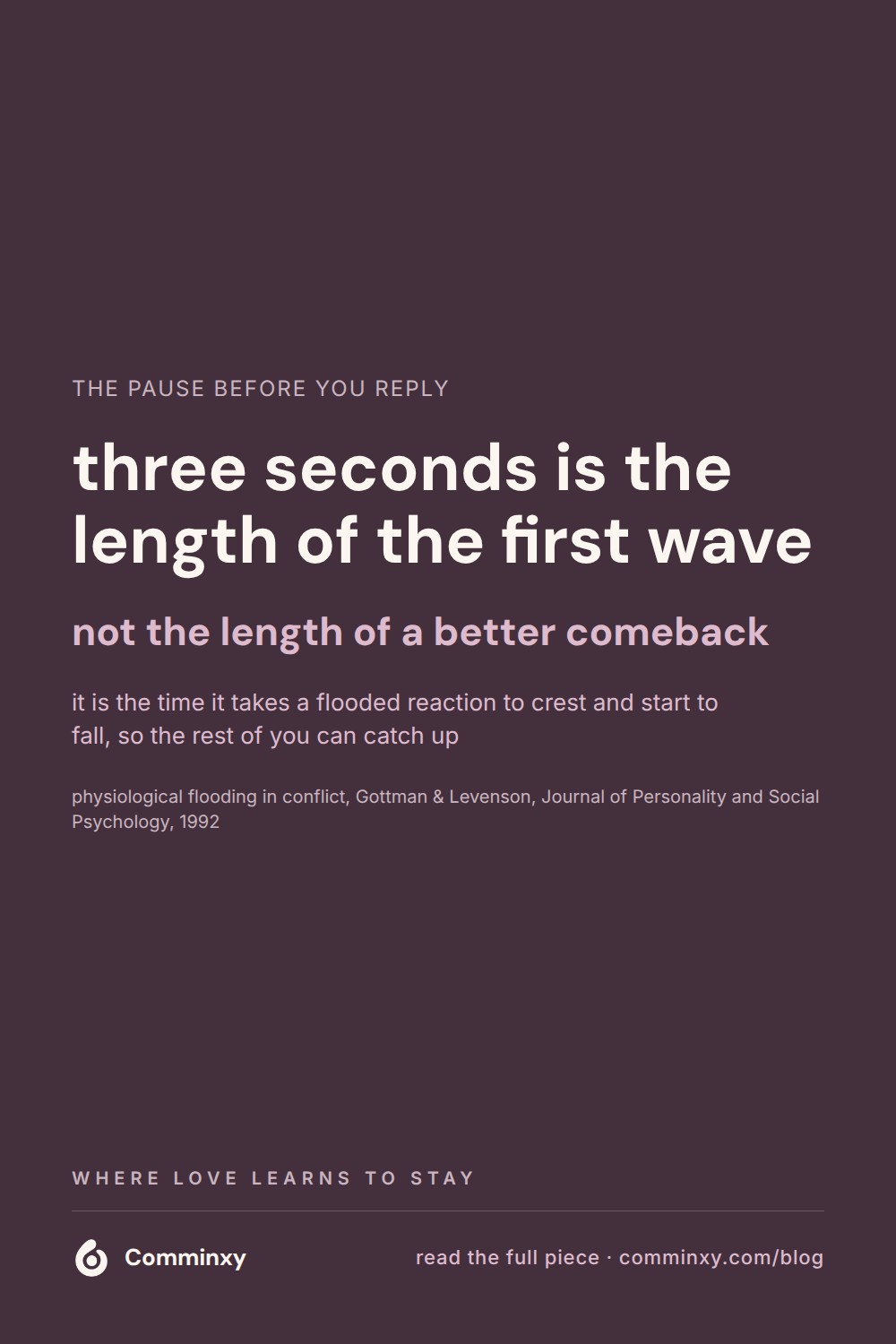
When couples fight badly, there is often a moment right before it goes wrong where the body has already decided. The heart rate climbs. The chest tightens. Attention narrows to the threat in front of you, which happens, tonight, to be the person you love. Gottman and Levenson spent years measuring exactly this, tracking heart rate and sweat and blood flow while couples argued, and found that this kind of physiological flooding is one of the things that separates couples who stay regulated from couples who spiral (Gottman and Levenson, Journal of Personality and Social Psychology, 1992).
Once you are flooded, you are not really talking to your partner anymore. You are defending against a threat. The words that come out in that state are built for winning, not for reaching, and you can feel the difference even as you say them.
The pause is not about being calmer or wiser or more evolved. It is far more mechanical than that. Three seconds is roughly the length of time it takes for the first wave of that reaction to crest and begin to fall. You are not using the pause to think of a better reply. You are using it to let your own body come back down enough that a better reply becomes possible at all.
The honest answer, including where it runs out
Here is where honesty matters more than tidiness. The three seconds do not always work.
Sometimes you take the pause and the flooding is still there when it ends, and the sharp thing comes out anyway, just three seconds late. Sometimes you are already too far gone to remember the pause exists. Nobody who is genuinely flooded is thinking, clearly and calmly, about a technique they read online. That is precisely the state the pause is meant to interrupt, which is also what makes it so hard to reach.
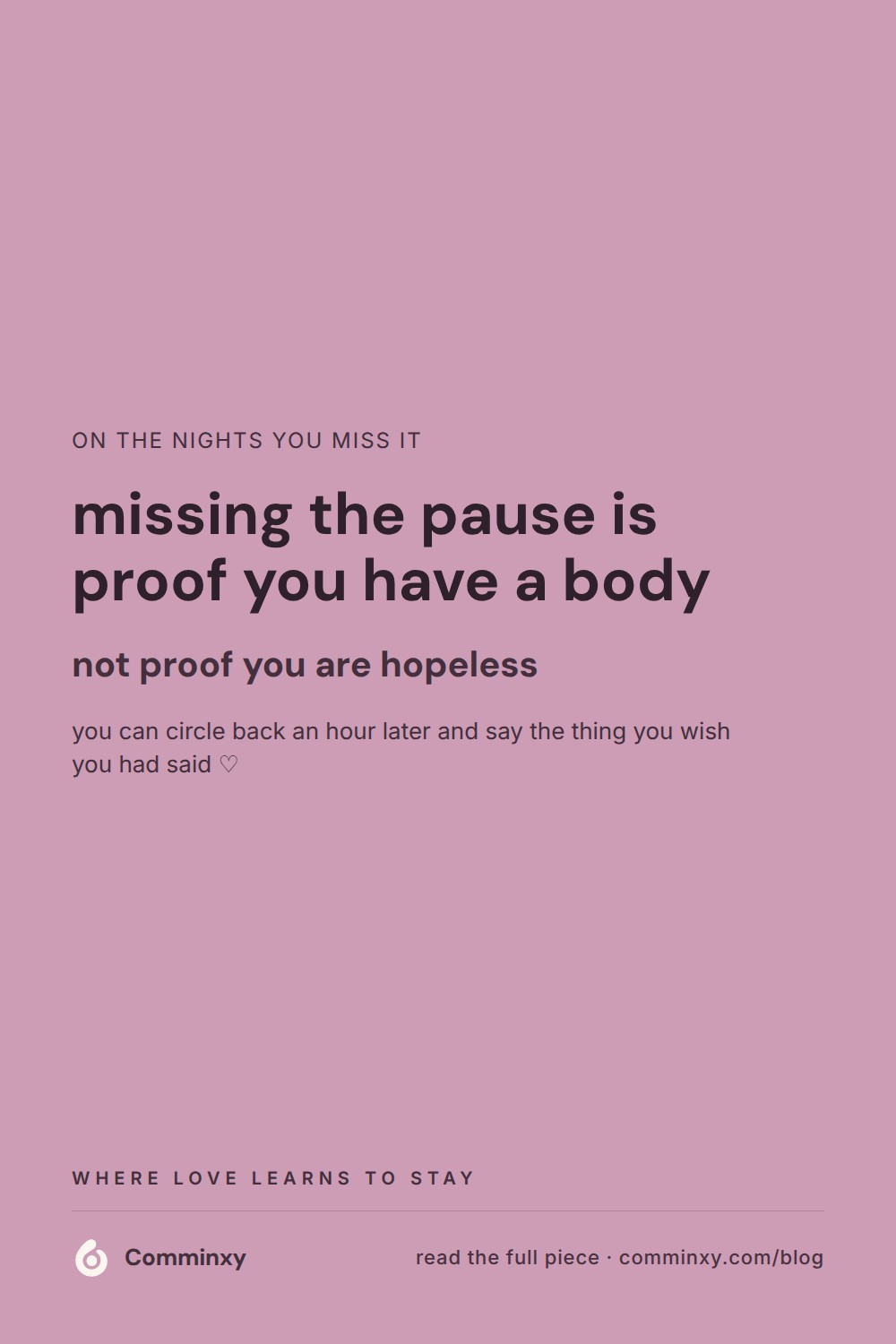
So the honest version is this. The pause is not a switch that stops fights. It is a small window that opens, unreliably, and sometimes you catch it and sometimes you do not. On the nights you catch it, it can genuinely change what happens next. On the nights you miss it, missing it is not proof that you are hopeless. It is proof that you are a person with a body, arguing with someone you care about, which is one of the most flooding things a body can do.
What the research cannot tell you is exactly how long your particular pause needs to be, or whether it will work in the specific fight you are dreading. It will not tell you that. Bodies differ. What it does suggest is that the direction is right, and that the couples who find some way back to a regulated state fare better over time than the ones who cannot.
What the pause can be filled with
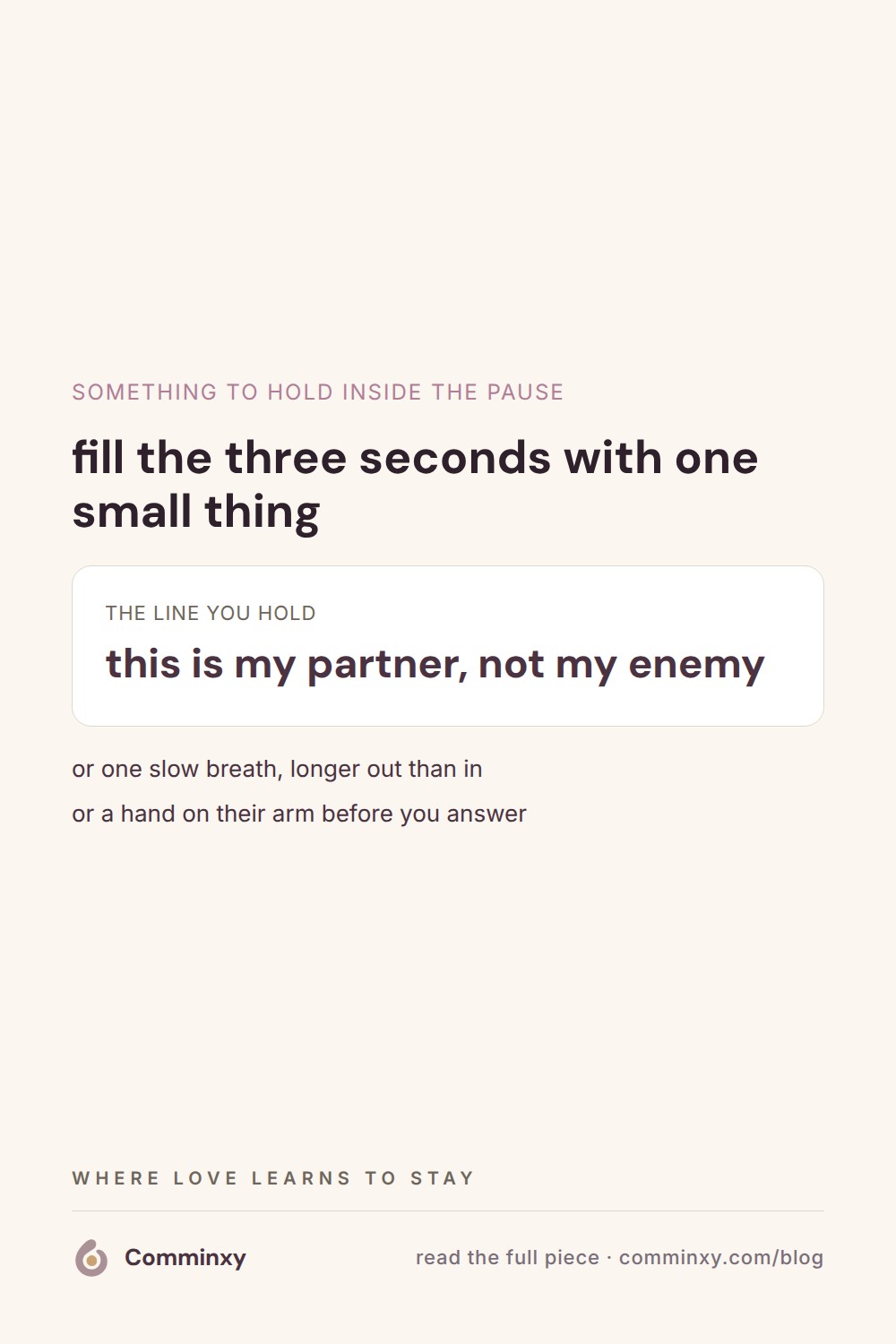
An empty three seconds is hard to hold when your whole system is telling you to respond now. So it helps to have something to do inside it, something small enough to reach for while flooded.
For some people it is a breath, one slow one, out longer than in. For others it is a single sentence held quietly in the mind, something like this is my partner, not my enemy, which sounds almost too simple until the night you actually need it. Some couples find that a bit of warmth, even clumsy warmth, does more than any pause alone. There is research on this too. Carstensen, Gottman and Levenson found that the couples who stayed steady over the long run were the ones who could bring humor and affection into conflict, using it to soothe their own physiology mid-argument (Carstensen, Gottman and Levenson, Psychology and Aging, 1995).
A hand placed on their arm before you answer. A half-smile that says we are both tired and this is silly. These are not performances of calm. They are ways of telling your own nervous system that you are safe, so that the reply which follows comes from somewhere gentler.
And if you cannot find any of that in the moment, the pause can also come after. You can circle back an hour later and say the thing you wish you had said, which is its own kind of repair. Learning to communicate better with your partner is far less about never reacting than about how quickly you find your way back once you have.
What you are really buying with the wait
The pause does not make you win. It makes room for you to stay yourself while disagreeing, which is a harder and more valuable thing.
Think back to that loaded reply, waiting behind your teeth. The three seconds do not delete it. They just give the rest of you a chance to catch up with the part that fired first, so that what leaves your mouth is closer to what you actually mean and further from what the fear wanted. You will still get it wrong sometimes. Everyone does, by Thursday if not sooner.
Comminxy exists for exactly those crossings, the small ones you almost missed and the ones you missed completely, offering a gentle place to notice the pattern and try again. Not because the reply behind your teeth makes you a bad partner. Because underneath it, most of the time, is someone still trying to reach the person across the room. That reaching is where love learns to stay.
Questions people ask
why do I say things I regret in the middle of a fight with my partner
Because your nervous system reacts faster than your judgment can catch up. When your heart rate climbs and your attention narrows, the words that come out are built to defend rather than reach. This is a physical reaction, not a character flaw.
how long should I wait before responding when my partner upsets me
Around three seconds is a useful starting point, since that is roughly how long the first spike of a stress reaction takes to begin settling. Your own pause may need to be longer, because bodies differ. The point is giving your body time to come back down, not thinking up a better comeback.
does taking a pause during arguments actually work
It helps sometimes and not others, which is the honest answer. On nights you are not too overwhelmed to remember it, a pause can genuinely change what happens next. When you miss it, you can still circle back later and repair.
is it too late to fix a fight after I already said the wrong thing
No, returning afterward to say what you wish you had said is its own form of repair. Getting it wrong in the moment is normal for everyone. What matters more is how quickly you find your way back.
Keep the idea with you — pin it, or download the cards.


Notice the reply behind your teeth before it lands
Get Comminxy free →