The Quiet Loneliness in a Good Relationship No One Warns You About
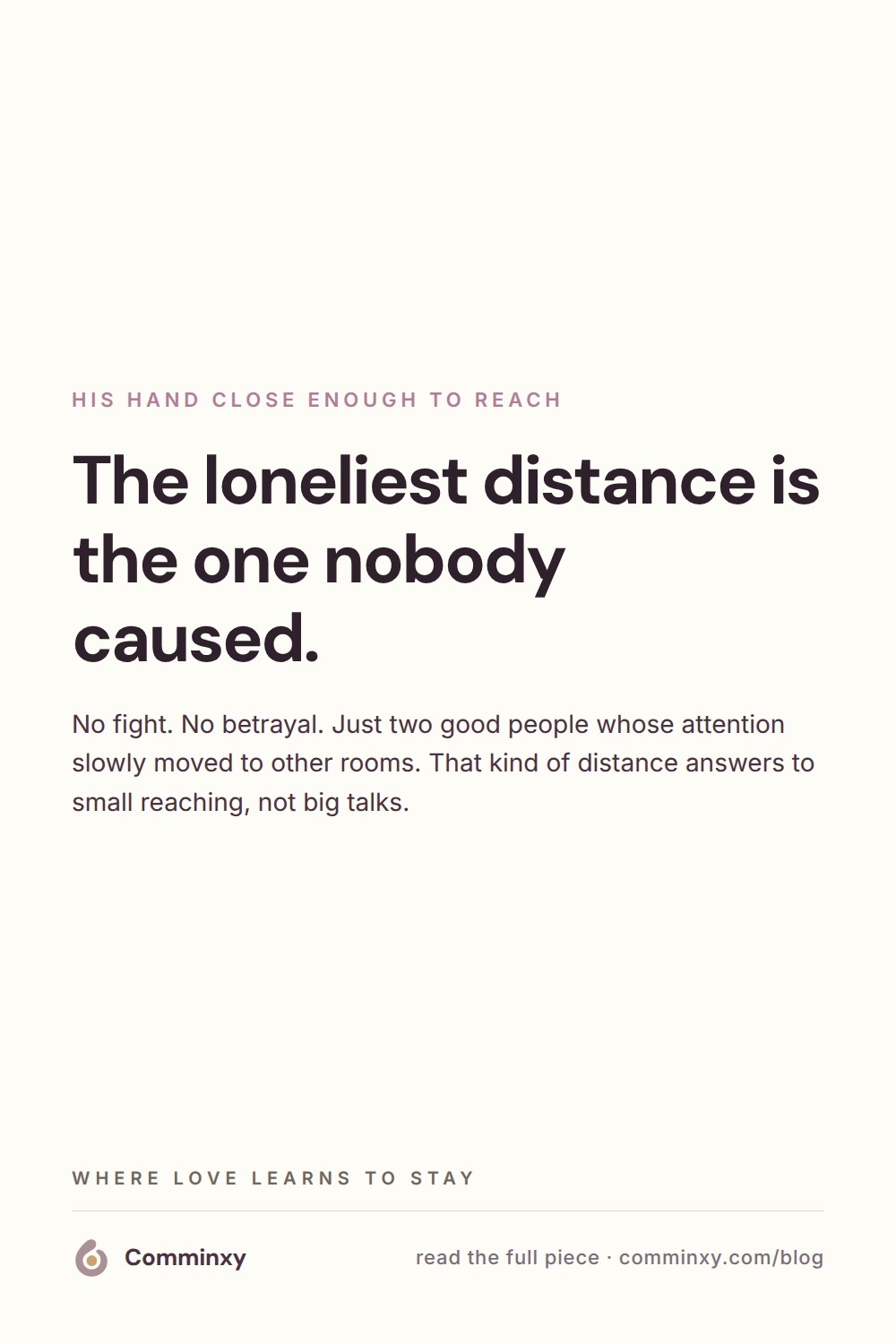
You're both on the couch. The dishes are done, the kids are asleep or were never coming, and the television is saying something neither of you is really watching. His hand is close enough to touch. And still, there's this ache you can't quite name, a quiet loneliness in a good relationship that no one warned you about. Nothing is wrong. That's almost the confusing part. You're not fighting. You're not unhappy, exactly. You just feel further away from someone sitting eighteen inches from you than you did when they lived across a city.
If you've felt that and then immediately felt guilty for feeling it, what do I have to complain about?, you should know how ordinary this is. It shows up in the best relationships, the kind other people admire. And it rarely arrives as a crisis. It arrives as a slow quieting.
The loneliness that lives inside "we're fine"
You tell your partner about something that happened at work. A small win, a strange comment from a colleague, a moment you turned over in your mind all afternoon. And they say, "That's nice," without looking up. Or they solve it. Or they nod in the way people nod when they're already thinking about the next thing.
Nothing cruel happened. No door slammed. But something you were holding out, a small piece of your day which is really a small piece of you, didn't get met. And you put it away. You don't even decide to. You just quietly stop reaching. Multiply that by a thousand ordinary evenings, and you arrive at the couch, at the eighteen inches, at the ache.
Why closeness fades when nothing's wrong
We're taught to watch for the dramatic things. The affair, the screaming, the walking out. And those things are real. When researchers asked formerly married people why their marriages ended, the leading causes were infidelity, incompatibility, and substance issues (Amato and Previti, Journal of Family Issues). Big, nameable ruptures.
But most of us aren't living inside a rupture. We're living inside a slow drift, and the drift is made of much smaller material. The moments we didn't turn toward each other. Not out of malice, but out of tiredness, distraction, the sheer volume of a shared life. The bond doesn't break. It just stops being fed.
Love can be entirely intact and closeness can still be starving, because they aren't the same thing. Love is a state. Closeness is a practice, something you do over and over in the smallest exchanges. And when the practice quietly stops, the loneliness moves in through the gap it leaves.
The tiny moment that carries more weight than you'd think
The moments that keep couples close aren't the hard ones. Not the fights repaired, the crises survived. They're the good-news moments. The small "guess what happened today."
Researchers studying how partners respond to each other's good news found that the way you answer when someone shares something positive shapes relationship satisfaction more powerfully than almost anything else. Specifically, the active-constructive response, turning fully toward the person, getting curious, letting yourself be genuinely glad with them, carries the strongest influence on how satisfied couples feel (De Netto, Quek, and Golden, Frontiers in Psychology, 2021).
Sit with what that means for a second. The arguments aren't what quietly decide the distance between you. It's the "that's nice" said without looking up. It's the thousand tiny bids for connection that got a polite, distracted response instead of a real one. The loneliness you feel on the couch isn't a sign that something dramatic went wrong. It's a sign that a lot of small, undramatic somethings went unanswered, on both sides.
Why this is easier to repair than it feels
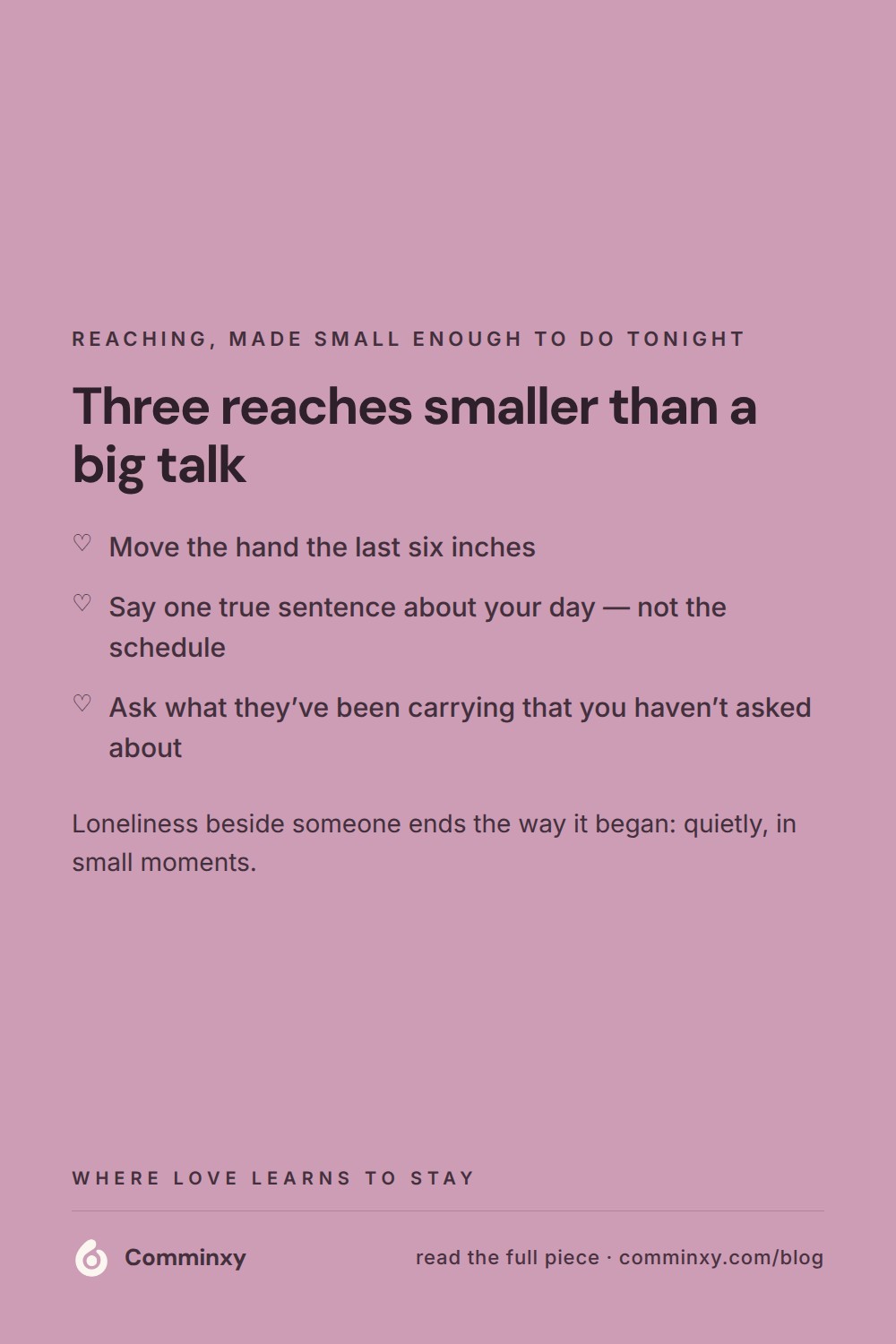
The good news hidden inside that finding is enormous. If the distance was built from small missed moments, then it can be rebuilt from small caught ones. You don't need a summit meeting or a dramatic reckoning. You need one moment of turning toward, and then another.
It can be as ordinary as looking up from your phone when they walk in with a story. Asking one more question instead of moving on. "Wait, what did she say back?" Letting yourself be a little more glad than feels efficient. These are not grand gestures. They're the practice of closeness, resumed. And they land more heavily than they should, precisely because they've been missing.
Much of this lives in the texture of everyday exchanges, the way we talk, the way we listen, the way we respond when someone hands us a piece of their day. If you want somewhere concrete to start, the small mechanics of turning toward each other are worth a closer look, and this piece on how to communicate better with your partner holds some of them gently. The distance rarely needs a solution. It needs attention flowing again.
What coming back toward each other looks like
It usually doesn't look like a conversation about the distance itself. It looks like Tuesday. One of you saying "guess what happened today," and the other one actually stopping. Putting down the phone, turning the body, asking the second question. The piece of yourself you'd stopped offering finding, for once, a place to land.
The first time it happens, it might feel almost too small to matter. It isn't. That small landing is the whole thing, in miniature. The practice starting again. And practices, unlike ruptures, don't require you to be perfect. They only require you to return.
So back to the couch, the television murmuring, his hand close enough to touch. The loneliness in that eighteen inches was never proof that the love left. It was proof of how many small moments went unanswered while the two of you were busy loving each other in every other way. Tonight, maybe, one of you tells the other something small. And the other one looks up. That's where it starts to come back. Tools like Comminxy exist to help you notice those moments in real time, the bids, the turning toward, the tiny openings you'd both stopped seeing, because this is exactly where love learns to stay. Not in the grand repair. In the next ordinary evening, met a little more fully than the last.
Questions people ask
why do i feel lonely in a good relationship
You feel lonely because small bids for connection have gone unanswered over time, not because anything dramatic went wrong. When your partner responds with distraction instead of genuine interest to the small things you share, closeness starves even when love remains. The loneliness builds from a thousand tiny moments where neither of you fully turned toward the other.
how do you fix feeling distant from your partner when nothing is wrong
Start turning toward each other in the smallest moments instead of waiting for a big conversation. Look up when they tell you about their day, ask one more question, let yourself be genuinely glad when they share good news. Closeness rebuilds through repeated small practices, not grand gestures or crisis talks.
what does it mean when your partner says that's nice but doesn't look up
It usually means they are distracted or tired, not that they don't care, but those small dismissals add up over time. Each moment where a bid for connection goes unanswered creates a tiny gap, and eventually those gaps become the quiet loneliness you feel. It is one of the most common ways closeness fades in otherwise good relationships.
Keep the idea with you — pin it, or download the cards.



Comminxy helps you notice the small bids you've both been missing
Get Comminxy free →