Introvert Extrovert Couple Communication: How to Meet in the Middle
The party has been over for an hour, and you are lying in the dark going back through it. Not the party itself. The car ride home. One of you spent the whole drive lit up, replaying who said what, still half-inside the room you just left. The other gave shorter and shorter answers until the shortness became its own kind of statement, and now here you both are, back to back, each quietly certain the other did something wrong.
This is one of the oldest tensions in introvert extrovert couple communication, and it almost never announces itself honestly. It shows up as a mood. A flatness. A partner who seemed fine at nine and distant by eleven. And underneath it, two people who spent the same evening in two different bodies, each one starting to wonder why the person they love makes the simplest things feel so hard.
Before anything else, it helps to know that neither of you invented this to hurt the other.
The same evening, felt in two different bodies
One of you came home refilled. The talking was not a performance to get through. It was the thing itself, the way the evening put something back that the week had taken out. To be pulled away from it early, or met at the door with silence, can feel like a curtain coming down on the one good part.
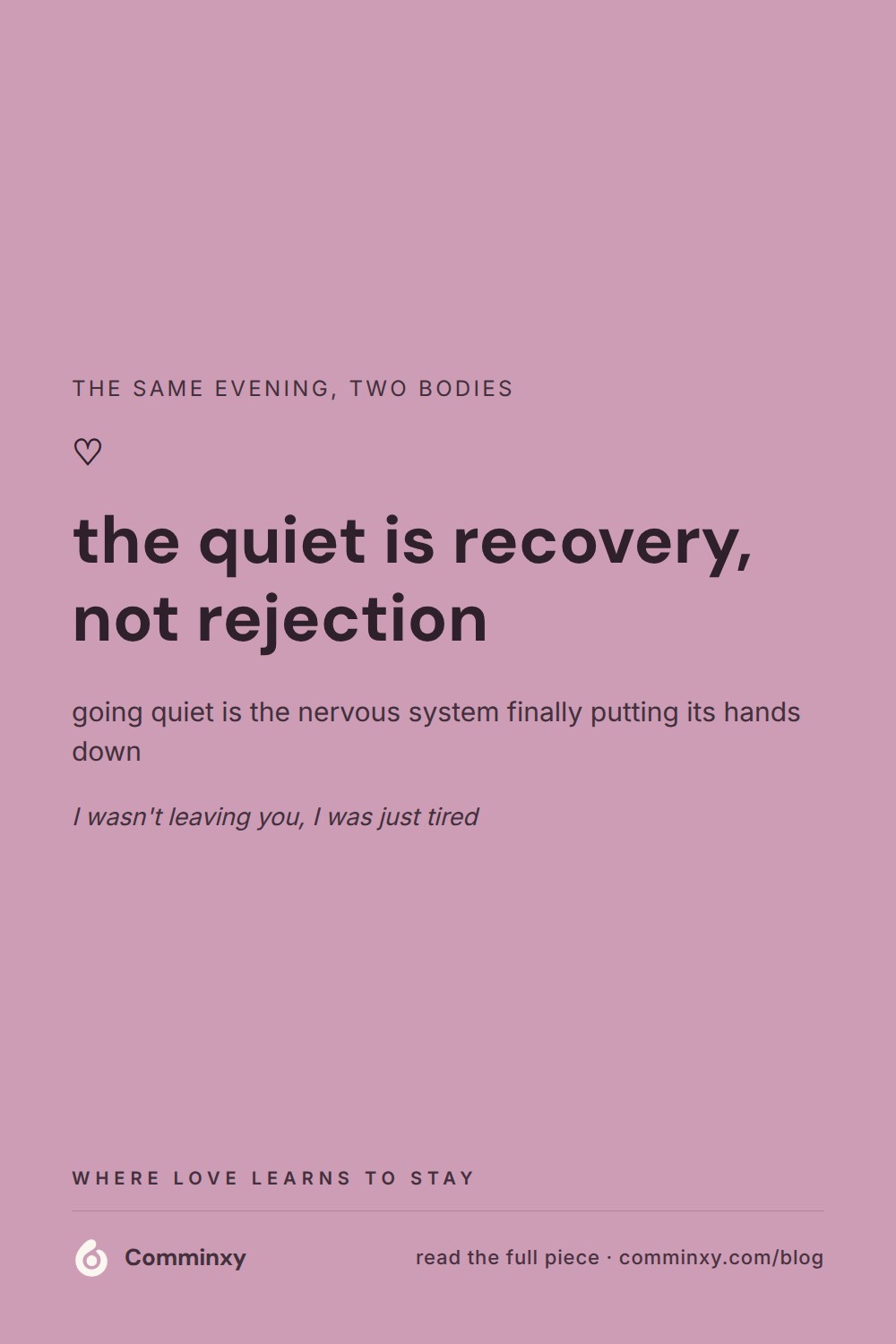
The other came home spent. Not because the people were bad, or the night was bad, but because there is a real cost to being switched on that long, and it comes due all at once, usually somewhere around the coat going onto the hook. The quiet that follows is not withdrawal from you. It is the nervous system finally being allowed to put its hands down.
Both of these are true at the same time. That is the whole difficulty. One person's recovery looks exactly like the other person's rejection, and neither of you is misreading it on purpose.
What the quiet partner is actually doing
There is a particular loneliness in being the one who needs less. You start to suspect that the amount of togetherness that feels warm to you reads as cold to them, and so you begin apologising, in small ways, for a temperature you cannot help.
What is easy to miss is how much the quiet one is often giving. Turning up to the party at all. Staying past the point of comfort. Making conversation with a stranger in a kitchen because it mattered to their partner that they came. By the time the door closes, a great deal has already been spent, quietly, without anyone counting it.
The trouble is what happens next. Because withdrawal, even the gentlest kind, does something over years that is worth naming plainly. In Gottman and Krokoff's long-term work, conflict withdrawal predicted a serious decline in marital quality over time, while active disagreement, the kind that stays engaged, sometimes led to things getting better (Gottman and Krokoff, Journal of Consulting and Clinical Psychology, 1989).
Read that gently. It does not mean the introvert is quietly ruining things by needing rest. It means there is a difference between I need twenty minutes and then I am yours and a silence that simply closes and never reopens. The first is recovery. The second, over enough nights, becomes distance neither of you chose. The rest is not the problem. The disappearing is.
What the talkative partner is actually doing
And on the other side of the bed is someone who has been told, in a hundred small ways across a lifetime, that they are too much. Too loud in the car. Too keen to rehash it all. Too quick to fill a silence that the other person was, apparently, enjoying.
What that partner is usually doing, when they narrate the whole evening back, is trying to stay close. The talking is a hand reaching out. It says I had a good time and I want you here in it with me. When it lands on a wall of tiredness, the reach doesn't stop. It gets louder, more insistent, more hurt, because being met with nothing is its own small grief.
So you get two people, both reaching, in languages that cancel each other out. One reaches by speaking. One reaches by going quiet and hoping to be left whole. And each experiences the other's reach as the withdrawal of love.
The way back is a smaller conversation than you think
The repair here is almost embarrassing in its plainness, which is why couples skip past it for years looking for something bigger.
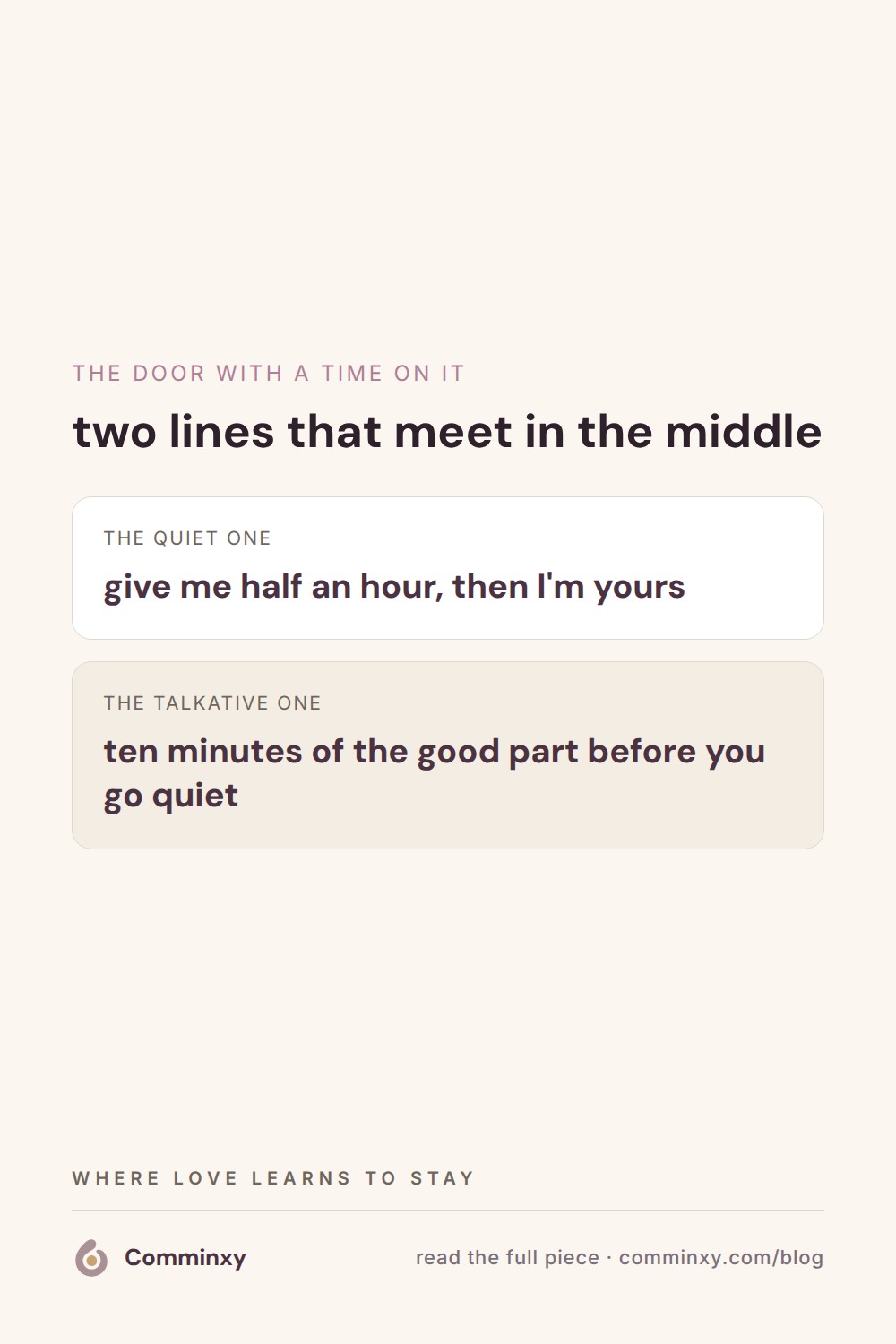
It starts with naming the thing out loud, in daylight, when no party is looming. Something as ordinary as when we get home from something big, I need about half an hour where you don't need me to be a person yet. It's not you. I come back after. Or, from the other side, the talking afterwards is how I hold onto the good bits. Can I have ten minutes of it before you go quiet on me?
Notice that neither of those asks the other person to change what they are. They ask only for a shape. A door left open, with a time on it. The quiet one gets to say I am coming back instead of just vanishing. The talkative one gets to be met, even briefly, instead of shut out.
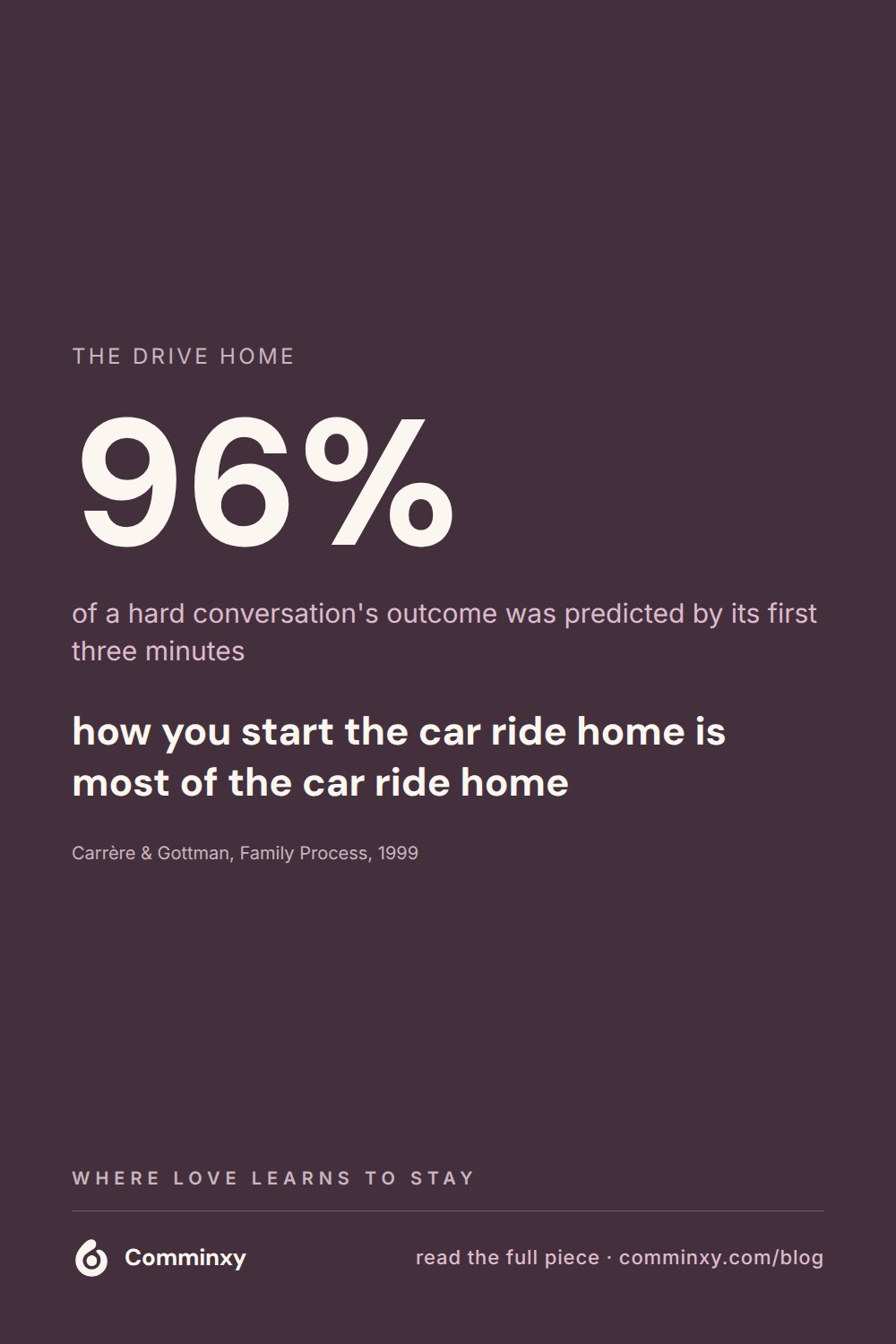
There is real evidence that this small, early handling of tension matters more than the grand gestures. Carrère and Gottman found that the first three minutes of how a couple begins a difficult conversation predicted the outcome of the whole thing ninety-six percent of the time (Carrère and Gottman, Family Process, 1999). How you enter the car ride home is, quietly, most of the car ride home.
You will forget all of this by next Saturday. One of you will disappear too fast, or reach too hard, and the old ache will come back for an evening. That is not failure. Two nervous systems on different clocks were never going to sync perfectly, and the couples who make it are not the ones who never mismatch. They are the ones who keep finding the door back to each other.
So the next time you are lying there, back to back, replaying who did what, you might try turning over and saying the small true thing instead. I wasn't leaving you. I was just tired. Or, I only wanted to keep the good part going a little longer. That is the whole repair, most nights. Comminxy exists to help partners find those words in the moment they are hardest to reach, so the quiet one and the talkative one can meet in the middle a little sooner, and love learns to stay through the mismatch instead of despite it.
Questions people ask
why does my introvert partner go silent after we go out
For most introverts the quiet is recovery, not rejection. Being social for hours has a real cost that comes due all at once, and going quiet is how the nervous system recharges. It is usually about needing rest, not about anything you did wrong.
is it normal for an introvert and extrovert to date
Yes, plenty of couples run on different social batteries and stay close. The tension tends to come from mismatched recovery needs rather than from being incompatible. What helps is naming what each person needs after an event before the mismatch turns into a fight.
how do I stop feeling rejected when my partner wants space
It helps to reframe their space as recovery rather than a verdict on you. Ask them directly for a small window of connection with a time on it, so you feel met without them feeling crowded. If the feeling of rejection runs deep or persists, talking with a counselor can help you sort through it.
how much alone time is normal in a relationship
There is no fixed amount, since it depends heavily on each person and their day. What matters more is that alone time comes with a clear return, so it reads as a pause and not a shutdown. Trouble usually starts when the quiet closes and never reopens.
Keep the idea with you — pin it, or download the cards.


Find the small true words before the silence hardens.
Get Comminxy free →