How to Know If Your Relationship Will Last (What the Research Really Says)
Most people, lying awake and running the question, picture a single tell. A sign that would settle it. Some behaviour that would mean this one is going to make it, or that it won't. And the research keeps arriving at a quieter, stranger answer: the thing that most reliably predicts whether a relationship lasts is not a trait either of you carries, but how the two of you treat each other in the small, repeated weather of ordinary days.
When researchers pooled 43 separate studies and ran machine learning across them, looking for what best predicted how satisfied someone was in their relationship, the winners were not personality types or compatibility scores. They were a person's own perceptions of the relationship itself: how committed they felt their partner was, how appreciated they felt, how they experienced conflict (Joel, Eastwick, Allison et al., PNAS, 2020). The person you are matters less than what happens in the space between you.
That same study found something harder to sit with. Change in relationship quality over time was largely unpredictable. The present could be read. The future stayed closed.
How to know if your relationship is going to last
So the honest answer to the question people type at midnight is that you cannot know, not in the way you want to. There is no instrument that reads the future of a particular couple. What the research offers instead is a map of what tends to erode things, and that map is worth having, because most people are looking at the wrong landmarks.
They watch for the big rupture, the betrayal, the dramatic fight. Gottman and Levenson, following couples over years, found that the ending often announces itself much more quietly. Marriages that dissolved earlier, around seven years in, were marked by criticism, defensiveness, contempt and stonewalling during conflict. The ones that came apart later, around fourteen years, were marked by something softer and sadder: a thinning of positive feeling, tenderness draining out of the everyday conversations, not just the hard ones (Gottman & Levenson, Journal of Marriage and the Family, 2000).
Which means the question is not only whether you fight badly. It is also whether the small warmth is still moving between you on a Tuesday when nothing is wrong. Those are the patterns worth understanding, and if you want to understand the conflict side more closely, our piece on communication patterns that pull couples apart sits near that edge.
The sign nobody thinks to look for
Something about this next part tends to catch people off guard. You might assume that what keeps a couple close is how much each person actually does for the other. The kind word, the coffee carried in, the quiet favour.
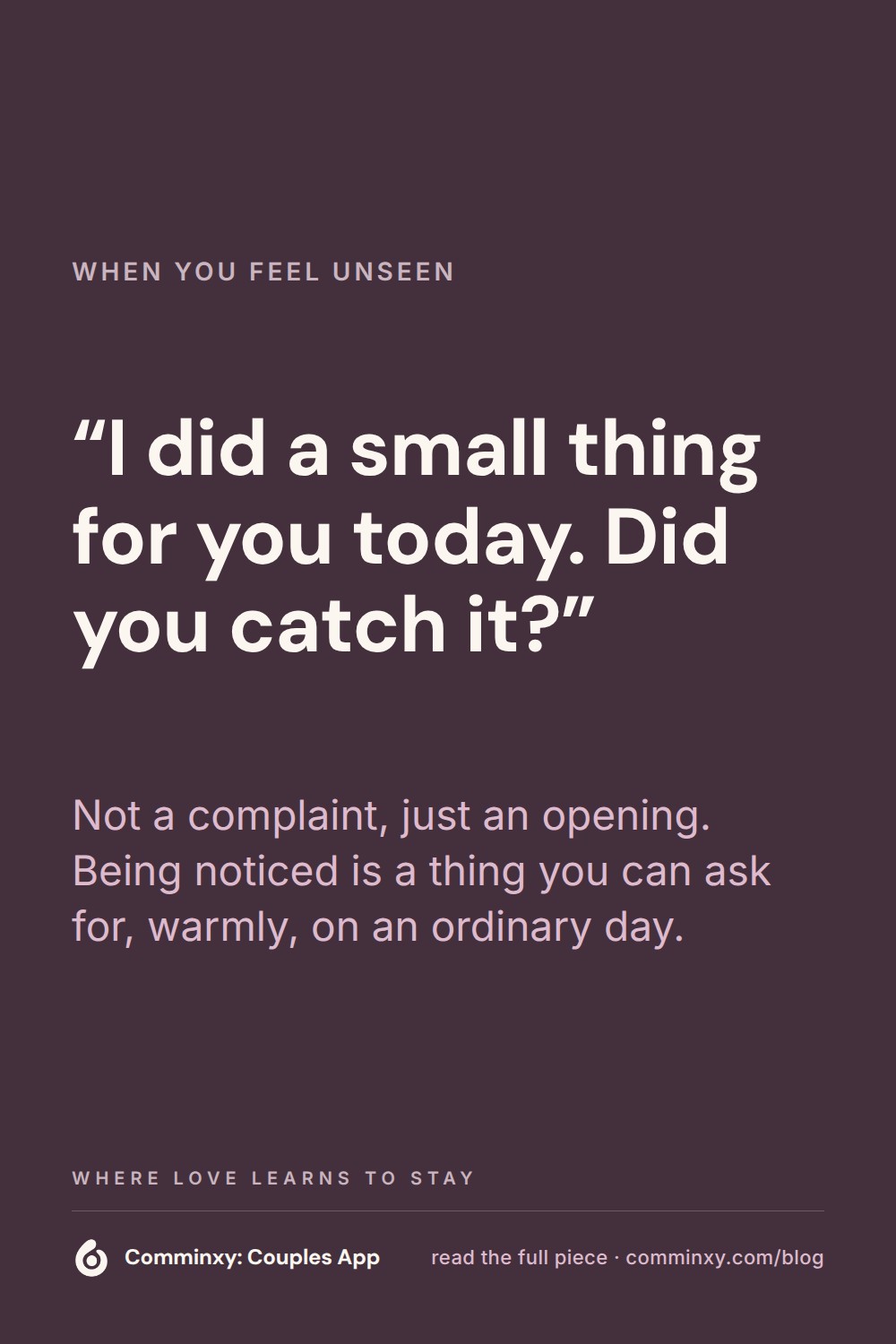
Gable, Reis and Downey asked couples to track positive things their partner did each day, and then compared what each person noticed. Partners agreed on 77% of positive behaviours (Gable, Reis & Downey, Psychological Science, 2003). The interesting part was the disagreements. When someone perceived a kind act that their partner had not even reported doing, that perception was still linked to better mood and well-being that day. But the kind acts that truly happened and went unnoticed by the person they were for? Those were linked to nothing.
Read one way, this is almost unbearable. You can pour yourself into someone and have it register as nothing, because they did not catch it. Read another way, it is a kind of relief. What holds a relationship together is not only how good a partner you are in some objective ledger. It is how much good you are each able to see in the other. And seeing is a thing that can be practised, softened, returned to, long after you thought the account was closed.
If you have been keeping score of everything you do that your partner misses, that ledger is real and your tiredness is real. The research is not telling you it does not count. It is pointing at a different lever than the one you have been pulling.
How to know if your relationship is right for you
This is a different question dressed in similar clothes, and it deserves to be untangled from the first. Lasting and right are not the same measure, and plenty of relationships manage one without the other.
Across 137 studies following dating couples, the strongest predictors of whether people stayed together were commitment, love, and how much each had woven the other into their sense of themselves (Le, Dove, Agnew et al., Personal Relationships, 2010). Satisfaction mattered too, but less than most people would guess. You can be unhappy and committed. You can be happy and halfway out the door.
So when the question is whether this is right for you, the research cannot answer it, and no study can decide it for you. What it can do is loosen a particular fear. Many people carry a quiet dread that they are structurally doomed, that something in their history has sealed it. Children of divorce often carry this most heavily. And it is true that parental divorce roughly doubled the odds of a person's own divorce in one large study. But the same study found that offspring of parents who stayed in unhappy marriages did not inherit that higher risk, and the effect concentrated where parents had seemed only mildly unhappy before parting (Amato & DeBoer, Journal of Marriage and Family, 2001). A doubled odds is not a sentence. It is a tendency, and tendencies bend.
The way back is smaller than you fear
If what predicts lasting is the daily weather, then repair is also daily, and that is better news than it sounds. You do not have to fix the whole thing. You have to change one exchange, and then another.
Picture a hand reaching across to still a leg that has been jittering through a tense conversation, no words, just the warmth of a palm saying I am still here, we are on the same side. That gesture does more than any speech. It is the closeness returning that the long-marriage research was quietly tracking, the thing whose absence predicted the slow drift. You can put it back. Clumsily, late, mid-argument. It still counts.
You will forget this by Thursday. You will miss the kind thing your partner does and they will miss yours, and some night the tenderness will feel very far away. That is not the relationship failing. That is two tired people living a real life, and the repair is available the next morning, and the morning after that. If talking has gone quiet between you, why couples stop talking and how to fix it is a gentle place to start.
So lie there with the question if you need to, but hold it more loosely now. Nobody can hand you the future of your particular love. What you get instead is the next exchange, and the chance to let a little kindness back into it, and then the one after that. Comminxy exists to walk alongside that, a communication companion for the ordinary days where lasting is actually decided. The ending you are afraid of is not written anywhere. You are still here, reading, trying. That has always been where it begins.
Questions people ask
how to know if your relationship is going to last?
You cannot know for certain, because research shows how a relationship changes over time is largely unpredictable. What you can read is the present, especially how you treat each other on ordinary days. The daily warmth and how you handle conflict say more than any single sign.
how to know if your relationship is right for you?
No study can answer this for you, since lasting and being right are different things. People stay together through commitment and love, sometimes even while unhappy, so staying is not proof of rightness. This is a question only you can sit with honestly.
does coming from a divorced family mean my relationship will fail?
No, it does not mean your relationship will fail. Parental divorce roughly doubles the odds of your own, but doubled odds is a tendency, not a certainty. The effect was strongest where parents seemed only mildly unhappy before parting.
what are the early warning signs a relationship is ending?
Earlier breakups often show criticism, defensiveness, contempt, and shutting down during conflict. Later ones look softer, with warmth slowly leaving everyday conversations even when nothing is wrong. Pay attention to the small positive moments, not only the arguments.
Keep the idea with you — pin it, or download the cards.

Let a little warmth back into the next exchange.
Get Comminxy free →