How to Fall Back in Love With Your Partner When the Spark Feels Gone
You were folding the laundry when the thought arrived, fully formed, almost bored of itself: you are not sure you are in love anymore. Not angry. Not planning anything. Just a flat, tired noticing, the kind that comes when you are matching socks and your hands know the work so well that your mind wanders somewhere it did not mean to go. You looked at their jumper in the pile, the grey one with the stretched collar, and felt nothing much at all. And then the quieter fear underneath it: what if that is permanent now.
Yes, people do fall back in love with a partner they have stopped feeling it for, and it happens more often than the flat Tuesday afternoon version of you can believe right now. That is the honest answer, the one worth saying plainly. Not by force, and not by faking it. But it is possible, and it is common, and the feeling going quiet is not the same as the feeling being gone.
That is the whole question this article is trying to answer honestly. Including the part where honesty means admitting what nobody can promise you.
The feeling that went quiet is not always the feeling leaving
When intense love does survive a long time, it tends to keep a specific company. Partners who report still being very intensely in love years in also tend to think warmly about each other, to still want each other, and to do new or slightly challenging things together rather than only the familiar loop of life admin and tiredness (O'Leary, Acevedo, Aron et al., Social Psychological and Personality Science).
The number worth holding is this. In a random US sample, forty percent of people married more than ten years said they were very intensely in love with their spouse (O'Leary, Acevedo, Aron et al., Social Psychological and Personality Science). Not warm about. Not fond of. Intensely in love, a decade or more in.
Sit with that for a second, because the story in your head probably says intense love is a young thing, a starting thing, something that spends itself and leaves you with companionship as the consolation prize. A large chunk of long-married people are quietly living proof that this is not the only ending. What the research does not do is hand you a method. It cannot tell you that if you do the new activity, the feeling returns on schedule. It tells you that the two travel together, which is a different and gentler thing to know.
How to make your husband fall in love with you again, and the uncomfortable thing hidden in that
The wish behind the search is understandable. You want them to feel it first. You want the old look back, the one that would prove this is real, before you risk reaching.
Something strange and oddly hopeful sits in the research. When researchers put more than forty datasets through machine learning to find what actually predicts how satisfied a person feels, the strongest predictors were not the partner's traits or the partner's own reports. They were the person's own perceptions: how appreciated they felt, how committed they believed their partner was, how satisfied they thought the relationship was (Joel, Eastwick, Allison et al., PNAS).
Read gently, this means the love you are waiting to receive is partly built inside your own noticing. Not invented. Not forced. But the thread you pull on is often your own.
There is a smaller study that makes this concrete. Partners frequently disagreed about whether a kind thing had even happened on a given day. When someone noticed a good gesture their partner had not even registered doing, that small seeing was still tied to feeling better about the relationship that day (Gable, Reis and Downey, Psychological Science). The grey jumper in the laundry is one reading of them. They also wore it to the appointment you were dreading, so you would not go in alone. Both are true. One keeps the door shut.
What a way back can actually look like
None of this means the answer is to try harder at feeling something you do not feel. That tends to make the quiet louder.
Couples who do manage to turn back often do it through one specific shift. In studies of emotionally focused therapy, the clearest change came when partners became less avoidant with each other, and when the more guarded one let their softer fear show, attachment anxiety dropped and satisfaction rose alongside it (Burgess Moser, Johnson, Dalgleish et al., Journal of Marital and Family Therapy). The way in was not grand. It was one person saying the true small thing instead of the easy flat one.
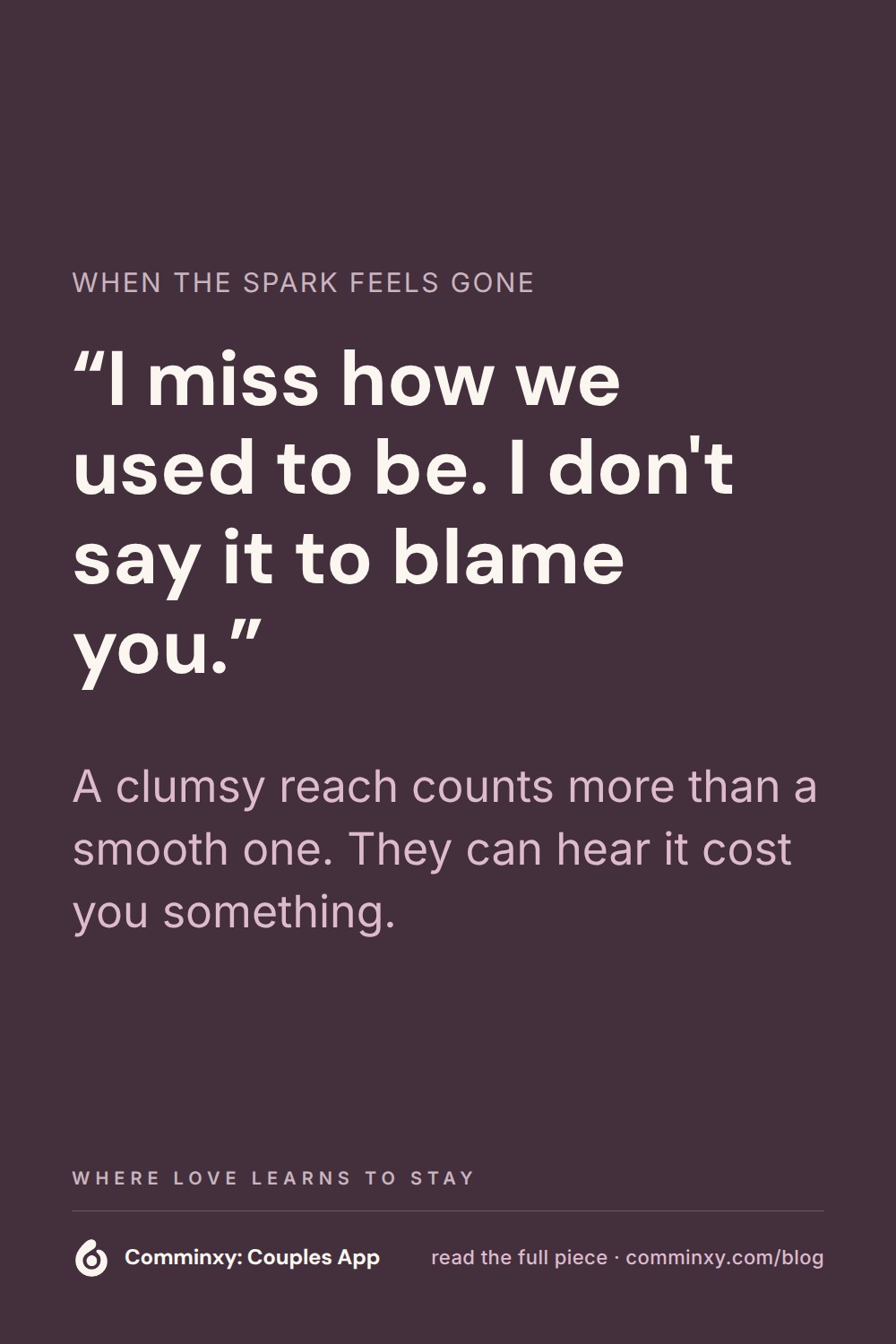
In practice that can be ordinary, close to invisible. Putting a hand flat on their back when they are at the counter, and leaving it there a beat longer than habit. Saying, out loud, I miss how we used to be, not as an accusation but as a confession. It may come out awkward. It may land in a silence before it lands anywhere good. A clumsy reach counts. It may count more than a smooth one, because they can hear that it cost you something.
The part nobody can promise you
Honesty means saying this too. The same research that mapped what predicts satisfaction found that change over time was largely unpredictable (Joel, Eastwick, Allison et al., PNAS). Nobody can hand you odds on your particular Tuesday, your particular two people. Anyone who promises the spark back on a timeline is guessing.
What can be said is narrower and more trustworthy. The flatness you felt over the laundry is not a verdict. Intense love surviving a decade is ordinary enough to be unremarkable, and a surprising amount of what you feel runs through what you let yourself notice and reach toward.
Pick the jumper back up. Not because it will fix anything, but because the person who wore it is still in the next room, and reachable, and so are you. Comminxy exists for exactly that small gap, the one you keep meaning to cross and keep putting off, as a companion for finding the words when the flat afternoon has taken them. The feeling may be quiet tonight. Quiet is not the same as gone, and you have not stopped trying, or you would not be reading this.
Questions people ask
how to fall back in love with your husband
Falling back in love often starts by noticing what is already good rather than waiting to feel the old spark first. Research suggests how satisfied you feel runs partly through your own perceptions of appreciation and commitment. Small honest reaches, like saying you miss how things were, tend to open the door more than forcing a feeling.
how to fix a relationship when one is losing feelings
Feelings going quiet is not the same as feelings being gone, and many couples do turn back from this point. The clearest shift tends to come when the more guarded partner lets their softer fear show instead of staying flat. If the distance feels too deep to cross alone, a couples therapist can help.
how to make my wife fall back in love with me
You cannot force another person to feel something, but you can change what you notice and how you reach toward them. Noticing the small kind things your partner does is tied to feeling better about the relationship, even when they do not realise they did them. Start with one true small gesture rather than a grand gesture.
can you fall back in love after the spark is gone
Yes, people do fall back in love with a partner they had stopped feeling it for, and it happens more often than you might expect. Intense love surviving a decade or more is common enough to be unremarkable. What nobody can promise is a timeline, since change over time is largely unpredictable.
Keep the idea with you — pin it, or download the cards.

Find the words for the small gap you keep putting off.
Get Comminxy free →