The Small Daily Habits That Make Your Partner Feel Loved (Even on Ordinary Days)
She mentions it three months after it stopped. Not angrily, not even with much weight. Just: "You used to check in after my bad meetings. I miss that." And the strange thing is that he had no idea he'd stopped. There was no decision, no turning away. Just the slow crowding out of something small by everything else louder.
If you've been on either side of that moment, you already know something most people miss about the habits that make a partner feel loved. They don't announce themselves. They live in the margins of ordinary days, so unremarkable you barely register them until they're gone.
Love isn't measured in the big moments (it accumulates in the small ones)
We tend to imagine that feeling loved comes from the peaks: the anniversary dinner, the surprise weekend, the tearful conversation that clears the air. Those matter. But they're rare by design, and no relationship can survive on them alone.
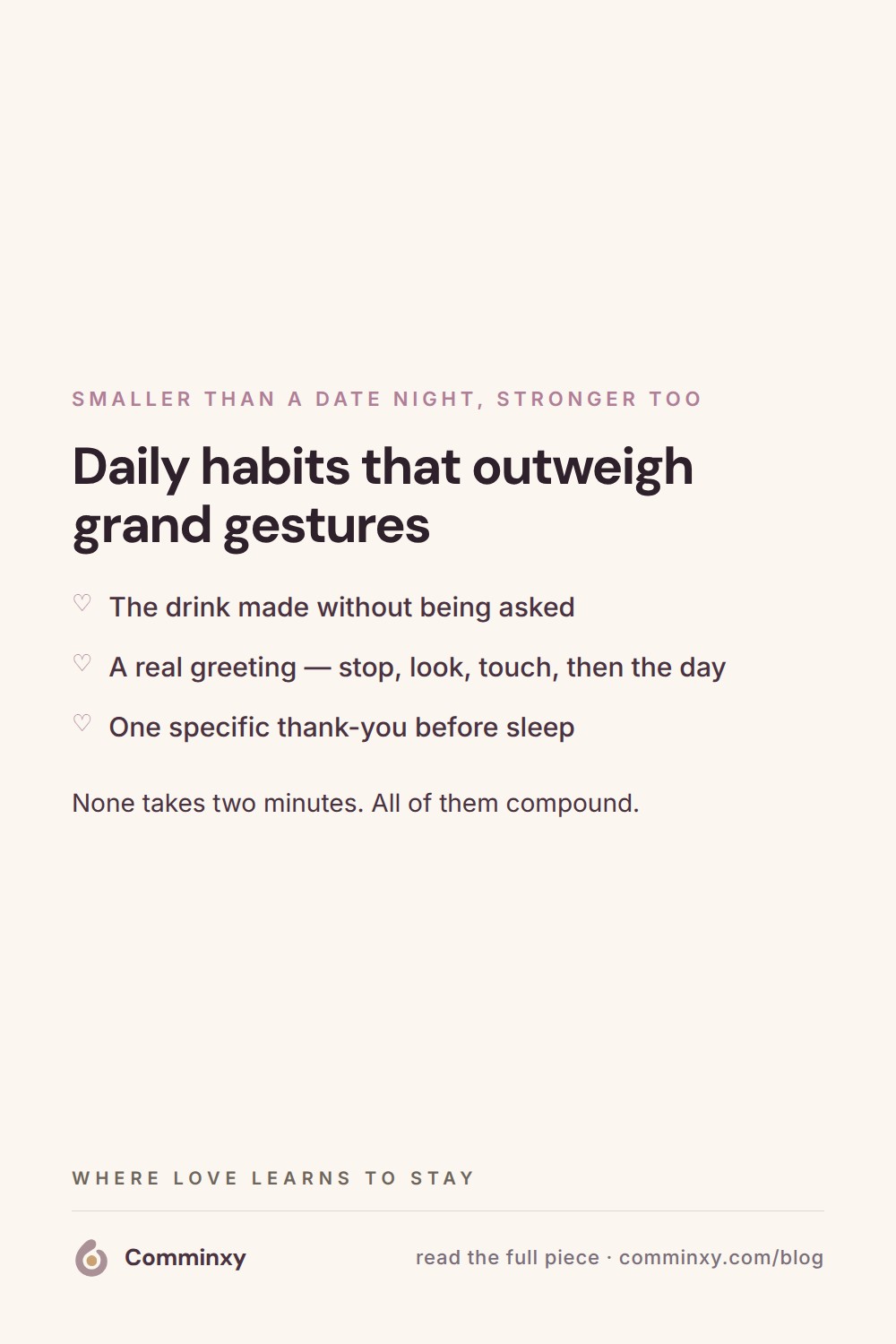
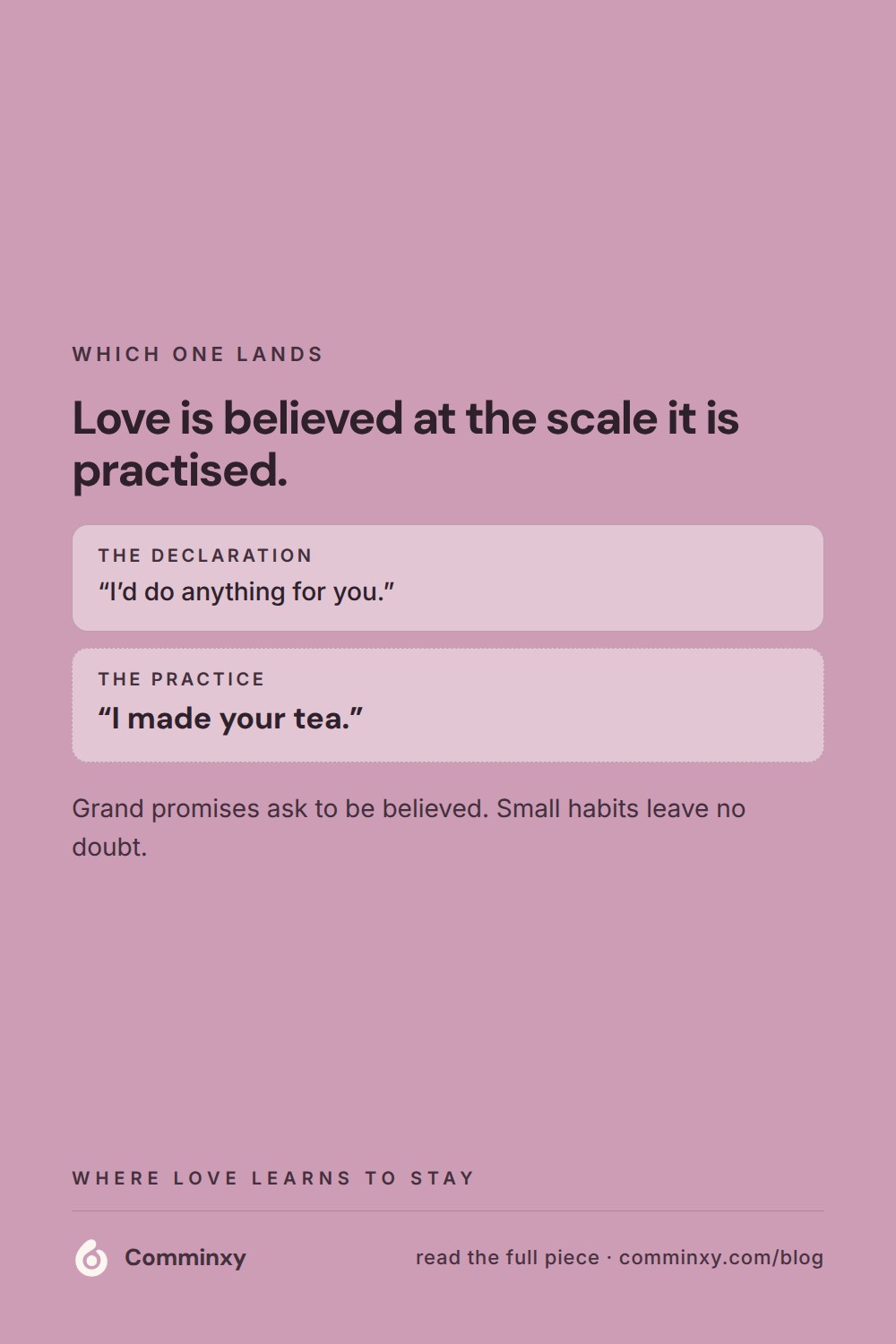
What actually holds two people together is far less cinematic. It's the texture of an average Wednesday. Think about the last time you felt genuinely cared for by your partner. There's a good chance it wasn't a big event at all. It was the tea left on the desk without being asked. The text that said drive safe. The way they remembered you were nervous about the meeting and asked how it went. These are almost too small to name. That's exactly why they work.
Why the small stuff stops happening (and it isn't because the love left)
The small gestures usually don't disappear because someone stopped caring. They disappear because caring became assumed. You know they love you. They know you love them. So the little proofs start to feel redundant, like saying something you both already know.
Life doesn't help. The logistics pile up, and slowly the relationship becomes a series of handoffs: who's picking up the kids, who's calling the plumber, what's for dinner. This is the quiet drift that so many couples describe when they say they've grown apart even though they still love each other. Nothing broke. The small things just got crowded out by everything else.
And the strange thing about small things is that their absence is almost impossible to point to. You can't say you stopped bringing me tea without feeling absurd. So you don't say it. You just feel the distance.
What researchers found hiding inside gratitude
Most of us assume that thanking a partner is nice for them, a small kindness we hand over. But it turns out the person who gains the most might be the one saying it.
Lambert and Fincham, writing in the Journal of Personality and Social Psychology (2011), found that expressing gratitude to a romantic partner enhanced the expresser's own positive perception of that partner, which in turn made them more comfortable voicing concerns within the relationship. When you tell your partner you noticed they took out the bins, you don't just make them feel seen. You quietly rebuild your own sense that this is a person worth being close to.
Gratitude isn't a transaction. It's a way of pointing your own attention back toward the good that's already in front of you. That's the unexpected gift of the small habit. It works in both directions at once.
The five quiet things that keep couples close
When Stafford and Canary set out to understand what actually sustains long-term satisfaction and commitment (Journal of Social and Personal Relationships, 1991), they didn't find a single heroic quality. They found five ordinary ones: positivity, assurances, openness, shared social networks, and sharing tasks.
What's striking is how humble that list is. Assurances aren't declarations. They're the small "we'll figure it out" murmured on a hard night. Sharing tasks isn't a chore chart. It's the felt sense that you're carrying the weight of a life together rather than each dragging your own half. None of these require a personality transplant or a weekend retreat. They're things you can do on a Tuesday morning. A hand on the back as you pass. A "how are you, really?" that waits for the answer. The choice to let them finish the story you've heard before.
Emotional closeness is built less from what we say in our best moments and more from these small proofs of safety we hand each other without thinking.
When the small habits have gone quiet (the way back is small too)
If you're reading this and realising the tea stopped a long time ago, please don't hear that as a verdict. The lovely thing about a relationship built from small moments is that it can be rebuilt the same way. You don't need a summit meeting or a heartfelt apology for the drift.
You just need one gesture, offered without announcement.
Notice something out loud today. Not because you should, but because noticing is where it starts. Say the thank-you you'd usually let dissolve into the morning. Ask the follow-up question. These aren't grand repairs. They're the relationship equivalent of relighting a pilot light. One small flame that makes the rest possible. And because a partner rarely misses these things consciously, they often can't tell you why the day felt warmer. They just know it did.
So think again of that meeting your partner mentioned, or the moment you didn't turn toward them when you could have. None of that has to change dramatically for the room to feel different. It only takes one of you turning, catching the other's eye, and saying the small true thing you'd normally swallow. Love doesn't stay because of the big moments. It stays because someone kept showing up in the ordinary ones. Comminxy exists to help you notice those openings a little sooner, and to make the small true thing easier to say, because that, in the end, is where love learns to stay.
Questions people ask
why do small gestures stop in a relationship
Small gestures usually stop because caring becomes assumed and life logistics crowd them out, not because someone stopped loving the other. You know they love you and they know you love them, so the little proofs start to feel redundant. The relationship becomes a series of handoffs about practical tasks instead of moments of connection.
how to make your partner feel loved every day
Make your partner feel loved by noticing something out loud, saying the thank-you you would normally skip, asking follow-up questions about their day, and offering small gestures without announcement. These can be as simple as texting them to drive safe, remembering they were nervous about something, or bringing them tea. The key is consistency in ordinary moments, not grand gestures.
what makes couples grow apart when they still love each other
Couples grow apart when small daily gestures get crowded out by logistics and life tasks, even though love remains. The relationship becomes about who picks up the kids or what is for dinner instead of moments of connection. Their absence creates distance that is hard to name or point to, so partners feel apart without knowing exactly why.
Keep the idea with you — pin it, or download the cards.



Comminxy helps you notice the small openings that keep love close
Get Comminxy free →