Gratitude in Relationships: The Quiet Glue That Keeps Love Close
The list is stuck to the fridge with a magnet shaped like a lemon. Milk, bread, the specific brand of coffee only one of you drinks, the thing for the leak under the sink that has been on there three weeks. Somewhere a partner walks past it, adds an item, walks off. And the person who wrote most of that list, who has been keeping the house running in a hundred small ways nobody logs, feels something they cannot quite name. Not anger. More like being furniture. Present, useful, unremarked.
Gratitude in relationships lives in exactly this gap. Not the grand thanks, the anniversary speech, the toast at the wedding. The daily, unglamorous noticing of a person who is still trying, still showing up, still doing the invisible work of loving you. When that noticing goes quiet, nothing dramatic happens. The house still runs. The list still gets filled. But something between two people starts to thin.
Why the thank-you goes quiet
Nobody decides to stop being grateful. It erodes the way a path wears down, one unremarkable footstep at a time.
Part of it is simply that you stop seeing. When someone has topped up the coffee for the four hundredth time, the four hundredth top-up does not register as a gift. It registers as normal. This is the strange tax of a good partnership: the more reliable someone becomes, the less visible their effort gets. You do not thank the floor for holding you up. And slowly, without meaning to, you can start treating a person like the floor.
The other part is quieter and a little sadder. Some people go silent on gratitude because they assume it is already known. They think it. They just do not say it. There is a private ledger where all the appreciation is filed, and they trust the other person can somehow read it. But a ledger nobody opens might as well be blank.
The gratitude you feel is louder than you think
Something worth knowing, if you are the kind of person who keeps the thanks inside: you are almost certainly wrong about how much it would mean.
When researchers asked people to express gratitude to someone who mattered to them, the people doing the thanking consistently underestimated how good it would make the other person feel, and overestimated how awkward it would be (Kumar and Epley, Psychological Science, 2018). They braced for a small, faintly embarrassing moment. What they got was someone genuinely moved. The gap between what they expected and what actually landed was large.
Sit with what that means at the fridge. The thank-you you are not saying, because it feels too small, or too obvious, or too late to matter now, would probably land far heavier than you imagine. The thing holding you back is a bad prediction. You are protecting yourself from an awkwardness that mostly does not exist, and in doing so you are keeping something warm from a person who would have carried it around all day.
What saying it does to the one who says it
Gratitude is usually framed as a gift you hand over. It is that. But it also does something quieter to the person giving it, and this is the part that tends to surprise people.
When you say the thank-you out loud, you have to first notice the thing. You have to look at your partner long enough to register what they did. And that act of looking changes what you see. In one study, people who expressed gratitude to their partner came away with a warmer view of that partner, and, crucially, felt more able to raise difficult things in the relationship afterward (Lambert and Fincham, Journal of Personality and Social Psychology, 2011).
That last part matters more than it first appears. Gratitude is often treated as the soft, optional stuff, nice if you have time for it, separate from the real work of sorting things out. What the research suggests is closer to the opposite. Appreciation is part of what makes the hard conversations survivable. A relationship with a steady undercurrent of noticing has somewhere to stand when it needs to say something difficult. If saying the true thing has become hard between you, some of the groundwork lives here, and some of it lives in how you talk to each other more broadly.
When you are the one who stopped noticing
Maybe reading this, the discomfort is not that you are unthanked. It is that you are the one who went quiet. You know, somewhere, that your partner has been carrying more than their share, and the words have not come, and the longer they do not come the harder they get to say.
This is not a character flaw. It is what happens to attention when life gets loud. Work, a sick parent, a bad stretch of sleep, money that will not stretch: any of these will narrow your focus down to the next thing that has to be handled, and the people closest to you are the ones who quietly get moved to the bottom of the list, because you trust them to still be there when you look up.
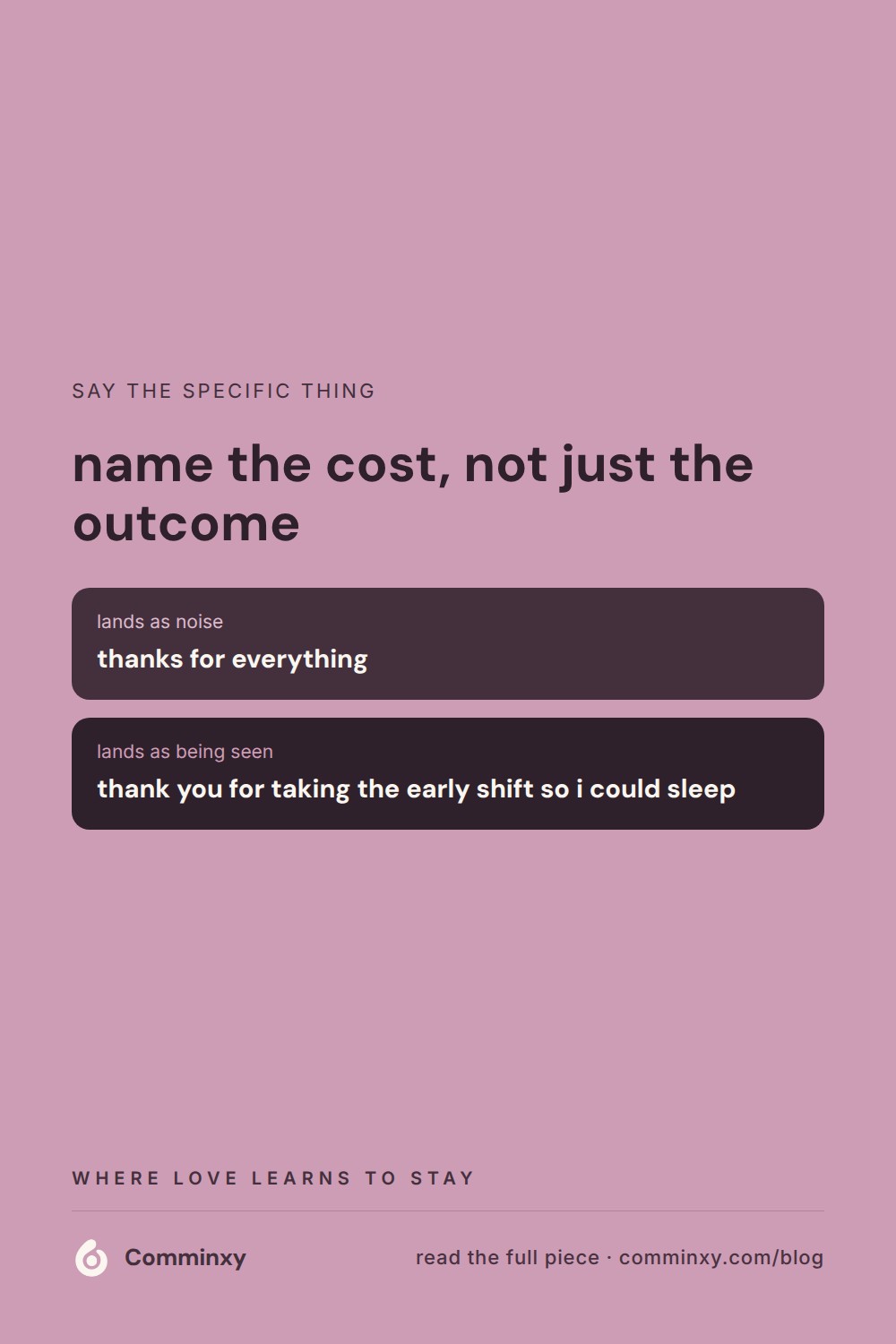
The way back is smaller than the guilt suggests. It does not require a speech or a clean slate or an apology for months of silence. It requires one specific sentence, said out loud, about one real thing. Not thanks for everything, which is so broad it evaporates. Something like: you handled the whole thing with the plumber and I never said anything, and it meant I didn't have to think about it once. Thank you for that. Specific. True. A little late, which is fine, because late and real beats on-time and hollow.
What changes when the noticing comes back
You will not do this perfectly. You will remember for three days and forget on the fourth. You will mean to say the thing and get distracted by the leak under the sink and go to bed with it unsaid again. That is not failure. That is being a tired person with a full life, which is who this is written for.
What tends to shift is not everything at once. It is the temperature of the ordinary hours. The person who felt like furniture starts to feel seen again. The one who went silent finds the words come a little easier the second time than the first. And the fridge list, still there, still needing milk and bread and the thing for the leak, stops feeling like a record of everything one person does alone, and starts feeling like something two people are keeping going together.
None of this asks you to feel grateful on command, which never works anyway. It asks only that when you do notice, you let it out of the ledger and into the room. Comminxy exists to make that easier in the moment it counts, to help the noticing become something said rather than something merely felt. That is a large part of how love learns to stay: not through grand repair, but through a person, again and again, being told that they were seen.
Questions people ask
why don't i feel grateful to my partner anymore
Often it is not that the gratitude is gone but that constant reliability has stopped registering as a gift. When someone does the same helpful thing hundreds of times, your brain files it as normal rather than noticing it. This is common in long partnerships and does not mean you have stopped caring.
how do i thank my partner without it feeling awkward
Say one specific true thing about something they actually did rather than a broad thanks for everything. Naming the exact act, and what it saved you from, makes it feel real instead of forced. The awkwardness you are bracing for is usually far smaller than you expect.
is it too late to start appreciating my partner again
No, and a late thank-you tends to land better than you think. You do not need a speech or an apology for the silence, just one honest sentence about one real thing. Starting small and specific matters more than making up for lost time all at once.
does saying thank you actually help a relationship
Yes, and it appears to help beyond just making the other person feel good. Expressing appreciation can shift how you see your partner and make it easier to raise difficult topics later. If deeper issues persist, talking with a couples therapist can help.
Keep the idea with you — pin it, or download the cards.



Let the thank-you leave your head and reach them
Get Comminxy free →