How to Forgive Your Partner When You Are Still Hurt
You said you forgave them. You meant it when you said it, or you meant to mean it. But three weeks later you are washing your hands in the bathroom and the memory arrives unbidden, and your chest goes tight all over again, and some quiet voice asks whether you actually forgave anything at all. This is the strange bind of trying to forgive your partner while you are still hurt. The words came out. The feeling did not follow them. And now you are wondering if something is wrong with you for still carrying what you said you had put down.
Nothing is wrong with you. Forgiveness is not a switch, and the belief that it should be one is what makes people feel like frauds in their own reconciliation.
The two things happening under one word
There are really two separate things sitting inside the word forgive, and we tend to treat them as one.
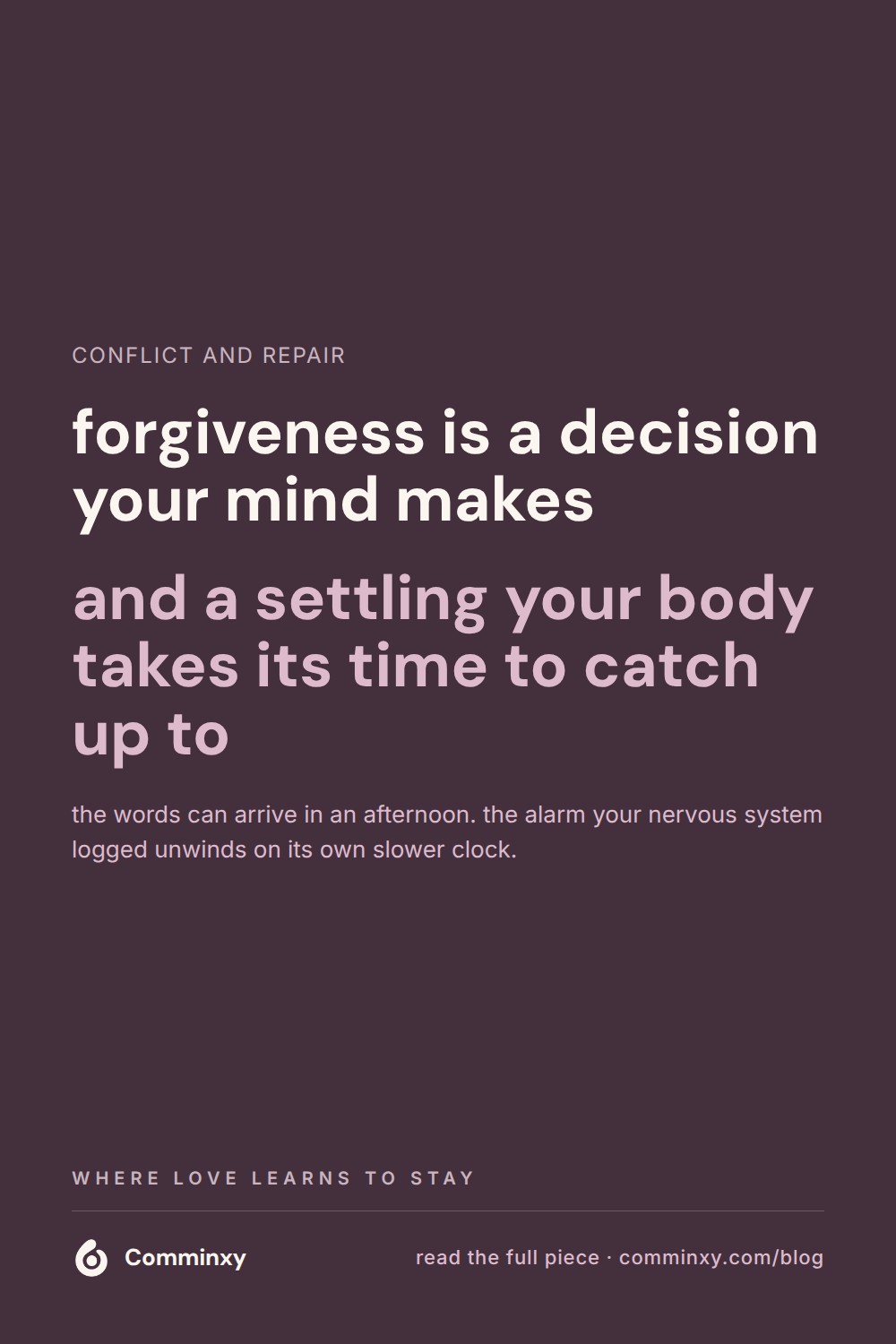
The first is a decision. You choose to stop holding the thing over them, to stop reaching for it as a weapon, to release the idea that they owe you a debt that can never quite be repaid. That part can happen in an afternoon. You can genuinely decide it and mean it.
The second is slower, and it belongs to your body more than your mind. It is the settling of the alarm that got tripped when they hurt you. Your nervous system logged the moment. It does not know the difference between a decision and safety. So it keeps flinching at the doorway you got hurt in, long after you have chosen to walk back through it.
When people say they forgave but still feel raw, they usually mean the decision arrived and the settling has not. Both are real. Neither cancels the other out.
Two ways to read the fact that it still hurts
Here is where two honest people could look at the same lingering ache and see something completely different, and both of them might be right.
One reading is that the hurt still living in you is unfinished business. That somewhere in the apology, something got skipped. Maybe they said sorry for the argument but never for the specific thing that actually cut you. Maybe you forgave quickly because the tension was unbearable and forgiving felt like the fastest way out of a cold house. In this reading, the ache is information. It is telling you a repair happened on the surface and left the deeper thing untouched, and the way through is not more willpower but a truer conversation. If this is you, it may be worth looking at how to say the harder thing more clearly, because the ache that keeps returning is often the sentence that never got said.
The other reading is gentler and just as true. The repair was real, the apology landed, you have genuinely chosen to move forward, and the hurt is simply taking the time that hurt takes. In this reading, the ache is not a sign of unfinished work. It is the ordinary residue of having been wounded by someone you love, and it will thin out on its own if you stop poking it to check whether it is still there.
The hard part is that you cannot always tell from the inside which one you are living. And you do not have to decide today. You are allowed to hold both, to watch which one the coming weeks confirm, to let the answer show itself rather than forcing it.
What actually calms the alarm
The slower kind of forgiveness, the settling, is not something you can think your way into. It happens through repeated small experiences of safety with the same person who once made you unsafe. Your body updates its file on them one ordinary moment at a time.
There is something quietly reassuring in what the research found about how steady couples handle their hard moments. Studying long-married partners, Carstensen, Gottman and Levenson found that satisfied older couples used affection and even humour in the middle of conflict to soothe their own physiology and hold the bond steady (Carstensen, Gottman and Levenson, Psychology and Aging, 1995). The warmth was not a reward handed out once the fight was fully resolved. It was woven through, doing the work of calming the body while the harder feelings were still present.
For someone trying to forgive while still hurt, that is a kind of permission. You do not have to wait until you feel fully healed to let a little tenderness back in. A hand on their shoulder as you pass. Making them tea without being asked. These are not you pretending the hurt is gone. They are the small proofs your nervous system needs that this person is safe again, and each one settles the alarm by a fraction. Forgiveness, the deep kind, is built from a hundred of these, not declared in one.
When the hurt keeps coming back to the surface
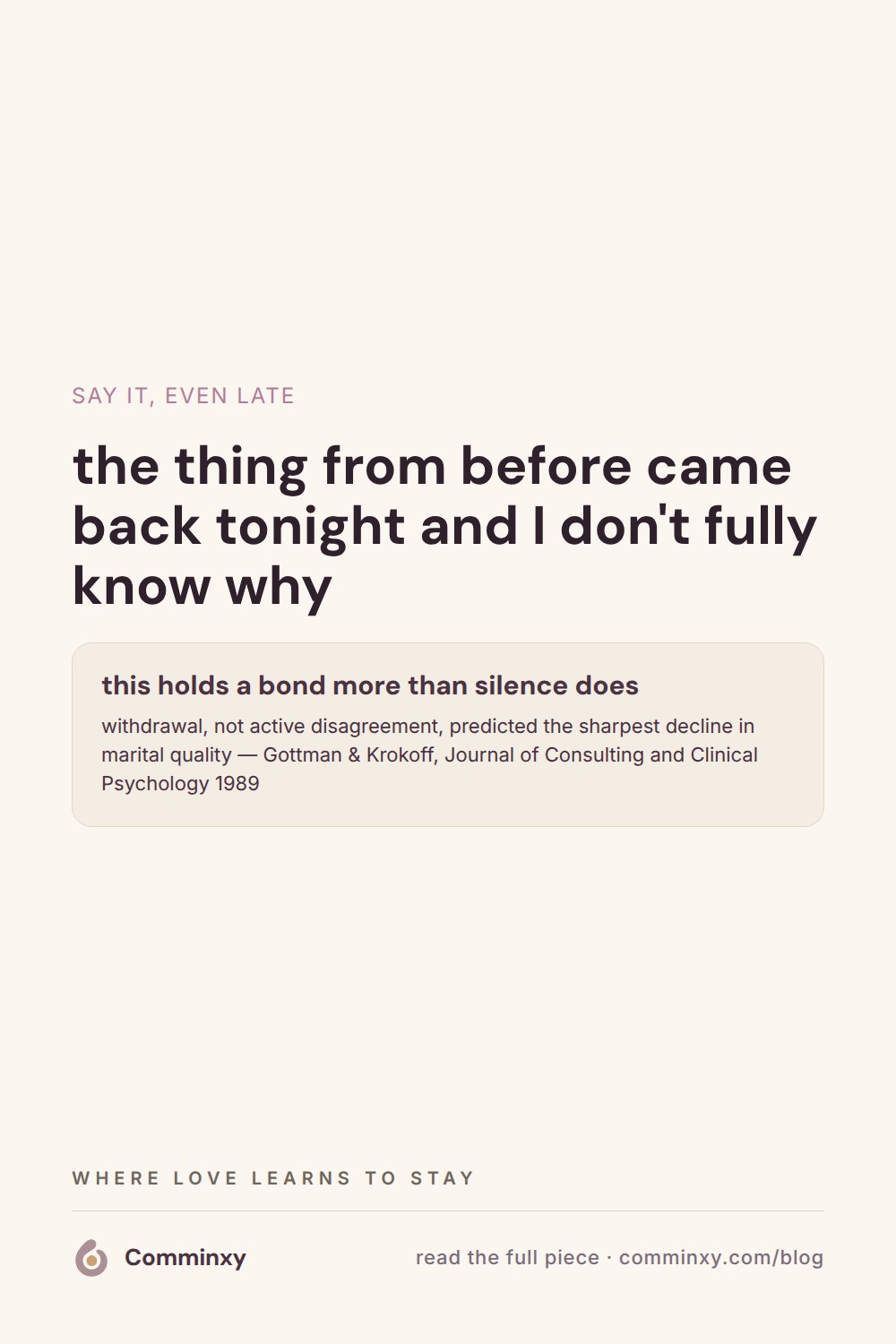
Sometimes the flinching does not fade, and you find yourself bringing the old wound into new arguments, or going quiet and pulling away when they get close. That withdrawal deserves care rather than shame, because it turns out to matter more than the raw disagreement ever did. Gottman and Krokoff found that pulling away and shutting down predicted marriages getting worse over time, while actively working through a disagreement could sometimes lead to things improving (Gottman and Krokoff, Journal of Consulting and Clinical Psychology, 1989).
What that means for you is oddly hopeful. The instinct to protect yourself by going silent, to forgive on the outside and quietly withdraw on the inside, is the thing that tends to erode a bond. Naming the hurt, even clumsily, even weeks late, is closer to what actually holds couples together. You do not have to have healed to say it. You can say, the thing from before came back tonight and I do not fully know why, and that sentence does more than a flawless forgiveness ever would.
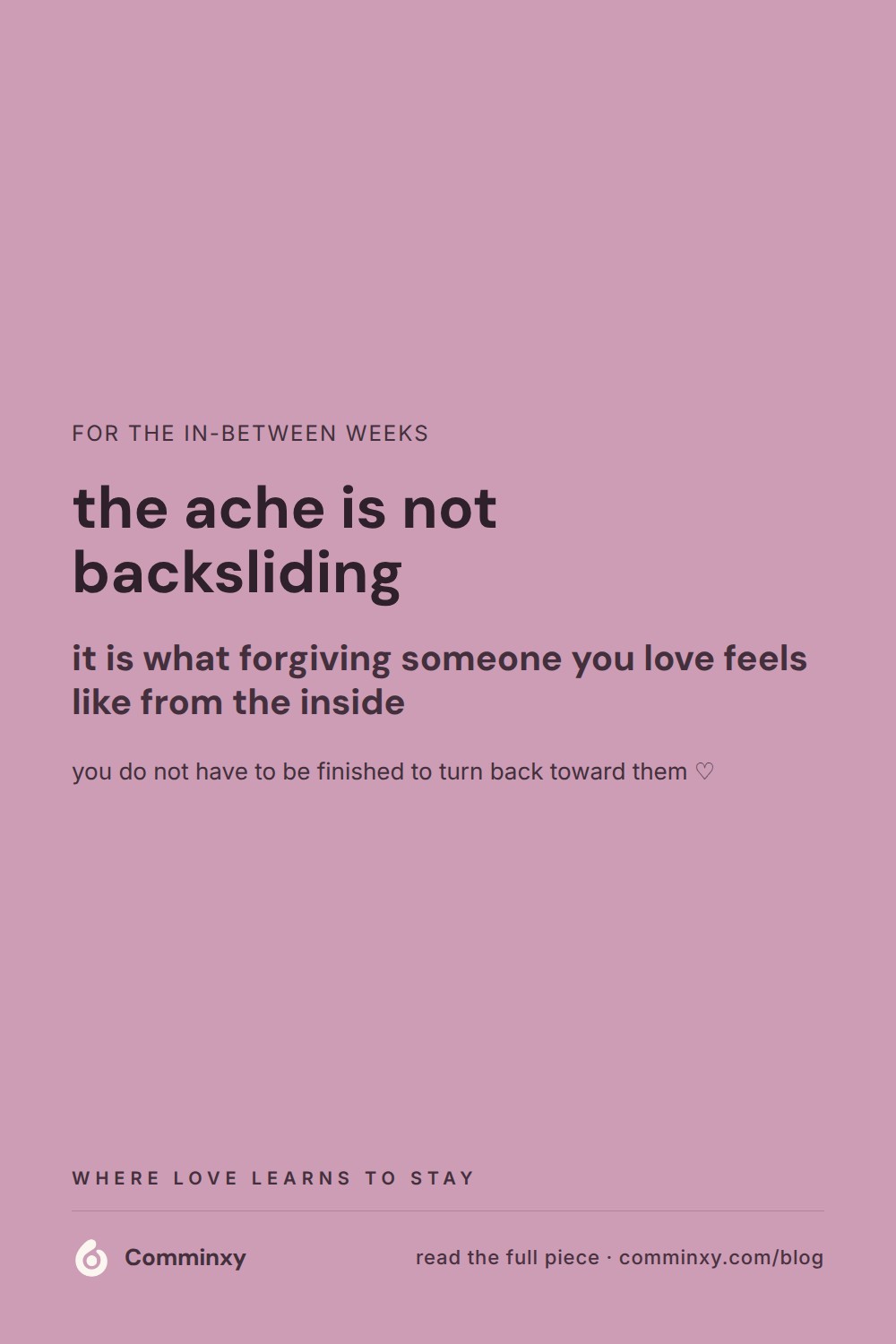
You will do this imperfectly. You will decide you have let it go and then feel it flare on a Tuesday for no reason you can name. That is not backsliding. That is what forgiving someone you still love actually looks like from the inside.
So the memory arrives while you are drying your hands, and your chest tightens, and you notice it. You do not have to be finished. You can turn back toward the person, tea or a hand or a plain true sentence, and let one more ordinary moment tell your body that it is safe here. Comminxy exists for exactly these in-between weeks, when the words have been said and the feeling is still catching up, holding space for the slow work underneath. This is where love learns to stay: not in the moment you declare it healed, but in the many small returns after.
Questions people ask
why do i still feel hurt after i forgave my partner
Because deciding to forgive and actually feeling settled are two different processes that move at different speeds. You can genuinely release the grudge in your mind while your body still flinches at the memory. That lag does not mean your forgiveness was fake.
did i forgive too quickly to keep the peace
It is possible if you forgave mainly to end the tension rather than because the real hurt was addressed. A helpful sign is whether the same ache keeps returning around one specific thing that never got talked about. If so, a more honest conversation may matter more than more effort to feel over it.
is it normal for old hurts to come back during new arguments
Yes, this is common when the deeper wound has not fully settled yet. Old feelings can resurface without warning even after you have chosen to move on. Naming what came up, even weeks late, tends to help more than going quiet.
how long does it take to stop feeling hurt after forgiving someone
There is no fixed timeline because it depends on the wound and on the repeated small moments of safety that follow. The feeling usually thins out gradually rather than switching off. If the hurt stays intense and unmoving for a long time, talking with a counselor can help.
Keep the idea with you — pin it, or download the cards.


For the weeks when the words are said and the feeling still lags
Get Comminxy free →