How to Feel Like a Team Again as a Couple When Life Has Pulled You Apart
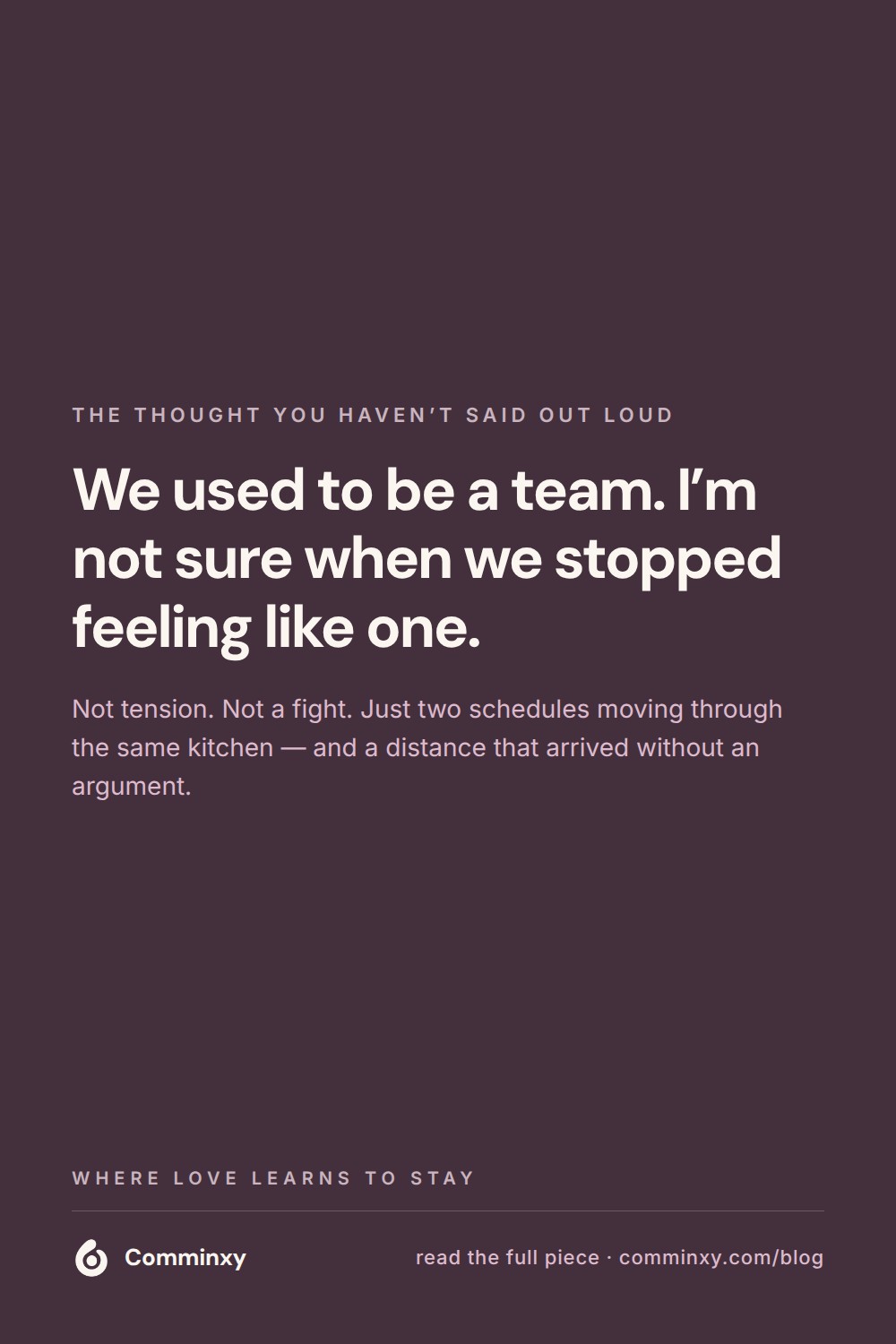
You meet in the doorway, one of you arriving, one of you leaving, and you do the handover. Bins go out tonight. She has had the antibiotic. The plumber is coming between two and four. Forty seconds, no friction, nothing unkind in any of it. It is the same exchange two colleagues make at a shift change, and you are both very good at it now. Later, loading the dishwasher while they answer emails in the next room, you feel it: we used to be a team, and I'm not sure when we stopped feeling like one.
If you want to feel like a team again as a couple, it helps to know what actually went missing. It usually is not love, and it usually is not effort. Most couples standing where you are standing are working harder than they ever have. That is part of what makes it so lonely.
When the partnership turns into logistics
The thing that pulls couples apart is rarely a fight. Often it is competence. You got good at running a life together: the mortgage, the school runs, the ageing parents, the careers that never quite slow down. You became excellent managers of a shared existence, and somewhere inside all that efficiency the we quietly became a to-do list.
You still trust each other. You still show up. But the conversations narrowed. They became about who is collecting whom, what is for dinner, whether anyone rang the plumber back. The wide ones went. The tell-me-about-your-day ones, where the asking was real, got squeezed out by everything that needed doing. This is one of the quiet ways couples who love each other still grow apart. Not a rupture. A slow narrowing of what there is to say.
Why dividing and conquering stops feeling like a team
There is a cruel joke buried in it. The strategy that got you through the hard season, you take that, I'll take this, is the same one that leaves you feeling like flatmates. Split the load and you stop overlapping. You run your zone, they run theirs, and the hours where you are actually doing something together shrink to almost none.
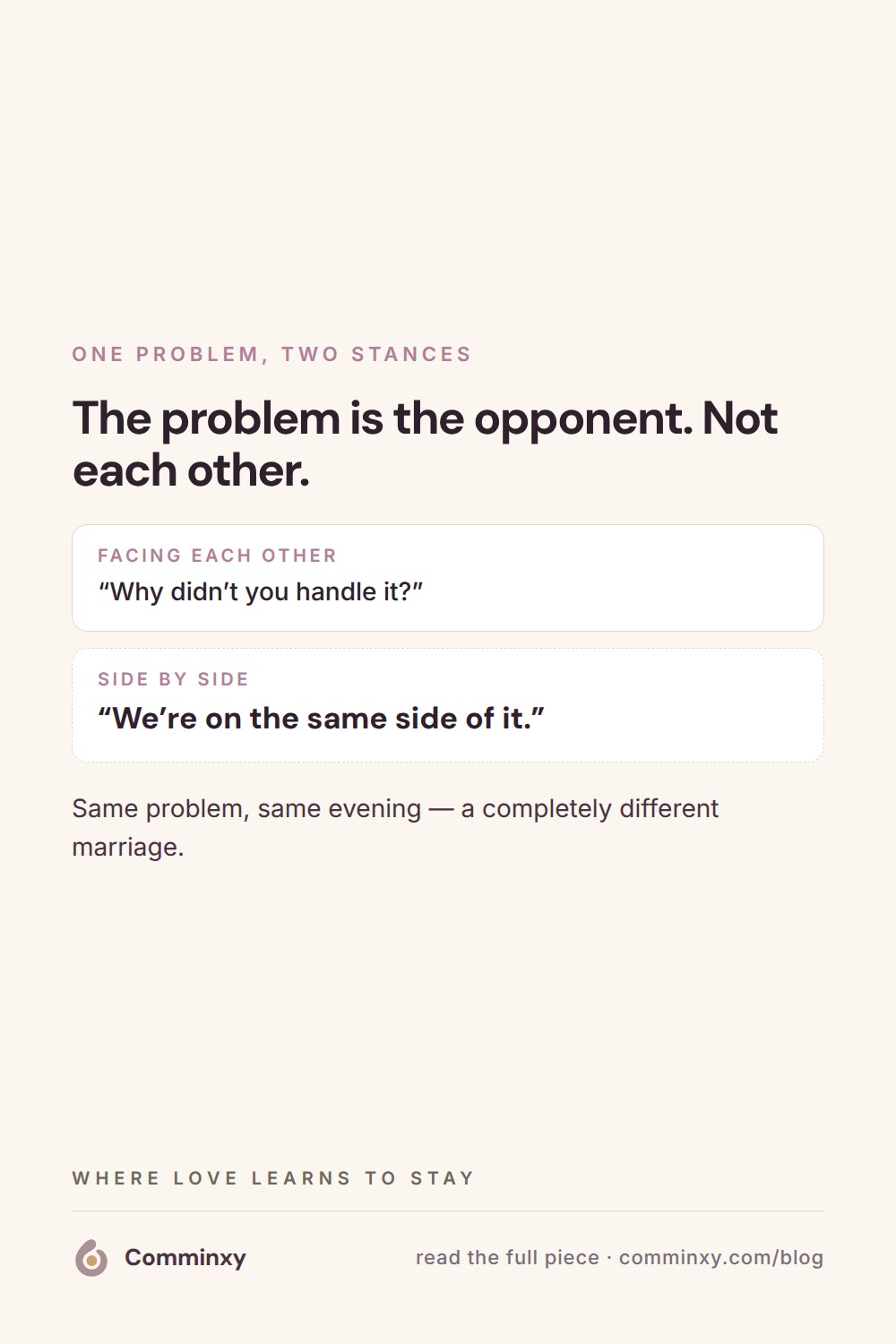
Those overlapping hours were carrying more than anyone realised. Studying what keeps long relationships close, Stafford and Canary found that satisfaction and commitment rest on a handful of ordinary behaviours, and one of them is simply sharing tasks (Journal of Social and Personal Relationships, 1991). Sharing them, not dividing them. There is a real difference between "I'll do the taxes, you do the school run" and "let's sit down and work this out." The first splits the world in two. The second says we're on the same side of it.
So when the team feeling goes, it is usually because the shared doing went first. You optimised yourselves into two departments of the same company.
The small openings you keep walking past
The team does not come back through a grand gesture. It comes back in the moments most of us miss.
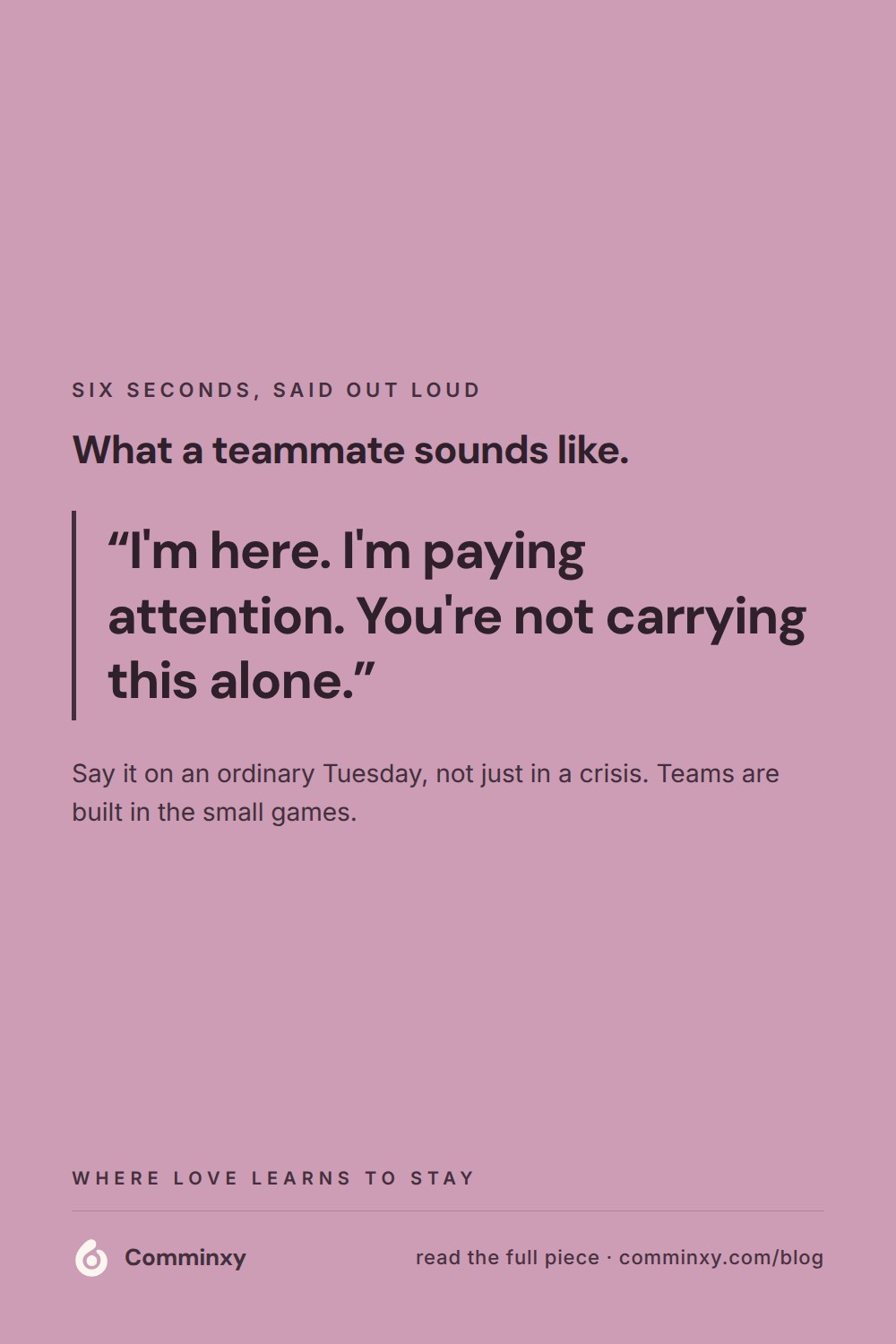
Your partner sighs at their laptop and mutters something about work. That sigh is a door. You can carry on unloading the dishwasher, or you can turn round and ask what happened. They mention, half to themselves, that they are dreading a call with their brother tomorrow. Another door. These are the small daily signals that say I'm here, I'm paying attention, you're not carrying this alone.
Most of us walk past them out of tiredness rather than indifference. You are so busy running your half of the operation that you stop noticing the other person is quietly asking to be met. Learning to catch a door before it shuts is most of the work. If those small conversations keep tipping into friction, it is worth looking at how to communicate better with your partner in a way that leaves you both on the same side.
Rebuilding the us without a summit meeting
You do not need a weekend away or a serious conversation about the state of the relationship, though there is nothing wrong with either. What tends to rebuild a team is smaller and stranger than that.
It is doing one ordinary thing together that you would normally split. Cooking side by side instead of one of you handling it. Folding laundry in the same room, talking while you do. Sitting down to the bills as a joint job rather than a chore that lives on one person's shoulders. These feel too minor to count. They are where the us quietly reassembles, because you are not exchanging information any more, you are sharing an hour.
The point is not to add to your load. It is to stop doing so much of it alone. There is real relief in that. The task you have been dreading gets lighter the moment it becomes ours rather than mine.
What it looks like when the team comes back
Distance in a long relationship is not a verdict. It is a season, and a great many couples move through it and out the other side. Surveying people married more than a decade, O'Leary, Acevedo, Aron and colleagues found that 40 percent described themselves as very intensely in love (Review of General Psychology, 2012). Not fondly attached. Not comfortably settled. Years in, and still that. The closeness you are missing is not behind you by default. It tends to hide behind the logistics for a while.
You will also get this wrong. You will read all of this, mean every word, and hand over the bins in the doorway tomorrow without looking up. That is not the drift winning. It is one evening, and there is another one coming.
So the next time you meet in that doorway with the handover ready, you might try something smaller than a summit. Come and do this with me. Or, how was it, really. Comminxy sits in that space with you, close enough to notice a door while it is still open. A team is not rebuilt in one conversation. It is rebuilt in the turning toward, once, and then again.
Questions people ask
Why do my partner and I feel like roommates?
Usually because the partnership turned into logistics. You divided the work efficiently and stopped doing things side by side. It reads as distance but it is mostly the cost of running a life well.
How do we feel like a team again?
Start by doing one ordinary thing together that you currently split. Cooking, laundry, the bills. Sharing a task rebuilds the sense of us far faster than a conversation about the relationship does.
Is feeling distant from your partner normal after years together?
Yes, and it is not a verdict on the relationship. Long partnerships move through seasons of closeness and distance. The research on couples decades in suggests that closeness is available again rather than spent.
Should we plan a big talk about how disconnected we feel?
You can, but it is rarely where the change comes from. Turning toward one small moment, a sigh at a laptop or something said half to themselves, tends to do more than a scheduled conversation about the state of things.
Keep the idea with you — pin it, or download the cards.


The doorway handover is a place to try something smaller.
Get Comminxy free →