Love vs Commitment in Relationships: Why Staying Takes More Than Feeling
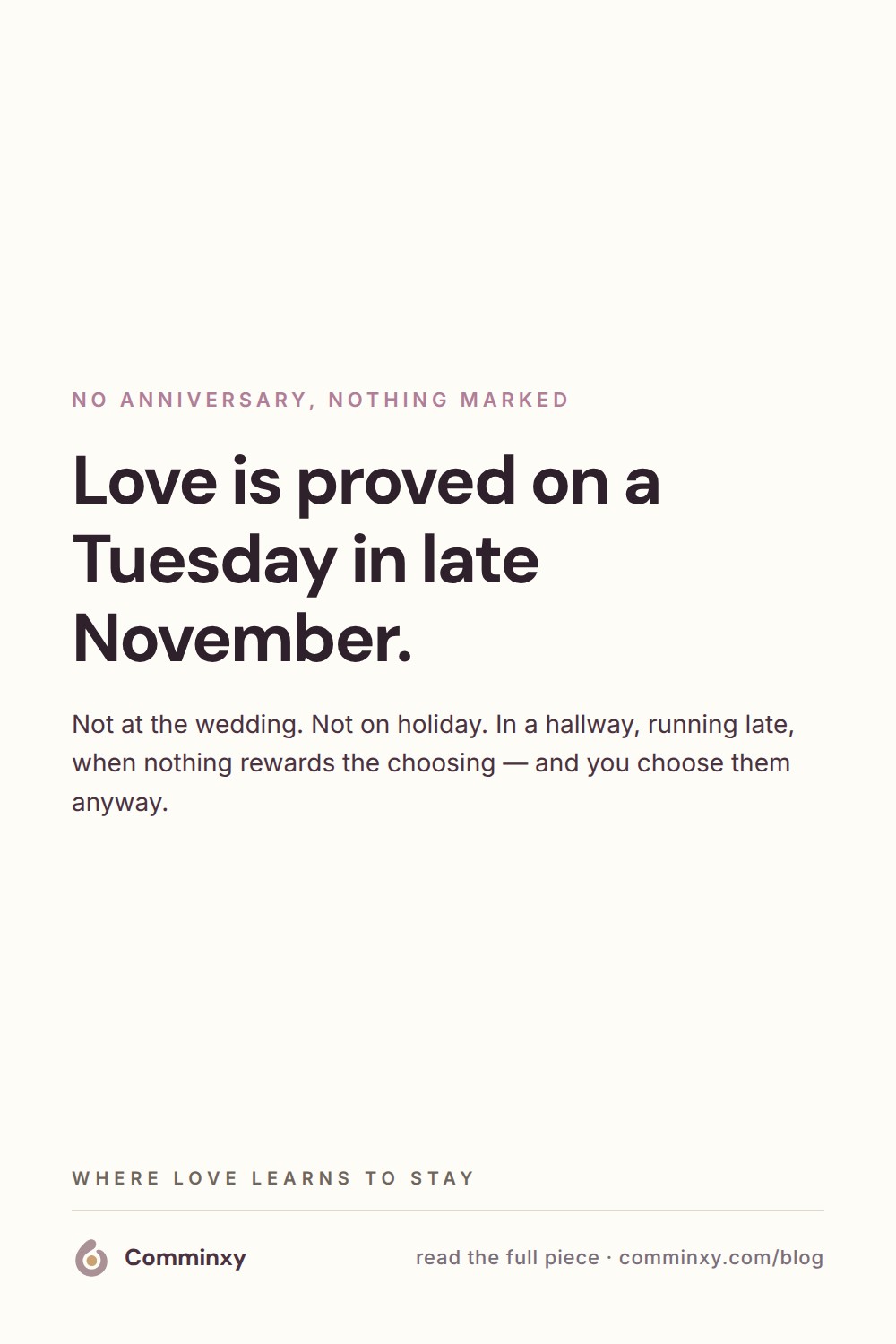
There's a Tuesday in late November — no anniversary, no fight, nothing marked on any calendar — when one of you is standing in the hallway pulling on a coat, running late, and the other one, half-asleep on the couch, says "drive safe" without looking up. And the door closes. And that's it. Nobody felt a rush of anything. Nobody's heart did the thing it used to do. Just two people who chose, in a hundred invisible ways that morning, to keep being we. If you've ever wondered whether that quiet, unremarkable steadiness counts as love — or whether love is supposed to feel like more — you're standing exactly where the question of commitment vs love in relationships lives.
Here's what I've noticed after sitting with couples for a long time: most people think love is the engine and commitment is the seatbelt. Love drives; commitment just keeps you from flying through the windshield when things get rough. But watch a relationship closely over years, and you start to suspect it might be the other way around.
The feeling that comes and goes, and the thing that stays
Love, the intense kind, is real. It doesn't only belong to the beginning, either. When O'Leary, Acevedo, Aron and colleagues surveyed people married more than ten years, 40% still described themselves as "very intensely in love" (O'Leary et al., 2012, Review of General Psychology). That number surprised me the first time I read it — it means the fireworks aren't guaranteed to fade, and long marriages aren't all quiet resignation.
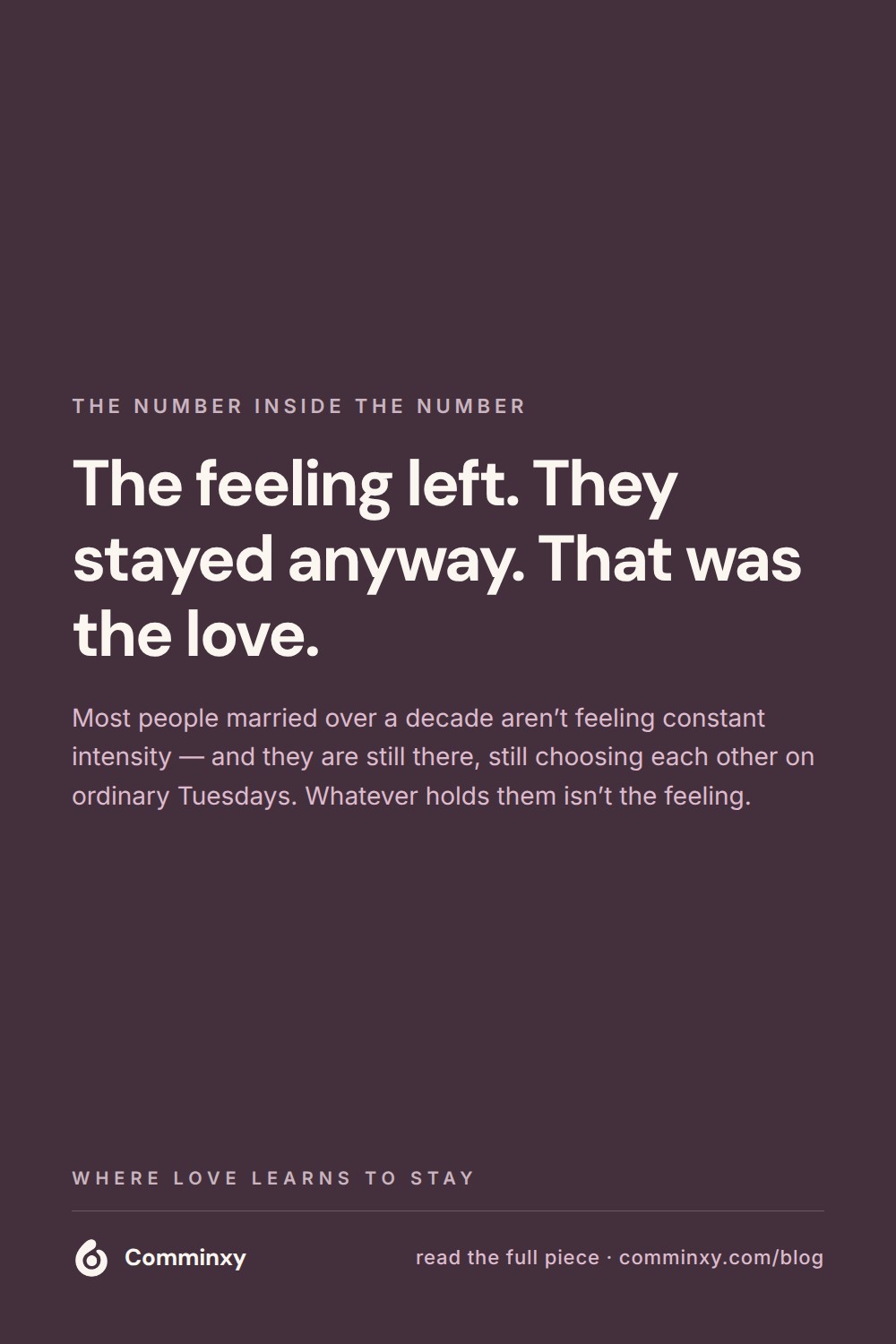
But notice what that figure also says without saying it. Sixty percent of people married that long weren't feeling that intensity — and they were still there. Still married. Still, presumably, choosing each other on ordinary Tuesdays. So whatever kept them wasn't the feeling. The feeling had gone somewhere, the way feelings do, and something else had held the door.
What actually keeps a person in the room
For a long time we assumed the couples who stayed were simply the ones who were happiest. Then Le and Agnew pulled together 52 studies and found that satisfaction alone doesn't predict commitment — it's satisfaction together with two quieter things: how few appealing alternatives you see, and how much you've built into this (Le & Agnew, 2003, Personal Relationships). The years, the shared friends, the inside jokes only the two of you understand, the version of yourself that only exists in this particular person's company. That accumulated us is called investment, and it turns out to hold more weight than the daily temperature of your happiness.
This reframes something a lot of us get wrong at 1am. When you lie there thinking I'm not sure I feel enough, you may be measuring the wrong thing entirely. You're checking the feeling gauge when the thing that keeps couples together was never really about the reading on that particular dial.
Why "just love" leaves people confused
When commitment is missing, its absence doesn't announce itself. There's no argument called "you're not committed." It shows up as a low hum of provisionality — a sense that you're both keeping one foot near the exit, waiting to see if this is going to keep being worth it. And when couples finally part, this is the thing they name most.
Scott, Rhoades, Stanley and colleagues asked divorced people what had contributed to the ending, and 75% pointed to a lack of commitment — more than named infidelity, more than named conflict (Scott et al., 2013, Journal of Family Psychology). Sit with that. The thing people mourn afterward isn't usually that the love ran out. It's that the deciding did. Somewhere along the way, one or both of them stopped choosing, and the choosing is what they missed.
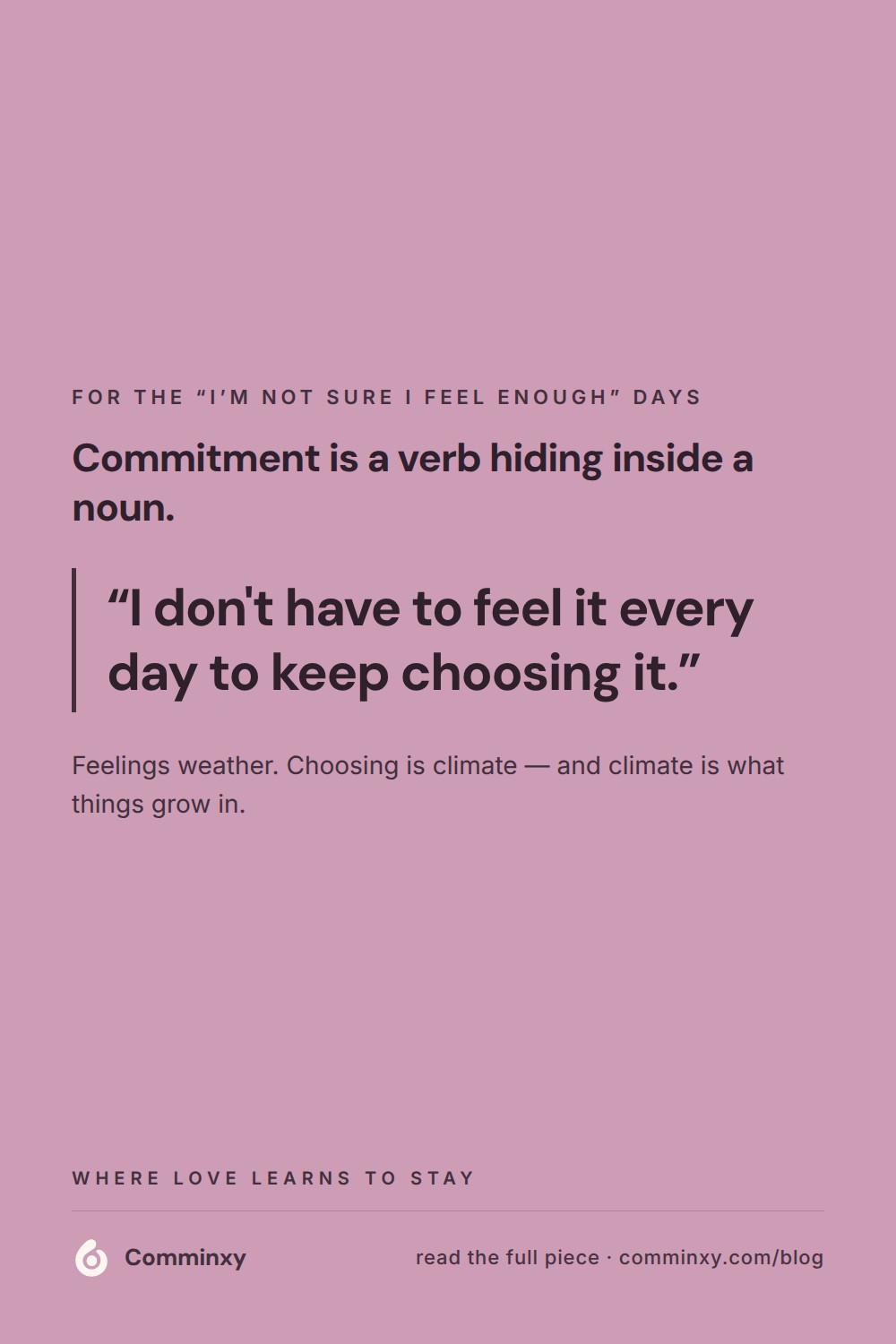
Commitment is a verb hiding inside a noun
The word makes it sound like a state — you're either committed or you're not, the way a light is on or off. But the couples who last don't seem to experience it that way. For them it's something closer to a series of small, repeated turns toward each other, most of them invisible even to themselves.
Stafford and Canary spent years studying what people actually do to keep a relationship alive, and found it comes down to a handful of everyday behaviours — staying positive, staying open, offering reassurance, sharing the ordinary tasks, keeping a shared social world. In their research, these behaviours explained up to 56% of how committed and satisfied couples felt (Stafford & Canary, 1991, Journal of Marriage and the Family). Which means commitment isn't a feeling you wait to arrive. It's mostly the "drive safe" from the couch. It's the reassurance offered before it was asked for. It's the choosing, done so often it stops looking like a choice.
That's oddly freeing. If commitment were a feeling, you'd be at its mercy. But if it's built from small turns, then on the days the feeling is thin, you still have something to do with your hands.
The way back when the choosing goes quiet
Sometimes what fades isn't love and isn't commitment — it's the sense that this is still going somewhere. Life narrows into logistics. You become excellent co-managers of a household and forgetful lovers of each other. Aron and his colleagues found something gently hopeful here: couples who do novel, slightly challenging things together — anything that stretches them a little — reinvigorate the relationship and rediscover some of the aliveness they thought had left for good (Aron et al., 2000, Journal of Personality and Social Psychology). Not a grand gesture. Just something new, done side by side, that reminds you the two of you are still capable of surprise.
And often the way back is even smaller than that — it's saying the thing out loud. "I still choose this." "I don't want us to become roommates." "Where are we going?" These conversations are hard to start, and easy to have badly, which is why learning to say the vulnerable thing without the accusation underneath it matters so much. Commitment renewed is rarely a fireworks moment. It's usually two people naming, plainly, that they'd like to keep going.
Which brings us back to the hallway
That "drive safe" from the couch — the one that didn't quicken anyone's pulse — was never the absence of love. It was love in its most durable form: a person choosing you on an unremarkable Tuesday, one more time, in a way so quiet that neither of you noticed it happen. The intensity may come and go across a lifetime. The choosing is the thing you actually build, one small turn at a time.
If you'd like a little help hearing those turns — and finding words for the ones that have gone unspoken — that's the kind of company Comminxy is built to keep. Not to manufacture the feeling, but to help the choosing stay visible to you both. Because this is where love learns to stay: not in the rush, but in the return.
Questions people ask
What is the difference between love and commitment?
Love is a feeling that rises and falls. Commitment is a decision that holds when the feeling is low. Most people assume love does the work and commitment is the backup, but over years it often runs the other way round.
Can you love someone and still not be committed to them?
Yes, and it is more common than people expect. Love without commitment tends to feel provisional, as though both of you are waiting to see whether this keeps being worth it. That waiting is usually felt long before it is ever named.
Is it normal to not feel in love with your partner all the time?
It is normal and it is not a warning sign on its own. In one study of people married more than a decade, sixty percent were not describing intense feeling, and they were still there. The feeling comes and goes. Something else keeps the door open.
What actually keeps couples together long term?
Research pooling fifty-two studies found that satisfaction on its own does not predict whether people stay. What predicts it is satisfaction combined with how much you have built together and how few appealing alternatives you see.
Keep the idea with you — pin it, or download the cards.


The ordinary Tuesdays are where the choosing actually happens.
Get Comminxy free →