How to Check In With Your Partner Without It Feeling Like an Interrogation
You texted "how are you doing with everything?" on a Tuesday afternoon, and the reply came back three hours later: "fine, busy." You sat with that for a while. Because you weren't really asking about the day. You were asking whether the two of you were still okay underneath all the logistics, and somehow the question landed like a form to fill out.
Most of us never get taught how to check in with a partner. We only learn how to ask things that need answering. So when we want to know how someone we love is actually holding up, the only tools we have are the ones built for extracting information. Where are you, did you call them back, what time is the thing. And those tools, pointed at a person's inner life, feel exactly like what they are: a search for a correct answer, with someone standing over the results.
The strange part is that the person asking usually means the opposite of an interrogation. You want to be close. You want in. And the wanting comes out as a demand, because wanting and demanding use so many of the same words.
Why a gentle question can still feel like a test
A question carries a shape, and the shape arrives before the meaning does. "Are you okay?" sounds caring in your head. In their body, especially at the end of a long day, it can register as a quiz with a right and wrong answer, where "no" opens a door neither of you has time to walk through right now.
There is also the matter of timing. A check-in lands on whatever ground the other person is already standing on. If they are braced, tired, mid-thought about something at work, even the softest question meets resistance that has nothing to do with you. You asked at the wrong second, and the wrong second did all the damage.
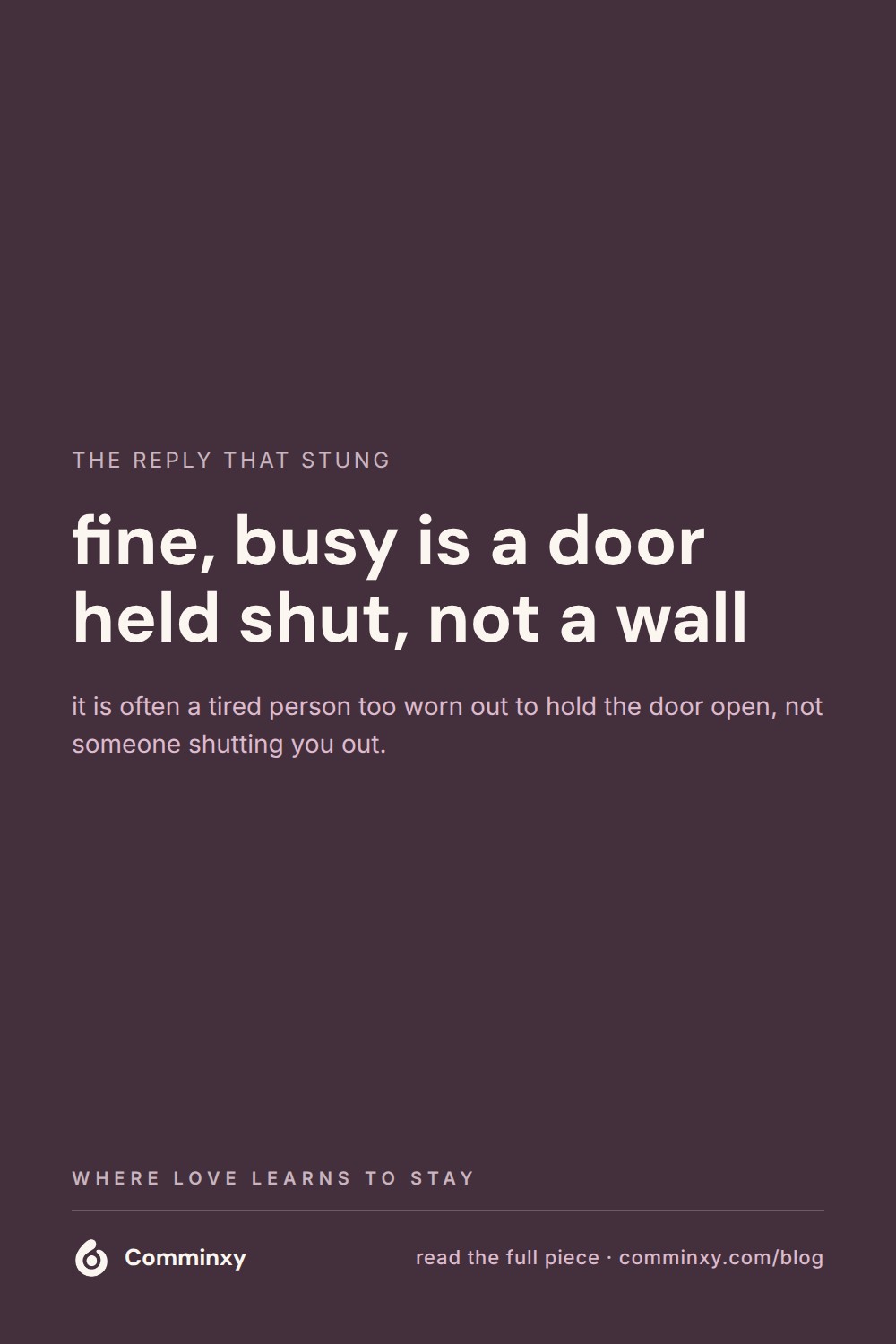
And sometimes the question carries a history. If the last few times you asked how they were turned into a longer conversation about what was wrong, they learn that the question is an opening move. So they close it fast. "Fine, busy" is not a wall. It is a door held shut by someone who is too tired to hold it open.
What a check-in is actually for
A check-in is not information gathering. You are not trying to find out facts. You are trying to let the other person feel, for a second, that someone is turned toward them.
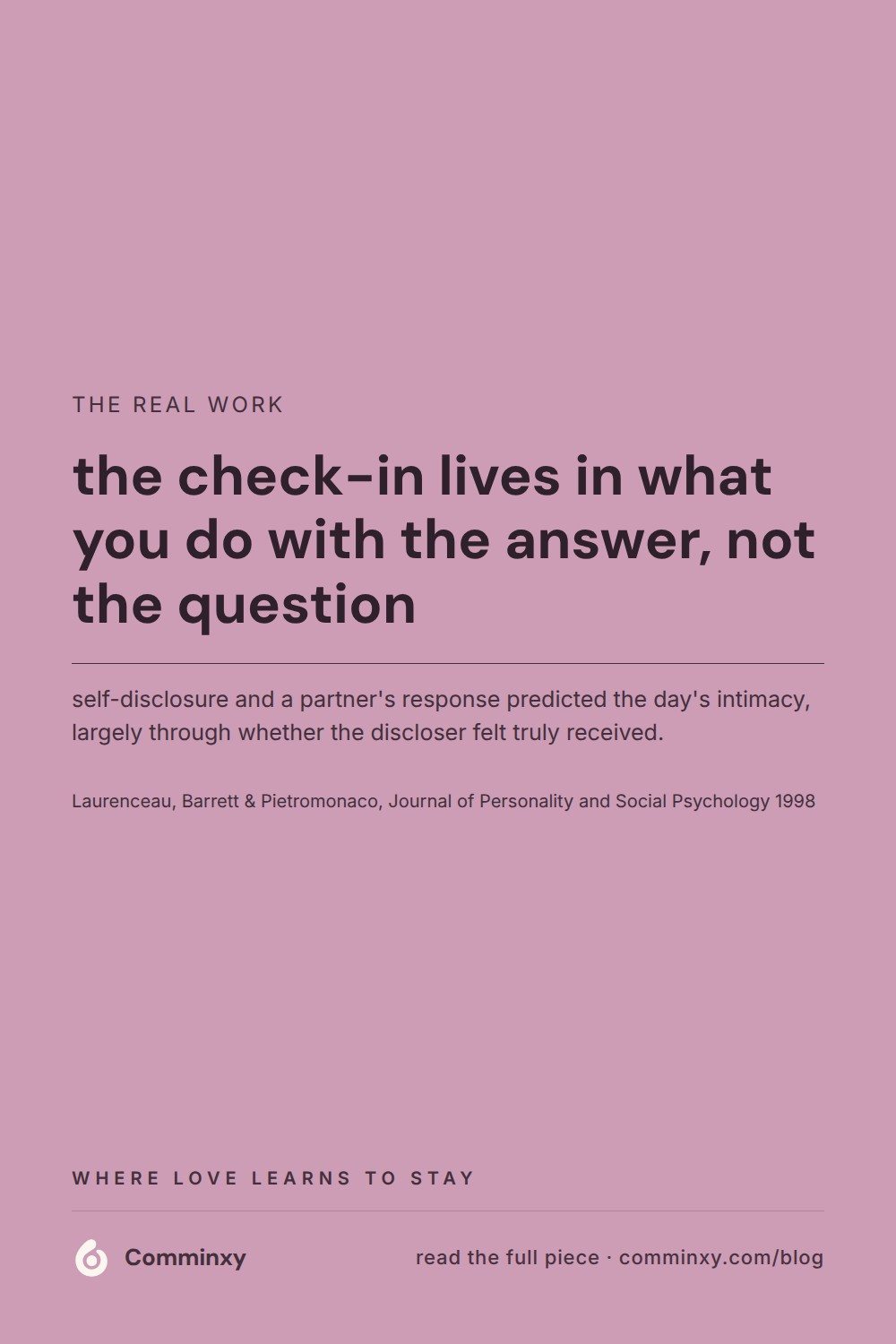
There is research that makes this surprisingly concrete. When Laurenceau and his colleagues studied what actually builds intimacy day to day, they found it was not disclosure alone that did the work. It was whether the person on the receiving end felt that their partner had actually heard and understood them, what they called perceived partner responsiveness (Laurenceau, Barrett, and Pietromonaco, Journal of Personality and Social Psychology, 1998). You can say the perfect caring sentence. If the other person does not feel met inside it, nothing lands.
Which reframes the whole thing. The quality of a check-in is not in the question you choose. It is in what you do with what comes back. A clumsy "you seem off today, what's going on" followed by genuine attention beats a flawless opener followed by advice they did not ask for.
The difference between asking and reaching
An interrogation wants an answer. A reach wants a person.
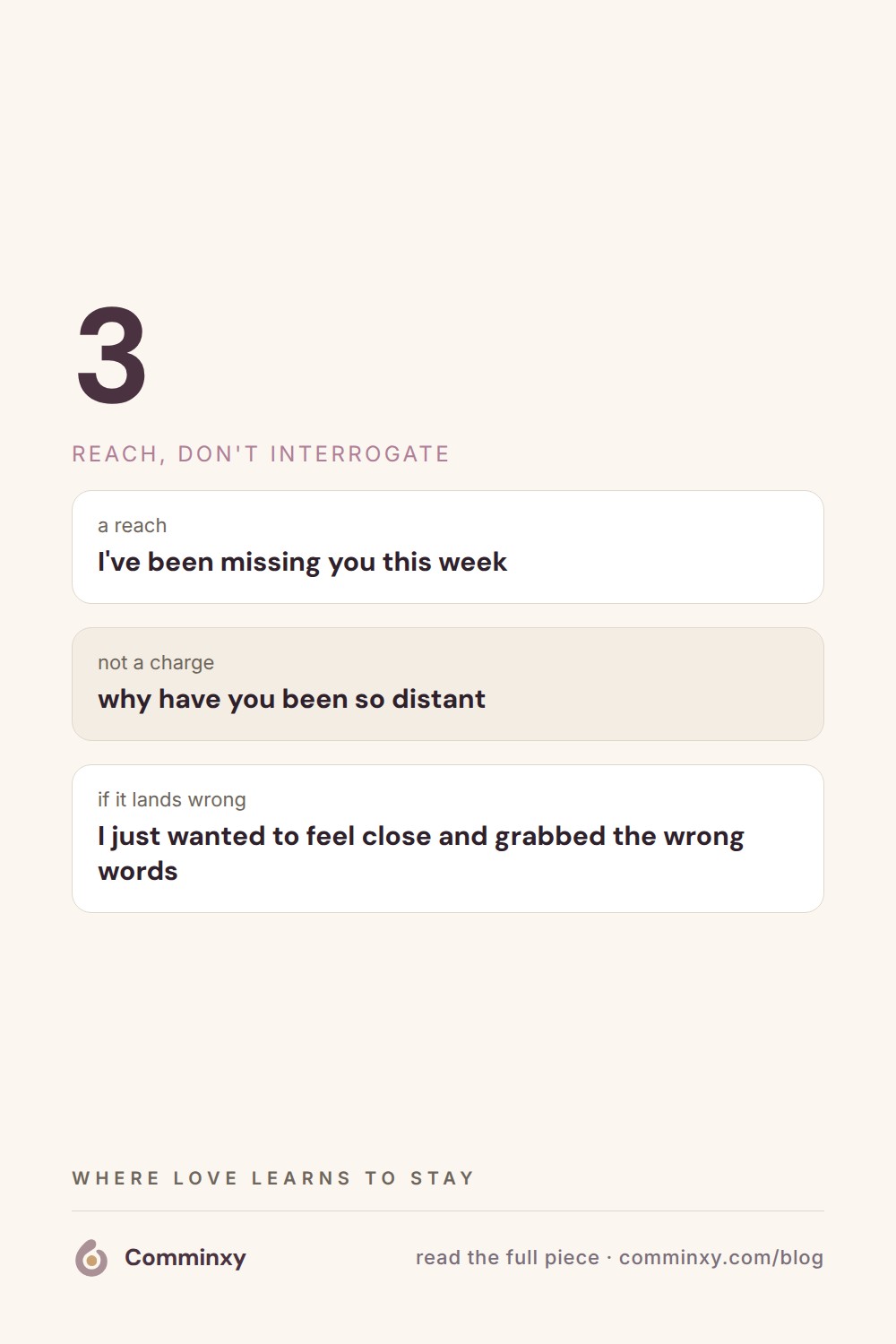
You can feel the difference from the inside. When you are reaching, you are offering something of yourself at the same time. "I've been missing you this week, even though we've been in the same house the whole time." That is not a question. It does not demand that they report on their emotional state. It just puts a hand out and leaves it there.
Compare that to "why have you been so distant lately," which sounds like a reach but is built like a charge. It names something about them, it assumes a verdict, and it asks them to defend themselves. The same worry, pointed two different ways. One opens a door. The other asks them to explain why the door was shut.
The gift in the first version is that it gives them somewhere to land without requiring anything. They can say "yeah, me too" and that is enough. They can say nothing and let you sit next to them. You have not set a question in front of them that must be solved before the evening can continue. This is often where couples quietly stop talking: not because they stopped caring, but because every opening started to feel like it came with a cost.
How to come back when it lands wrong
You will get the timing wrong. You will ask the loaded version of the question on a night they had nothing left, and watch them flinch, and feel the whole thing curdle. This happens to people who love each other carefully. It is not a failure of effort.
The repair is smaller than you think. You do not need to defend what you meant. You can just name what happened out loud. "That came out like I was accusing you. I wasn't. I think I just wanted to feel close and I grabbed the wrong words." Saying that undoes most of the harm, because it tells them the question was never a trap.
There is something quietly reassuring in the research about older couples who stay close. Carstensen, Gottman, and Levenson watched long-married pairs navigate conflict and found that the ones who stayed warm used small moments of humor and affection to soften a tense exchange before it hardened (Carstensen, Gottman, and Levenson, Psychology and Aging, 1995). A check-in that goes sideways can be rescued the same way. A hand on their arm. A slightly softer voice. "Let me try that again." The repair does not have to be eloquent. It has to be kind.
What changes when the pressure comes off
When a person stops feeling tested, they start answering the real question on their own time. Not that night, maybe. But the door you left open stays open. They come back to it when they are ready, which is usually when you least expect it, over a kettle or in the dark before sleep, because the reaching registered even if the answer did not arrive.
Checking in well is less about finding the right words and more about letting your partner feel there is no wrong answer. If you want to go deeper on the shape of those first few sentences, how to communicate better with your partner sits right alongside this.
Think back to that "fine, busy." It was never a rejection. It was a tired person answering the question they thought you were asking. The next time, you might ask the question you were actually asking, the one with no right answer and no clock on it. Comminxy exists for exactly these moments, helping you notice the difference between a reach and a demand before it leaves your hands. That is where love learns to stay: not in the perfect question, but in the steady sense that turning toward each other is safe.
Questions people ask
why does my partner get defensive when I ask if they're okay
Often the question lands as a test with a right and wrong answer, especially when they are tired or braced for a longer conversation. If past check-ins turned into discussions about what was wrong, they may close the question fast to protect their energy. It is usually about timing and history, not a lack of care for you.
how do I check in without sounding like I'm accusing them
Offer something of yourself instead of demanding a report on their state, like saying you have been missing them. This gives them somewhere to land without requiring them to explain or defend anything. It opens a door rather than asking why the door was shut.
what do I do after I ask a question at the wrong time and it goes bad
Name what happened out loud instead of defending what you meant, such as admitting it came out like an accusation when you just wanted to feel close. A softer voice or a hand on their arm can reset the moment. The repair matters more for being kind than for being eloquent.
my partner won't open up when I ask how they're feeling
When the pressure comes off, many people answer the real question in their own time rather than on the spot. Leaving the door open often matters more than getting an answer that night. If distance or silence feels persistent and heavy, it can help to talk with a couples therapist.
Keep the idea with you — pin it, or download the cards.


Notice whether you are reaching or demanding before the words leave.
Get Comminxy free →