How to Use AI to Understand Your Partner Better, Not Replace Them
The question sits open in a browser tab at 11pm. You have typed something like "why does my partner shut down when I bring up money," and the screen has given you a tidy, confident answer. Four reasons. A gentle suggestion. It reads well. And somewhere under the relief of finally having a response, there is a smaller, quieter unease. The thing that answered you has never met them.
If you have ever wondered how to use AI to understand your partner better, you are probably already doing it. Pasting in the text that stung. Asking for a read on a silence. There is nothing shameful in that. Reaching for help in the dark is not a failure of love. It is love looking for a handle to hold.
So the honest question this article tries to answer is narrow: can a machine actually help you understand the person you share a bed with, and where does that help stop being help?
What the machine can genuinely give you
A pattern you are too close to see. That is the real gift, and it is not small.
When you are inside a long argument about the same thing you always argue about, your view narrows to a pinhole. You can see their last sentence and your own hurt, and almost nothing else. An outside voice, even a synthetic one, can sometimes widen the frame. It can notice that every one of these fights starts the same way. It can name the shape of a thing you have been living inside for years without ever stepping back far enough to look at.
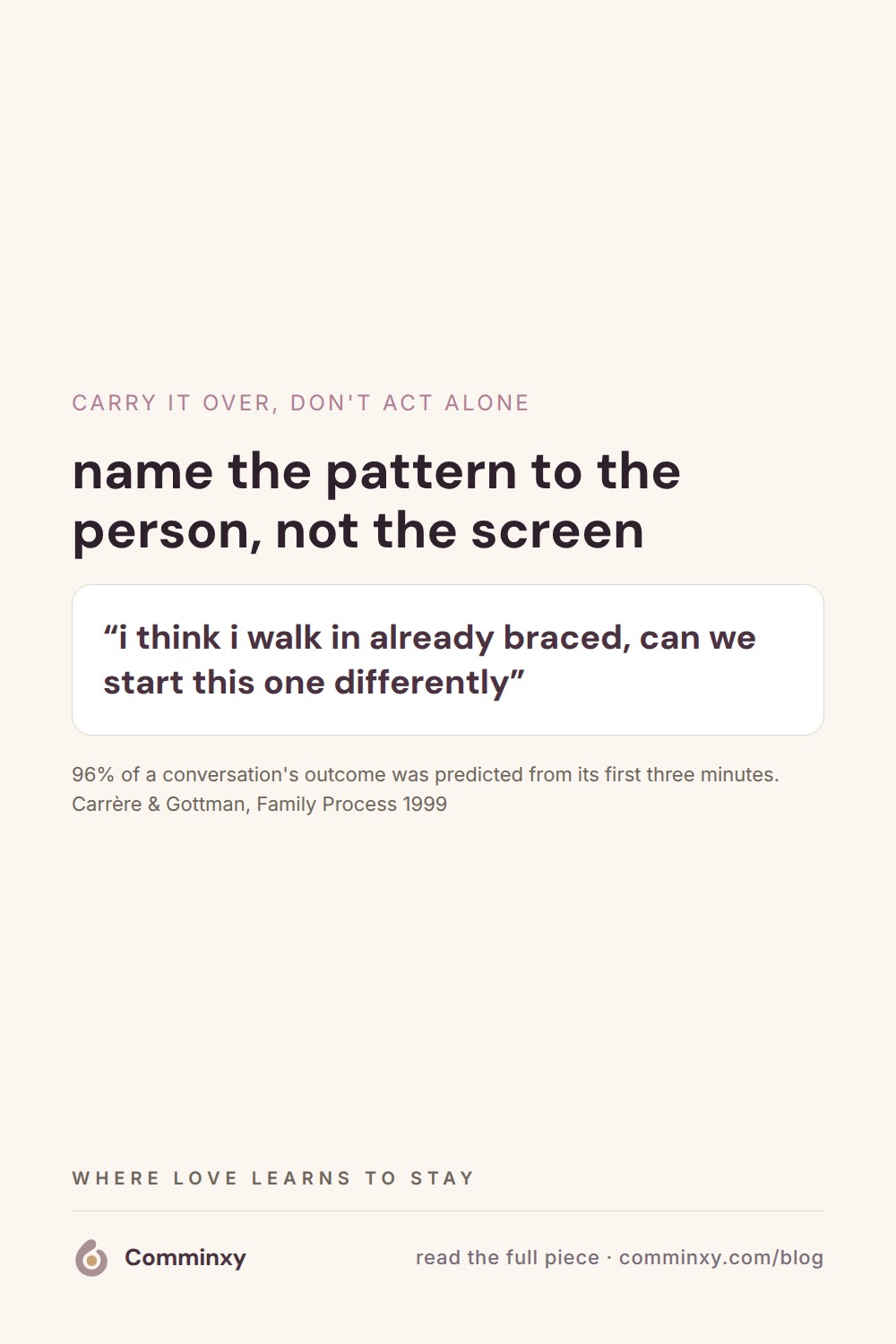
There is reason to care about that shape. How a couple opens a hard conversation in its first three minutes predicts the outcome of the whole fifteen-minute conversation with striking accuracy (Carrère and Gottman, Family Process, 1999). The beginning carries the ending inside it. If you tend to walk into these conversations already braced, already sharp, that is worth knowing, and it is genuinely hard to see from the inside.
This is where a thoughtful AI question can earn its place. Not "who is right," but "what keeps happening in the first minute." Used that way, it is a mirror held at an angle you could not reach alone.
Where it quietly leads you wrong
The trouble is that a mirror held by someone who only hears your side will always flatter the hand holding it.
You describe the fight. You are tired, so you describe it the way it felt, which is honest but not complete. The version you type is the version where you were reaching and they were cold. And the answer you get back builds on that version, confirms it, hands it back to you polished and sourced and sounding like truth. It can make you more certain of a story that was only ever half the room.
Partner responsiveness, the sense that the other person has actually grasped what you meant, turns out to be central to whether a moment lands as intimate at all (Laureanceau, Barrett, and Pietromonaco, Journal of Personality and Social Psychology, 1998). The feeling of being understood comes from being understood by them. A screen can tell you what your partner probably meant. Only your partner can tell you what they actually meant, and the difference between those two things is where most of the real work lives.
So the honest answer has a limit in it. AI can help you understand the situation. It cannot understand the person, because it has never watched their face change at the word that undoes them.
The part nobody can answer for you
There is a question underneath the one you typed, and it is the one the machine cannot touch.
When your partner goes quiet in the money conversation, you can get a hundred generic reasons. Shame. Childhood. Avoidance. Any of them might be true. But which one is true of this specific person, with this specific history, on this specific Tuesday, is not in any dataset. It is in them. And the only way to that answer is the slow, unglamorous one of asking and waiting.
Withdrawal, the going-quiet itself, is worth taking seriously. Conflict withdrawal predicts long-term decline in how couples feel about each other, while open disagreement sometimes does the opposite (Gottman and Krokoff, Journal of Consulting and Clinical Psychology, 1989). That is not a reason to panic when someone shuts down. It is a reason to stay curious about it instead of filing it under a label an app handed you. The retreat usually means they are overwhelmed, not indifferent. Knowing that, in the body, is something you build across a hundred quiet moments, not something you can download.
Using the help without disappearing behind it
The way back is simple and a little bit brave. Take what the machine gives you, and carry it toward the person, not around them.
If an answer names the pattern well, you do not then act on it alone in your head. You bring it over. Something as plain as, "I think I come into these conversations already angry, and I don't want to. Can we try starting one differently." That sentence is not elegant. It does not need to be. A clumsy real attempt usually reaches further than a perfect script, because the person on the other end can feel which one is actually addressed to them.
Let the AI be the place you think, and let your partner be the place you arrive. One is for sorting the noise in your own head. The other is the only one who can tell you whether you got it right. If it helps to think about how the two of you actually communicate, that thinking is useful right up until it replaces the conversation itself.
So close the tab tonight if you need to. The answer on the screen felt like relief because it felt like company, and you were right to want company. But the person who can actually meet you is asleep in the next room, or across a city, or waiting for a text you have not sent. Tools like Comminxy exist to walk you the last few steps from understanding on a screen to understanding between two people, because that short distance is where love learns to stay. The machine can help you see. Only they can let you in.
Questions people ask
can ai really help me understand my partner
It can help you spot patterns in a conflict that are hard to see from the inside. What it cannot do is tell you what your specific partner actually meant, since it has never met them. Treat its read as a starting point for a real conversation, not the final word.
is it bad to ask chatgpt about my relationship problems
No, reaching for help when you are stuck is normal and understandable. The risk is that the tool only hears your side, so it may just confirm the version of events you typed in. Use it to think, but check your conclusions with your partner before acting on them.
why does my partner shut down when we talk about money
Going quiet during conflict often means someone feels overwhelmed rather than uninterested. The actual reason depends on their specific history and what is happening for them that day. The only reliable way to find out is to ask gently and give them space to answer.
how do i bring up a pattern i noticed without starting a fight
Lead with yourself rather than an accusation, and keep it simple. Saying something like you noticed you walk in already tense and want to try differently tends to land better than a polished script. If these conversations keep escalating badly, a couples therapist can help.
Keep the idea with you — pin it, or download the cards.




Take what you see on the screen back to the person who can answer it.
Get Comminxy free →