When Jealousy in a Relationship Is Normal, and When It Quietly Becomes Something Else
Jealousy is a signal, not a verdict. It tells you that something you care about feels, for a moment, like it could be lost. That part is human, and it shows up in nearly everyone who has ever loved another person. Some jealousy in a relationship is normal, and on its own it is neither proof of love nor evidence of a problem. What matters is far less dramatic than the feeling itself: what you do in the minutes after it arrives.
Consider what the feeling is actually guarding. You are at a work dinner, and across the table your partner is laughing at something a colleague said, that particular laugh, the one you thought was yours. Nothing has happened. Nothing is going to. And still something in your chest folds inward and goes quiet. The glass in your hand feels heavier. You are not imagining the pull. You are noticing, accurately, that this person matters enough to lose.
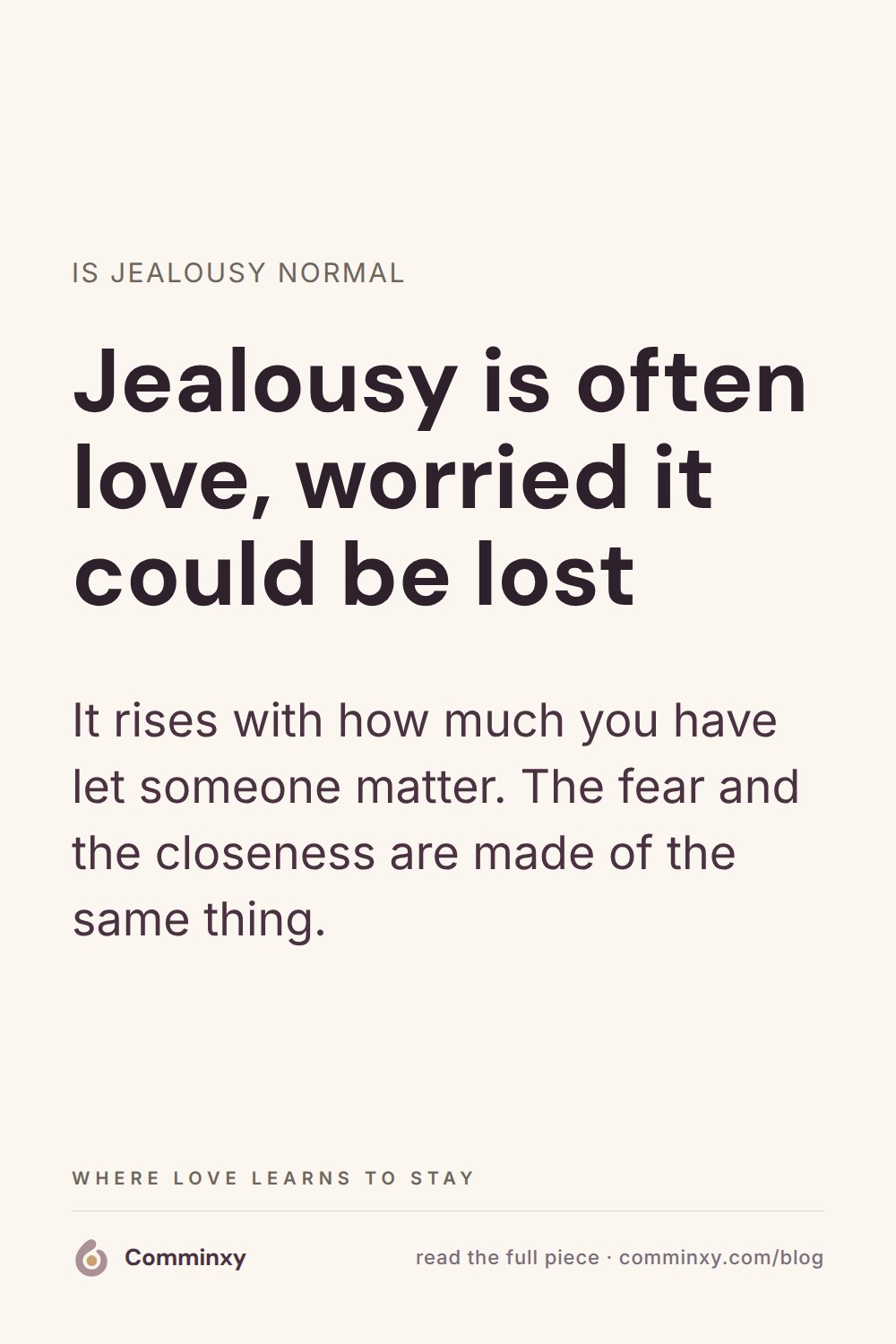
Jealousy in a relationship is most often an indication of attachment, not distrust
Most people reach for the word distrust first. It is the easiest story to tell, and the cruelest to yourself, because it makes jealousy into a character flaw you were supposed to have outgrown. The more honest reading is usually simpler. Jealousy tends to rise in exact proportion to how much you have folded another person into your sense of who you are.
Psychologists have a plain phrase for this: inclusion of the other in the self. When researchers pooled a large body of longitudinal studies, the strongest predictors of whether relationships lasted were not conflict or jealousy at all. They were commitment, love, dependence, and how much each person had woven the other into their own sense of self (Le, Dove, Agnew, Korn, and Mutso, Personal Relationships, 2010).
Read that the other way round and something softens. The jealousy you felt at that dinner table is made of the same material as the closeness you value. You cannot have the one without risking the other. A heart that cannot be threatened is usually a heart that has not let anyone all the way in.
Healthy jealousy in relationships, and the line it sometimes crosses
There is a version of this feeling that passes through you and leaves nothing behind. A flicker at the dinner, a slight tightness, and then the colleague goes home and your partner finds your hand under the table and the whole thing dissolves. You might not even mention it. It did its small job and left.
Then there is the version that does not leave. It stays in the room after everyone else has gone. It starts asking to see a phone. It rereads a message that was never meant to carry that much weight. It narrows the world until your partner has fewer places to stand and fewer people to be themselves around.
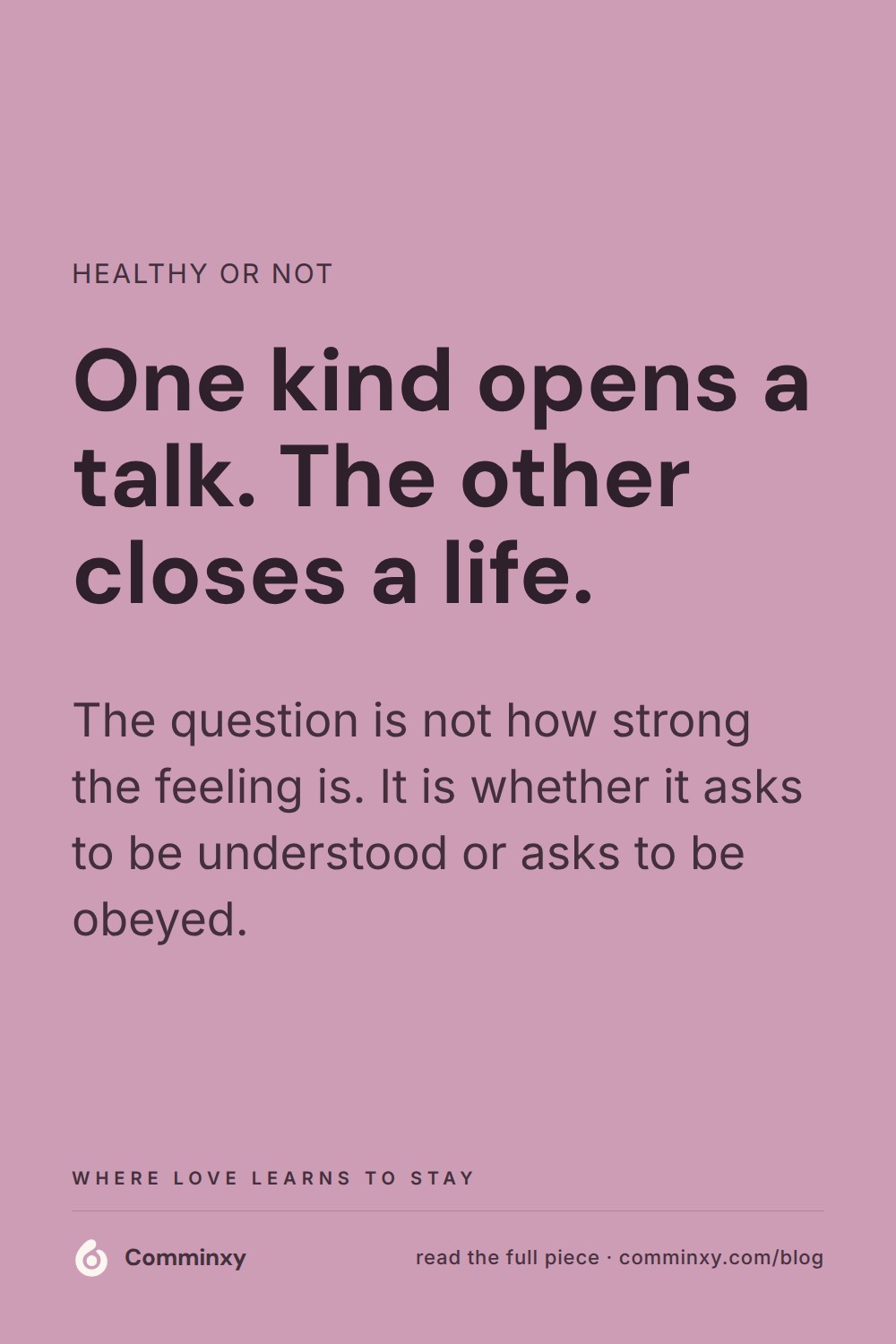
The difference is not the intensity of the feeling. A quiet, constant jealousy can do more lasting damage than one loud, honest flare. The question worth sitting with is whether the feeling is opening a conversation or closing a life. One of those is jealousy asking to be understood. The other is jealousy asking to be obeyed.
And sometimes you are the one asking to be obeyed. You checked the phone. You asked the question you already knew the answer to, in the tone that made the answer not matter. That is worth naming plainly, without flinching and without turning yourself into a monster for it. A frightened person reaching for control is still a frightened person. The reaching can stop.
What jealousy is really trying to tell you
Underneath almost every jealous moment is a sentence that has not yet found words. I am not sure I still matter to you the way I did. I saw something and I do not know where I stand. You lit up for someone, and I cannot remember the last time you lit up for me.
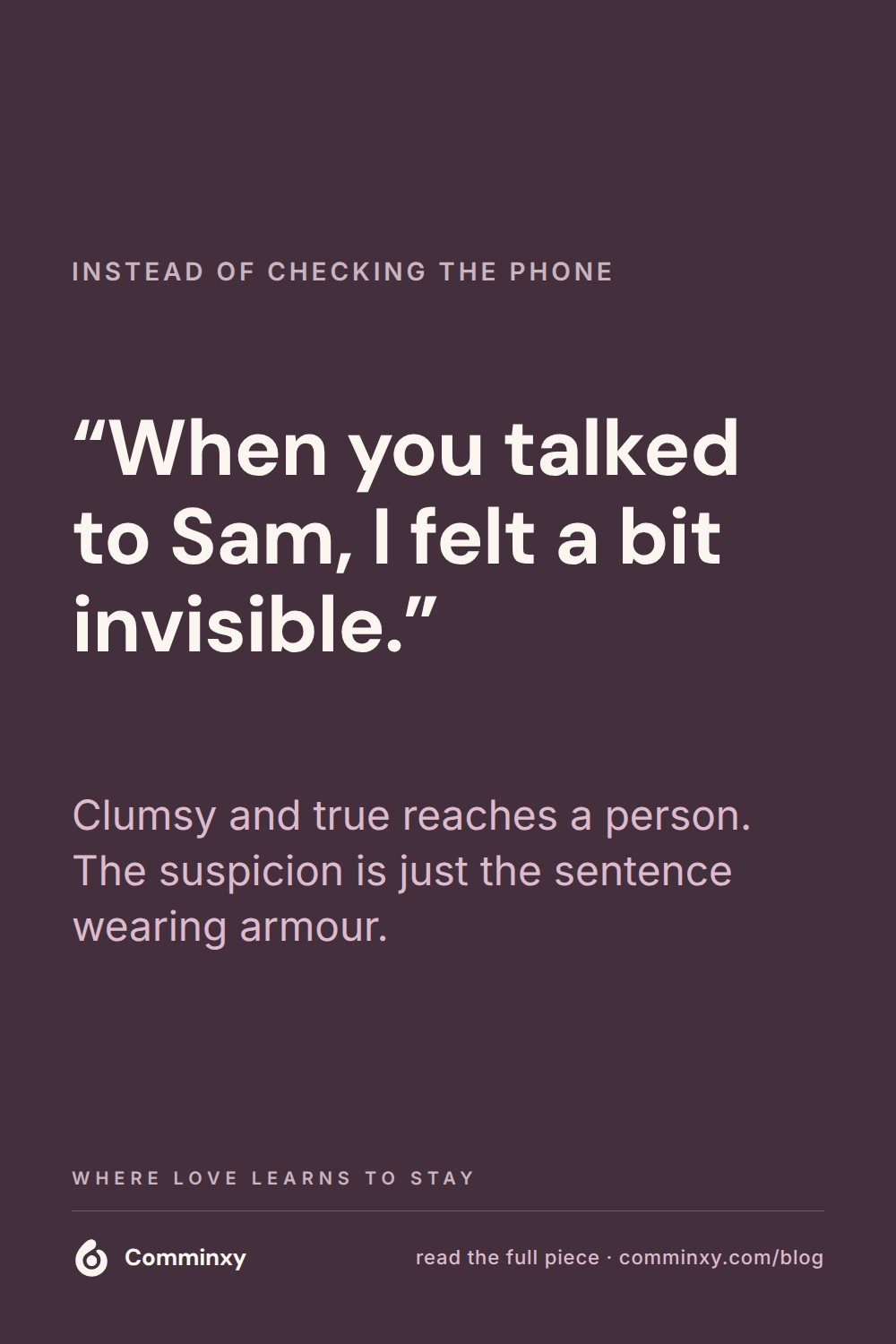
These sentences are hard to say because saying them feels like confession. It feels like handing someone proof that you are insecure, that you need too much, that you are the difficult one. So instead of the sentence, out comes the suspicion, which is the sentence wearing armour. The armour protects you and reaches no one.
The repair almost always lives in taking the armour off. Not accusing, not interrogating, not pretending you felt nothing. Something closer to: At dinner tonight, when you were talking to Sam, I felt a bit invisible, and I did not like how far away you felt. It is clumsy. It will come out wrong half the time. Clumsy and true reaches a person in a way that polished and guarded never does, and you do not have to get the words right for them to count.
This is slow, unglamorous work, and most of it happens in small conversations rather than big ones. If putting the feeling into words is where you keep getting stuck, it may help to read how to communicate better with your partner, which sits with exactly that gap between what you feel and what comes out of your mouth.
When reassurance stops being enough
There is a limit to what a partner can do here, and it is worth being honest about it. No amount of reassurance fills a hole that is not shaped like the relationship. If every account must be shown, every absence explained, every warmth toward another person accounted for, and the relief lasts an hour before the next wave arrives, something older than this relationship may be moving through it.
That is not a failing. It is often a nervous system that learned, somewhere a long time ago, that love disappears without warning and the only safety is vigilance. Vigilance kept someone safe once. It is simply very expensive to run inside a relationship that is not actually leaving.
Naming that out loud, even just to yourself, changes its weight. This fear is real, and it is also older than you. Both of those can be true at the same time.
Finding your way back to the table
Return, for a moment, to that dinner. Your partner laughing, you going quiet, the glass heavy in your hand. Imagine, instead of swallowing it or sharpening it into an accusation in the car home, you catch their eye across the table. Nothing is said. They see you. Later, at home, you manage something halting and true, and they hear it, and the distance closes a little. Not perfectly. Enough.
Jealousy was never the enemy there. It was the part of you that still turns toward this person, still wants to be chosen, still has something to lose. Handled with a little honesty, it can become one of the ways you find your way back to each other rather than away. Comminxy exists for exactly these moments, the ones where the feeling is real but the words are stuck, helping you say the frightened true thing before it hardens into something colder. Because love is not threatened by the fear of losing it. That fear is just love, asking to stay.
Questions people ask
Is jealousy in a relationship normal?
Yes, some jealousy is normal and shows up in nearly everyone who has loved someone. On its own it is neither proof of love nor evidence of a problem. What counts is how you respond to it rather than the feeling itself.
Jealousy in a relationship good or bad?
It can be either, depending on what it leads you to do. A flicker that passes and opens an honest conversation can bring two people closer. A constant jealousy that demands control and narrows your partner's world does quiet damage.
Jealousy in a relationship is most often an indication of what?
Most often it is a sign of attachment, not distrust. Jealousy tends to rise in proportion to how much you have woven another person into your sense of who you are. The closeness you value and the fear of losing it are made of the same material.
Signs your partner is jealous of you?
Common signs include wanting to know where you are, growing uneasy when you succeed or get attention, and discomfort with your other relationships. If the reassurance only lasts a short while before the next wave arrives, the fear may be older than the relationship. Honest conversation helps, and a counsellor can help when it feels too big to untangle alone.
Keep the idea with you — pin it, or download the cards.


Say the frightened true thing before it hardens into something colder.
Get Comminxy free →